
By Mehr News Agency, CC BY 4.0,
The legal minimum age for girls to marry in Iran is nine, as long as she has the court’s permission and her father’s approval. Otherwise, she has to wait until she is thirteen.
Furthermore, sex within marriage is considered consensual and legal under Iranian law. At least 27,000 girls under the age of 15 were married in a single year, according to Iran’s own statistical center. This is just one of the horrifying realities of life in Iran since the Islamic Revolution.
Numerous mainstream media outlets have written apologetic obituaries of Ayatollah Khamenei, referencing his long white beard and the fact that he was a grandfather.
The same media and their liberal allies have failed to underscore how repressive life was under the ayatollah.
The irony, of course, is that the liberals taking to the streets in “Hands Off Iran” protests would have been jailed and possibly killed in Iran.
Under the regime’s legal system, LGBTQ identity was essentially treated as a crime punishable by death, and women could be arrested or tortured for speaking out in public or for not wearing a hijab.
Finally, the anti-regime protests over the last few weeks, in which more than 30,000 people were killed, prove that claims of repression under the ayatollah’s regime are not Republican misinformation.
They are a fact, easily demonstrated by a brief review of some of Iran’s most repressive laws.
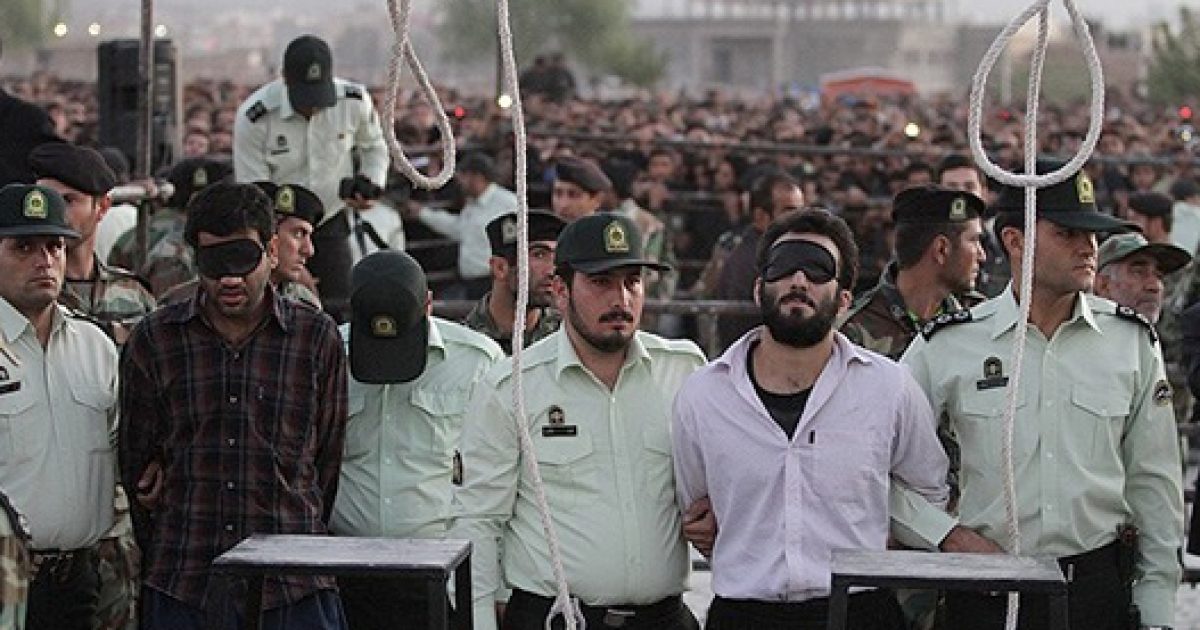
Iran’s legal system is structured around Sharia-based Hudud offenses, which the state defines as violations of the “rights of God.” Under the Iranian penal code, Hudud crimes carry severe punishments including death by hanging, stoning, or decapitation, as well as amputation or flogging.
Alcohol consumption, adultery, same-sex relations, and certain non-violent drug offenses all fall within this category, while insulting the prophet or apostasy can also bring the death penalty.
In addition to these codified crimes, the regime frequently relies on broad catch-all charges such as moharebeh, meaning “waging war against God,” and mofsed-e-filarz, or “spreading corruption on earth.”
These charges carry no fixed penalty and allow sentences ranging from months in prison to execution, effectively granting the judiciary unlimited discretion to punish conduct the state deems undesirable. Prosecutors have routinely used “waging war against God” charges against journalists and political dissidents.
The death penalty can also be imposed for attempts against the security of the state or for outrages against high-ranking officials.
In practice, the combination of Hudud laws and expansive charges like corruption on earth allows the regime to criminalize a vast range of behavior that would be considered normal or protected in democratic societies, including peacefully removing a headscarf, converting to another religion, or being gay.
The framework is codified in statute and regularly applied by the courts.
Prevailing fatwas prescribe the death penalty for apostasy, and Iranian law prohibits Muslim citizens from changing or renouncing their faith.
People born to parents classified as Muslim risk arbitrary detention, torture, or execution if they convert to another religion or adopt atheism. Authorities regularly raid house churches and detain Christian converts.
The penal code also criminalizes insulting Islamic schools of thought and any proselytizing activity that contradicts Islamic law, punishable by up to 10 years in prison.
These provisions are used to suppress religious expression and prevent the spread of beliefs that challenge the state’s interpretation of Islam.
Iranian law broadly discriminates against religious and ethnic minorities. The government denies freedom of religion to Baha’is, who face arrest on national security charges, closure of their businesses, and a systematic ban from registering at public universities.
The government also discriminates against Sunni Muslims and restricts the political and cultural activities of Azeri, Kurdish, Arab, and Baluch minorities.
Activists from these communities are frequently prosecuted under vaguely defined national security statutes in trials that fall far short of international standards.
Iran’s Islamic Penal Code (Articles 233–241) criminalizes consensual same-sex relations. Penetrative intercourse between two men is generally punishable by death for the passive party.
For women, the punishment for same-sex conduct is up to 100 lashes, with repeat offenders subject to the death penalty. Same-sex marriage is banned, and Iran provides no legal recognition of same-sex couples or their families.
The law provides for prosecution of anyone accused of “insulting” Islam or threatening national security.
The government severely restricted freedom of speech and the press and used these laws to intimidate or prosecute those who criticized the government, raised human rights concerns, or questioned morality code enforcement.
Authorities routinely cut off internet access, slowed speeds, and blocked websites and social media platforms.
The 1986 Press Law prohibits content that undermines Islam, including material deemed to violate “public chastity,” effectively banning any media discussion or promotion of LGBTQ topics, with the death penalty as a possible punishment for violations.
Women have fewer rights than men in Iran. A woman’s testimony in court carries half the weight of a man’s, and monetary compensation awarded to a female victim’s family upon her death is half that owed to the family of a male victim.
The regime also enforces strict controls over women’s behavior and appearance. Iran’s morality police, known as Gasht-e Ershad, or the “Guidance Patrol,” is a specialized unit within the Law Enforcement Command tasked with enforcing Islamic codes, particularly the mandatory hijab for women.
Established in 2005, these patrols monitor public spaces to enforce dress codes and behavioral norms, with penalties that can include fines, detention, flogging, or lashes.
In September 2023, parliament approved increased penalties for noncompliance with the mandatory dress code, raising sentences from two months to up to 10 years in prison and increasing fines to approximately $8,600.
In April 2024, the government announced a domestic surveillance program using street cameras to monitor hijab compliance, and authorities closed 45 businesses for serving noncompliant customers.
Beginning on April 13, 2024, the Law Enforcement Command launched the “Noor Plan,” a state-run enforcement campaign and the most aggressive crackdown on hijab noncompliance since the morality police were scaled back following the 2022 “Woman, Life, Freedom” protests.
Under the Noor Plan, security forces escalated patterns of physical violence against women, including beating, kicking, and slapping those perceived as violating dress codes, while compliance was also monitored through drones.
In December 2024, the regime further expanded these controls when the “Law on Protecting the Family through the Promotion of the Culture of Chastity and Hijab” came into force.
The 74-article law imposes severe penalties, including flogging, heavy fines, harsh prison sentences, travel bans, and restrictions on education and employment for women who defy compulsory veiling.
It also penalizes private businesses that fail to enforce the dress code while granting impunity to officials and vigilantes who violently attack noncompliant women. That sort of sounds like the mask policies during COVID, probably that is why American liberals support the regime.
The post Marriage at Age Nine and Other Repressive Laws under the Ayatollah appeared first on The Gateway Pundit.