
Henry Ridgwell (VOA), Public domain, via Wikimedia Commons
When U.S. and Israeli airstrikes killed Iran’s Supreme Leader, Ali Khamenei, they were not just removing the head of the regime but also the leader of Iran’s “Axis of Resistance,” a network that includes Hezbollah in Lebanon, militias in Iraq, and the Houthis in Yemen, which has historically served as Tehran’s forward-defense network.
On day two of the campaign, Hezbollah and several Iraqi militias joined attacks against Israel and U.S. interests. The Houthis have so far limited their response to political support and public mobilization.
The Houthis are one of Iran’s principal proxies, whose primary role has been to harass ships in the Red Sea at Iran’s direction. For more than a decade, the IRGC Navy has maintained a forward presence of commercial vessels in the Red Sea and the Gulf of Aden, serving as auxiliary intelligence ships, collecting intelligence on international shipping and disseminating it to the Houthis.
By fusing all-source intelligence with Automatic Identification System data gathered from transiting vessels, these ships maintained an accurate maritime activity plot that could be passed to the Houthis to facilitate targeting. U.S. officials say Iran used the vessel MV Behshad specifically to provide that targeting information. The Behshad operated as an intelligence, command, and control center to help carry out strikes beyond the horizon, closing a technology gap in Houthi capabilities.
The U.S. conducted a cyberattack against the vessel in February 2024 to inhibit its ability to share intelligence with Houthi rebels. After the vessel’s departure from the region, Houthi attacks dropped sharply, from an average of 19 attacks per month during the first phase of the campaign to eight strikes in the period following its withdrawal.
During the campaign, the Houthis turned the Bab al-Mandab chokepoint into an anti-access/area-denial zone, conducting more than one hundred attacks against commercial ships and warships since November 2023. The campaign expanded in phases, beginning with Israel-linked vessels, then ships heading to Israeli ports, and later vessels linked to the United States and Britain.
The Red Sea and Bab al-Mandab Strait link European and Mediterranean markets with Asia via the Suez Canal, carrying roughly 10–15 percent of global seaborne trade under normal conditions. During the Houthi campaign, major container lines and tanker operators rerouted vessels around southern Africa, adding approximately 10–14 days to voyages and increasing fuel costs.
Transits through the Bab al-Mandab hit a record low in June 2025, down 65 percent from June 2023. Eilat port halted operations, and Suez Canal revenues dropped. The Houthis’ real strength lies not in the volume of their arsenal but in their ability to sustain a high perception of risk.
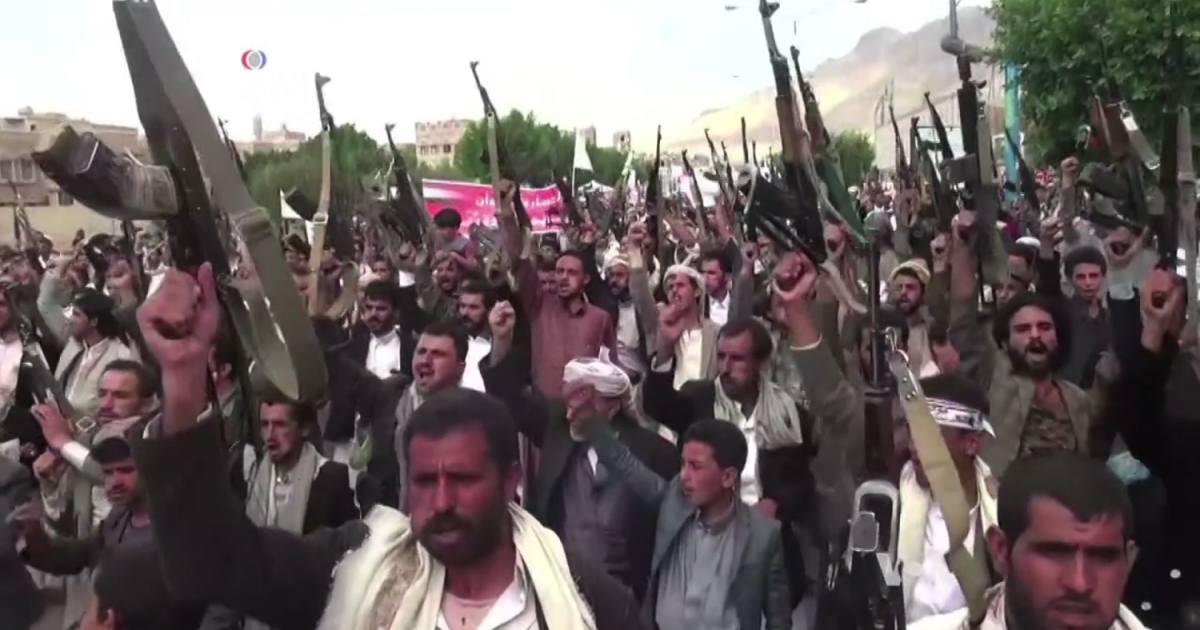
In previous confrontations between Israel, Iran, and the United States from 2023 to 2025, the Houthis participated in “solidarity strikes,” launching missiles and drones and enforcing a maritime blockade around the Bab al-Mandab Strait, targeting Israeli-linked shipping, U.S. warships, and commercial vessels. This time, Abdulmalik al-Houthi has appeared three times since the outbreak of the war. In his first speech, he declared solidarity with Iran and affirmed readiness for “all developments.”
His second speech, following the announcement of Khamenei’s assassination, was more emotional, offering condolences to the Iranian people and reaffirming support for Tehran, though he again refrained from committing to military action. A third speech reinforced the same message. In none of the three did the group issue a clear declaration of military intervention, as it had done in past conflicts. He also called for mass demonstrations in Yemen in solidarity with the Iranian people.
The Associated Press, citing two anonymous senior Houthi officials, reported on February 28 that the group was planning to resume attacks on Red Sea shipping, but Houthi officials quickly denied that claim on social media. Analysts say the contradictory statements reflect internal divisions, with hardliners pushing for direct involvement while other factions favor restraint.
Several factors shape the Houthis’ decision-making: ideological alignment with Iran, pressure to share the burden within the Axis of Resistance, domestic political pressures, and the desire to maintain their reputation as a regional actor. If they do not join, the Houthis risk appearing disloyal or weak within that alliance. At the same time, joining the war risks retaliation from the United States and Israel, and public opinion in Houthi-controlled areas increasingly prioritizes economic stability over external military action.
Israeli strikes in August 2025 had already eliminated much of the Houthi senior leadership, including their chief of staff. UN Special Envoy Hans Grundberg warned against dragging Yemen into a broader regional confrontation, and Yemen’s internationally recognized government cautioned the Houthis against military actions supporting Iran or using Yemeni territory to target neighboring countries.
Despite their current restraint, the Houthis retain long-range missile and drone capabilities and have redeployed assets along the Red Sea coast and near Saudi borders. If they enter the war, likely targets could include Israeli cities, Red Sea shipping, or U.S. bases in the region, along with a reimposed blockade at the Bab al-Mandab Strait.
If the Houthis stay out of the conflict, the main threat to global shipping will be IRGC drones. Most of Iran’s combat ships have been sunk at this point.
The destruction of the Shahid Bagheri drone carrier stripped the IRGC Navy of a platform designed to extend its operational reach beyond coastal waters and provide a survivable offshore node for unmanned systems even if shore infrastructure came under attack. CENTCOM Commander Admiral Brad Cooper stated that Iran’s ballistic missile attacks have decreased by 90 percent since day one of the campaign and drone attacks by 83 percent.
However, the drone threat has not been fully eliminated. Trump administration officials told lawmakers in a closed-door briefing that Iran’s Shahed attack drones represent a larger challenge than anticipated and that U.S. air defenses would not be able to intercept them all. U.S. Secretary of War Hegseth and the Chairman of the Joint Chiefs acknowledged that the drones fly low and slow, making them more able to evade air defenses than ballistic missiles.
A Carnegie Endowment for International Peace senior fellow noted that targeting drones is resource-intensive and expensive, will drain certain types of interceptors quickly, and that ground-based air defense interceptor missiles are not infinite, an area where the United States and its allies have faced stockpile challenges for years.
The Houthis must choose between escalating alongside Iran or shifting toward a political settlement in Yemen. The coming days are expected to reveal whether the movement prioritizes its ideological alignment with Tehran or adopts a strategy focused on survival.
The post Iran’s Houthi Proxies May Be Sitting Out the U.S.-Iran Conflict appeared first on The Gateway Pundit.