
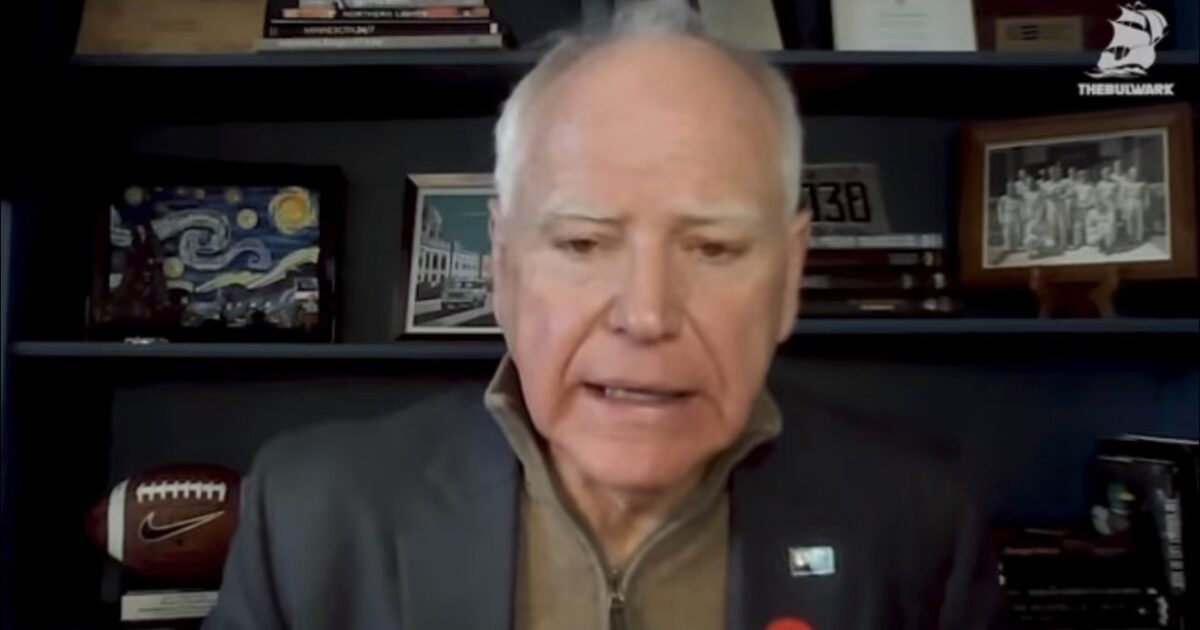
Most of the fraud uncovered in Minnesota has taken place since Tim Walz became governor. Democrats wanted him to be our vice president.
Billions of dollars of fraud occurred under Tim Walz’s watch, and now it turns out that autism centers did not even require licensing and that state officials were not allowed to conduct unannounced inspections.
The question now is whether Tim and other Minnesota officials were simply ignorant of what was happening, or whether they actively supported, enabled, or even participated in this fraud of epic proportions.
Money tied to Minnesota’s Early Intensive Developmental and Behavioral Intervention program surged from about $1.7 million in Medicaid reimbursements in 2017 to nearly $229 million in 2024 through late November, with cumulative spending approaching $700 million. That amounts to roughly a 300-fold increase in less than a decade, or about a 30,000 percent rise. While officials cite expanded autism diagnoses and broader access to services, the scale and speed of the increase have raised serious concerns.
Critics argue that a significant portion of this explosion in spending reflects fraud and lax oversight, noting that the growth occurred under Democratic governors. They contend that unchecked fraud drives long-term spending obligations higher, ultimately pressuring the state to raise taxes.
The figures come from Minnesota Department of Human Services data reported by the Minnesota Star Tribune following FBI raids on multiple autism centers as part of investigations into alleged large-scale fraud schemes.
The investigation overlapped with the Feeding Our Future case, in which 70 people were charged with defrauding a federal child nutrition program, and at least a dozen defendants were connected to autism centers.
Prosecutors allege that some parents received kickbacks, which became central to the scandal. Companies such as Smart Therapy LLC in Minneapolis and Star Autism Center in St. Cloud were accused of paying parents between $300 and $1,500 per month in cash to enroll their children.
In exchange, centers billed Medicaid for more than 40 hours per week of one-on-one therapy that was either not provided or performed by untrained 18-year-old relatives with no background in autism care. Authorities also allege widespread billing for “ghost” services, including therapy sessions that never occurred or for implausible numbers of hours.
In the Smart Therapy case, owner Asha Farhan Hassan pleaded guilty in December 2025 to a $14 million autism fraud scheme, admitting to using unqualified high school graduates as behavioral technicians and billing for maximum allowable hours even when no care was provided.
A state-commissioned Optum report later flagged 90% of the claims reviewed as problematic, including those from companies lacking basic operational details such as phone numbers or websites.
The latest development centers on licensing. Before the scandal, Minnesota did not require autism centers to hold a specific state license; providers only had to enroll as Medicaid providers. Under Minnesota Statute 256B.0949, individuals could serve as Level III providers with minimal qualifications: being 18 years old, holding a high school diploma or GED or fluency in a non-English language, completing brief online training modules, and being hired by an enrolled agency.
Lawmakers raised concerns that oversight relied on Qualified Supervising Professionals, but investigations revealed that supervision sometimes existed only on paper. Level III workers were allegedly left alone with children or were relatives billing Medicaid for time spent providing little or no therapeutic services.
After the Feeding Our Future scandal, Gov. Tim Walz and the Department of Human Services identified 14 Medicaid service categories as high risk due to explosive spending growth. Of those 14 programs, six still do not require licensing, a gap lawmakers say made fraud easier to commit. And yet, prior to DHS designating EIDBI as high risk, the state was not legally permitted to conduct unannounced site visits at roughly 500 autism centers statewide.
Now that licensing is required, committee members have expressed frustration over the slow pace of compliance. Of more than 500 previously unlicensed centers, only six have applied ahead of the May 31 deadline.
So far, it does not appear that Tim Walz has been implicated. However, one has to ask how such rampant fraud could be occurring under his nose and expanding at exponential rates under his watch without him knowing. Furthermore, while the state claims to have launched investigations, the lid was blown off this mountain of fraud by content creator Nick Shirley when he uncovered billions in daycare fraud, which brought national attention to the rest of it.
The post Minnesota Fraud Investigation: Only Six of 500 Autism Centers Applied for License appeared first on The Gateway Pundit.