
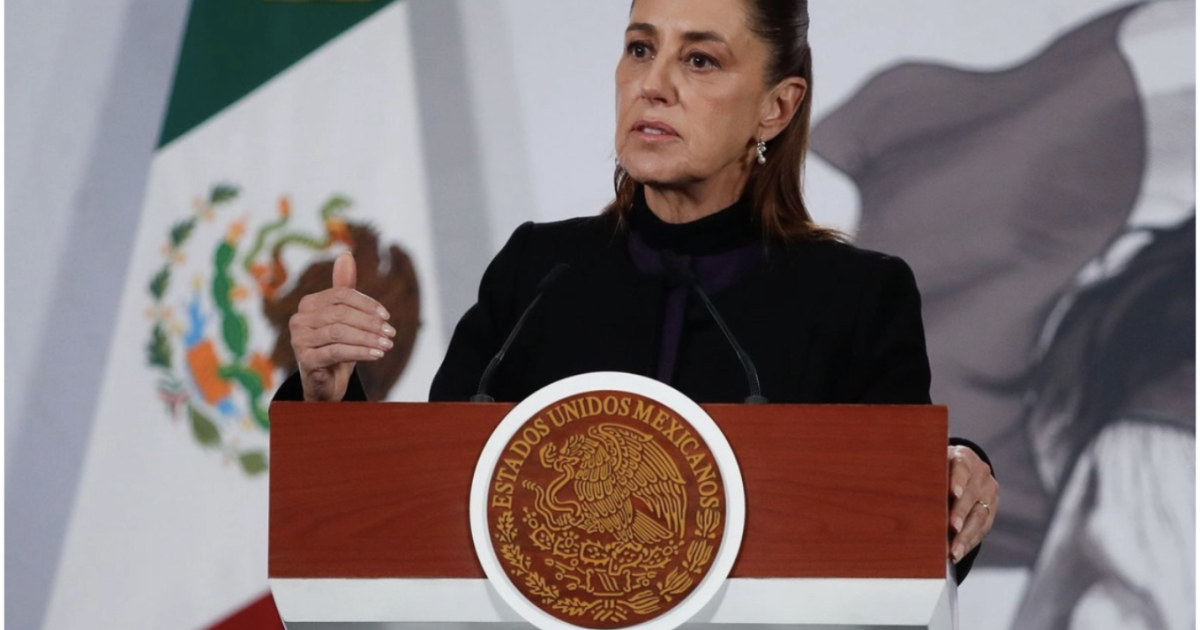
Mexican President Claudia Sheinbaum has been unwilling or unable to wrest control of Mexico from the cartels. Now she wants to sue Elon Musk. Photo: yoporlajusticia.gob.mx
Mexican President Claudia Sheinbaum said her government is considering legal action against Elon Musk after he accused her of having ties to drug cartels.
Musk made the allegation on X in response to a resurfaced 2025 video in which Sheinbaum rejected a return to a militarized crackdown on cartels, saying, “Returning to the war against the narco is not an option.
First, because it is outside the framework of the law.” After another user asked whether she was “a cartel plant,” Musk replied that she was “just saying what her cartel bosses tell her to say,” adding that their punishment for disobedience was worse than “a performance improvement plan.”
Mainstream media is focusing on whether or not she can sue him and how difficult it would be because of U.S. free speech laws.
Mexican officials have responded by telling Musk to concentrate on stopping drug use in the U.S., which enriches the cartels. They have also blamed the United States, arguing that many of the guns used by the cartels come from the U.S.
Neither the mainstream media nor the Mexican government seems very concerned about the fact that the government is not independent of cartel control and that the country has descended into violence, with a full-scale cartel war underway alongside a parallel war between the government and the cartels.
The recent killing of Nemesio Oseguera, known as “El Mencho,” the longtime leader of the Jalisco New Generation Cartel, by Mexican security forces in February 2026, along with the subsequent Operation Swarm, which resulted in the arrest of 14 mayors this month, represents the state’s latest attempt to break the cycle of cartel violence.
Operation Swarm underscores how deep the corruption runs. Among those arrested by Mexican authorities was Diego Rivera Navarro, the mayor of Tequila, Jalisco, in connection with an alleged multi-million-dollar extortion scheme involving major tequila producers and the Jalisco New Generation Cartel. Federal officials allege that Navarro’s administration imposed property taxes more than 20 times the legal rate and levied fines exceeding 60 million pesos, or roughly $3.5 million U.S., in exchange for withholding permits.
The investigation began after complaints from at least 10 companies, including Becle, parent company of Jose Cuervo, 1800, and Maestro Dobel. Navarro was detained along with three senior municipal officials, and authorities confirmed that three mayors were arrested during the operation.
The operation sparked roadblocks and arson attacks in parts of the country. Asked whether the action signaled a return to a more aggressive security strategy, Sheinbaum rejected that interpretation, saying, “The detention of a suspected criminal with an arrest warrant can generate this type of circumstance, but we are looking for peace, not war.”
A military campaign launched in 2006 under former President Felipe Calderón led to violent turf battles and escalating homicide rates as cartels splintered. More than 130,000 people are listed as missing in Mexico, where much of the violence is linked to cartels that traffic narcotics to the United States. In the 2024 election cycle alone, at least 37 candidates were assassinated, more than the rest of the world combined.
When including party officials, activists, and relatives of politicians, the number of political murders exceeded 80, with more than 330 recorded incidents of targeted violence against political figures during the campaign period and over 550 candidates officially requesting state protection due to credible death threats.
The reality in 2026 is that while the federal government can carry out surgical strikes against top cartel leaders, the cartels retain deep-rooted control at the local level through intimidation and “plata o plomo,” accept payment and comply, or resist and be killed. They are known to exert influence over high-ranking members of the army and police, as well as judges and elected officials, through corruption or threats of violence. The sheer volume of political assassinations is widely cited by international analysts as evidence that state authority is compromised.
That erosion of state power is now visible in the judicial reforms. By shifting to a system in which judges are elected by popular vote, U.S. State Department officials warn that the judiciary becomes even more vulnerable to the same “plata o plomo” pressures that already shape political races.
In a country where cartels can determine whether candidates live or die, the ability to influence judicial elections effectively gives criminal organizations the power to entrench their own impunity. Legal analysts argue this is not speculative but a structural shift that risks formalizing cartel influence over the highest courts in the country.
If Sheinbaum actually sues Musk for libel, he can use truth as his defense. In the United States, truth is a complete defense. If Elon Musk can prove that his statement is substantially true, the case is dismissed.
Under the substantial-truth doctrine, a defendant does not have to prove that every minor detail is 100 percent accurate. He only has to prove that the gist or the sting of the statement is true. Most likely the lawsuit will never happen, but if it did and Musk won, she still would not admit that she is owned by the cartels, certainly not without permission.
The post Mexico President Sheinbaum Retaliates Against Musk for Accusing Her of Cartel Ties appeared first on The Gateway Pundit.