
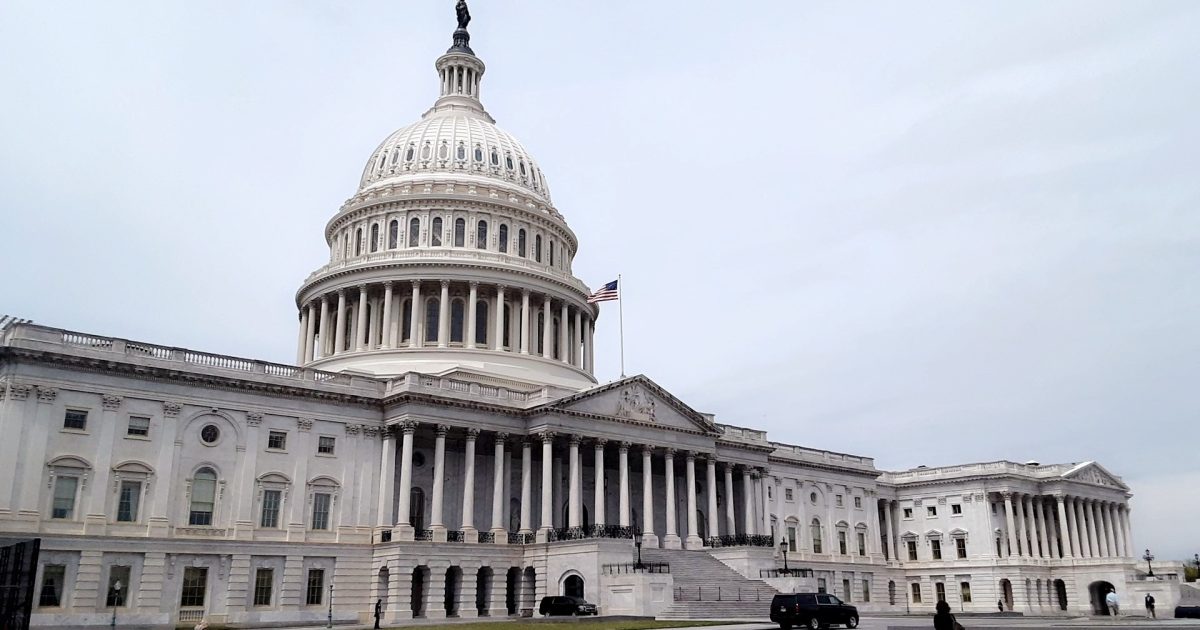
United States Capitol via Wikimedia Commons
An increasingly acute transatlantic confrontation appears to be taking shape as the American government turns its attention toward what has been described as widespread, systematic electoral interference originating in Brussels.
At the center of the storm is the Central/Eastern European country of Romania, whose presidential election—after the victory of Călin Georgescu was nullified—has become a flashpoint in an increasingly heated debate over national sovereignty, globalist censorship, and the future of democracy in Europe.
The US House of Representatives is reportedly preparing hearings that could place former Secretary of State Anthony Blinken, one of the chief architects of the Ukraine war, under scrutiny over allegations tied to European censorship practices and election manipulation. Congressional investigators are reportedly focusing on Romania as a test case for how EU institutions and globalist-aligned governments effectively neutralize political outcomes deemed ‘unacceptable’ by the entrenched, corrupt establishment in Brussels.
Far from signaling any hostility toward Europe as a civilization, the Trump administration’s posture is aimed at the unelected machinery of the European Commission, the EU’s executive body which faces little to no oversight or accountability. Trump allies insist the conflict is not with nations, but with a supranational bureaucracy that has increasingly substituted regulatory coercion for democratic consent.
Romania’s nullified presidential election, without a doubt, sits at the core of the controversy. The second round of voting in the presidential election, which followed Georgescu’s resounding first round victory, had already begun when Romania’s globalist authorities abruptly annulled the process, citing claims of ‘foreign interference’ that, to this day, have yet to be substantiated with publicly released evidence.
Brussels, along with its subservient government in Bucharest, officials quickly blamed Russian influence, but a preliminary report from the US House Judiciary Committee challenges that narrative. Drawing on open-source intelligence and platform disclosures, the report concludes there is no identifiable foreign actor capable of justifying the extraordinary decision to cancel the election.
It should be noted that Romania’s globalist authorities have still not declassified the national security meeting that allegedly triggered the cancellation. This seemingly deliberate opacity has fueled suspicion that the decision to cancel the Romanian people’s vote was politically motivated rather than security-driven.
The issue has placed former US Ambassador to Romania Kathleen Kavalec in the spotlight. Her recall and potential testimony under oath are seen by critics, of which there is no shortage, as a serious liability for figures associated with the Biden-era foreign policy apparatus.
Kavalec is reported to have been present during key moments of judicial pressure and institutional coordination in Bucharest—developments that are widely believed to have contributed to the cancellation of the election. Her account of the events that transpired could illuminate whether American diplomatic channels were used to bless or facilitate constitutional abuses and anti-democratic dictates.
Romania’s former president Klaus Iohannis, widely regarded as a loyal executor of Western globalist institutional directives, now finds his legacy, or what was left of it, under intense scrutiny. Allegations that senior US officials encouraged Romanian authorities to proceed with legally dubious actions are expected to feature prominently in upcoming hearings.
The unfolding scandal has deep political implications in America as it approaches high-stakes midterm elections. A revived inquiry into transatlantic election interference threatens to damage Democratic credibility at a moment when control of Congress hangs in the balance.
Across the EU, the reaction, unsurprisingly, has been defensive and increasingly alarmist. French President Emmanuel Macron, days ago, openly warned EU leaders to brace for confrontation with the United States, accusing President Trump of seeking to dismantle the Union’s centralized power structure.
The European Commission’s disciplinary culture has also drawn renewed criticism. Earlier this year, members of the European People’s Party were reportedly sanctioned for procedural dissent, reinforcing claims that dissent within Brussels is tolerated only until it becomes inconvenient for the powers that be.
Against this backdrop, Hungary has emerged as a critical EU member state resisting Brussels’ tyranny and anti-democratic interference in national politics. Prime Minister Viktor Orbán’s government, long at odds with Brussels’ globalist class and EU centralization, has supported efforts to expose what it refers to as a systematic assault on national sovereignty.
This week, MCC Brussels announced the creation of the Observatory for Interference in Democracy, an initiative designed to document how elections across the EU are increasingly shaped through regulatory pressure and coercion, NGO networks, and digital governance mechanisms. Romania’s canceled election will be one of its first major case studies.
BREAKING: MCC Brussels launches the Democracy Interference Observatory (DIO).
Our mission: To document and expose how the EU and EU-linked actors influence national elections across Europe. pic.twitter.com/mPCeKyNJ4N
— MCC Brussels (@MCC_Brussels) February 11, 2026
The observatory plans to examine how the EU’s Digital Services Act has been deployed to reshape online discourse during election cycles. Requests for related Commission documents have already been denied, with officials citing regulatory supremacy over transparency rules.
According to MCC researchers, this refusal mirrors a broader pattern: allegations of foreign interference are invoked, emergency measures are imposed, and dissenting voices are suppressed under the banner of “democratic protection.”
The Romanian model, critics argue, is now being replicated elsewhere. In Hungary, opposition figures have echoed the same rhetoric, calling for expanded use of EU digital laws to police political speech ahead of national elections.
Supporters of Orbán and Romanian conservative candidate Călin Georgescu see this as proof of a coordinated strategy. In their view, sovereignty-minded leaders are targeted through administrative vetoes enforced from above.
The post US-EU Tensions Escalate as America Probes Alleged Brussels Interference in Romanian Election appeared first on The Gateway Pundit.