
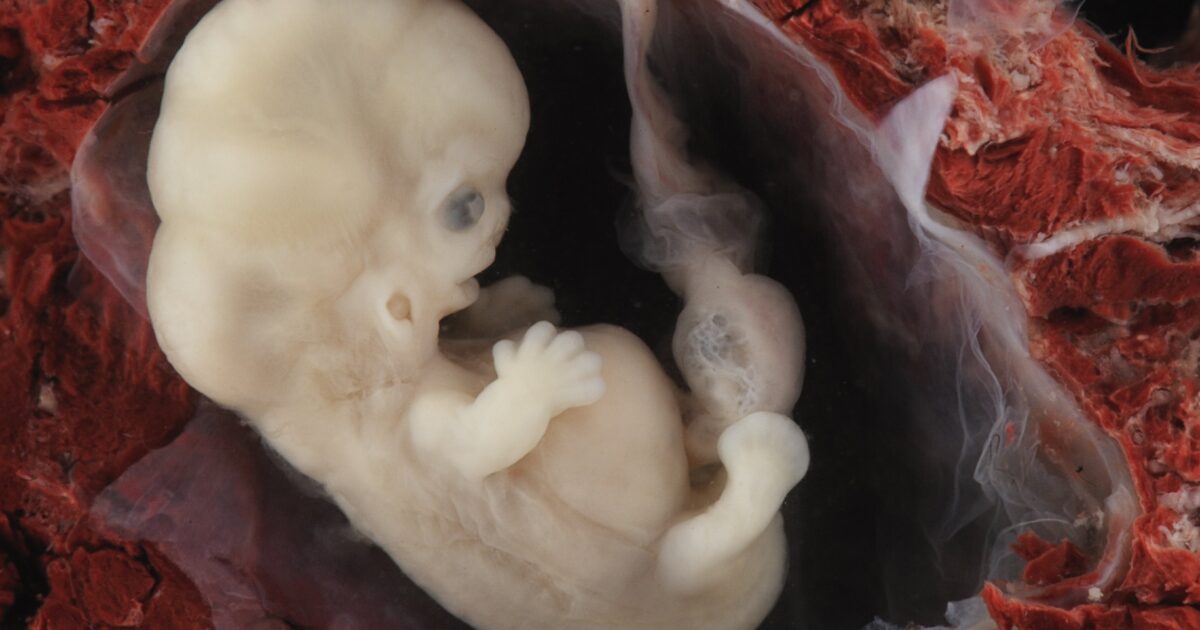
A human embryo at six to seven weeks already looks like a baby, yet elective abortion remains legal at this stage in 31 states. Photo courtesy of Lunar Caustic, CC BY 2.0 (https://creativecommons.org/licenses/by/2.0), via Wikimedia Commons.
“It’s just a clump of cells,” “it’s not a baby, it’s a fetus,” “my body, my choice,” “you’re just trying to control women,” and “abortion is healthcare” are among the most common pro-abortion arguments. When critics point out that life begins at conception, the standard response is often “separation of church and state,” as if the claim were a religious belief rather than a biological fact.
The abortion argument has been hashed and rehashed countless times. The purpose of this article is not to relitigate familiar slogans, but to address a mistaken assumption I held for years. I assumed the “it’s just a clump of cells” argument applied only to first-trimester abortions. That assumption is wrong. The laws of many states allow abortions right up to birth. In some cases, it is possible to allow a baby to die after it is born.
Roughly 93 percent of abortions in the United States occur before 13 weeks, the end of the first trimester, when the unborn baby is less than three inches long. That statistical reality shapes how the argument is commonly framed. But under the U.S. Constitution, rights are not assigned by size.
Taller people do not have more rights than shorter people, heavier people do not have more rights than smaller people, and adults do not have a greater right to life than children. Size has never been a valid measure of human worth, and it is irrelevant to whether a human being possesses a right to life.
More importantly, the legal structure of abortion law exposes the weakness of the “clump of cells” framing. In many states where abortion is legal, there is no statutory limit on gestational age at all. No U.S. state explicitly establishes a maximum number of weeks for elective abortion in statute, and in several states the law imposes no week-based cutoff of any kind. Because “elective” is not separately defined in law, there is no statutory point at which elective abortions must stop. As of early 2026, nine states and the District of Columbia have no specific gestational age limit written into their statutes: Alaska, Colorado, Minnesota, New Jersey, New Mexico, Oregon, Vermont, Michigan following recent ballot measures, and Washington, D.C.
In these jurisdictions, the longest time period allowed by law for an elective abortion is not capped in weeks. Claims that “24 weeks” or “viability” function as legal limits are inaccurate, as those thresholds reflect medical practice rather than statutory law.
This legal reality makes the “clump of cells” argument scientifically indefensible. Biologically, that description becomes inaccurate very early in pregnancy. By weeks nine or ten, the embryo is classified as a fetus and all major organs have begun forming. By week twelve, there are recognizable fingers and toes, fingernails, and voluntary movement. By week twenty, during the standard anomaly scan, the baby is roughly the size of a banana, has eyebrows, a developed nervous system, and can kick strongly enough for the mother to feel.
By week twenty-four, widely considered the threshold of viability, a prematurely born baby has a sixty to seventy percent chance of survival in a modern neonatal intensive care unit and can respond to sound, with visible hair, eyelashes, and facial features. At that point, calling it a “clump of cells” is no longer rhetoric. It is a biological falsehood.
In some cases, it is possible for a baby to be effectively euthanized after being born following an abortion or attempted abortion. In tragic situations where a baby is born with a fatal abnormality and cannot survive more than a few minutes or hours, doctors and parents may choose palliative or comfort care rather than aggressive and painful medical interventions that cannot save the child. Critics sometimes label this “after-birth abortion,” while medical professionals define it as hospice care for a terminal patient.
Some states, including New York and Virginia, have updated their laws to remove specific born-alive reporting requirements or criminal penalties that previously applied uniquely to abortion providers, arguing that existing homicide laws already cover these situations. Pro-life advocates counter that removing these explicit protections makes it easier for passive infanticide through neglect to occur without detection or accountability.
The related claim that “it’s not a baby, it’s a fetus” fares no better scientifically. “Fetus” simply means offspring. In biology, it refers to a developmental stage in humans from roughly nine weeks until birth. It is a technical term, not a species-defining one. Human offspring are babies. There is zero percent chance that a human pregnancy will result in anything other than a live or dead baby. No human has ever given birth to a puppy, a chair, or a capybara. There is no scientific ambiguity about the species of a human embryo or fetus.
From the moment of conception, a unique forty-six–chromosome human genome exists and begins directing continuous development. The organism is not a “potential” human life. It is a human life with potential. Biology defines it as a whole, living, individual member of the species Homo sapiens, not as an appendage of the mother like an organ.
Another common line of defense is the appeal to “separation of church and state.” When someone says science shows life begins at conception, the response is often that this belief is religious and therefore should not be reflected in law. That claim is wrong both constitutionally and scientifically.
The phrase “separation of church and state” does not appear anywhere in the U.S. Constitution. It is derived from the First Amendment, which states that Congress shall make no law respecting an establishment of religion or prohibiting the free exercise thereof. The “wall of separation” metaphor comes from an 1802 letter written by Thomas Jefferson to the Danbury Baptist Association and was later adopted by the Supreme Court as an interpretive tool, not constitutional text.
More importantly, the claim that life begins at conception does not require theology. Embryologists generally agree that fertilization creates a new, living human organism. A human zygote is alive, genetically human, and biologically distinct. These are empirical observations that can be verified under a microscope and do not depend on the Bible, the Torah, or any religious authority.
Medical organizations such as ACOG agree that pregnancy begins at implantation, when the fertilized egg attaches to the uterus.
From there, the argument moves into pluralism. Because different religions and philosophical traditions hold different views on when “life” or the “soul” begins, the claim is that government should not codify one belief into law. But this reframes a biological question as a theological one.
Pro-abortion advocates often concede the biological facts, then separate biological life from legal personhood. This distinction is sometimes framed as “cells versus persons.” They argue that many things are biologically alive and have unique DNA, such as white blood cells or tumors, yet are not granted legal rights. Personhood, they argue, requires additional criteria such as consciousness, the ability to feel pain, or viability. These are moral and philosophical thresholds, not scientific ones.
This argument breaks down once we recognize that white blood cells or tumors are not human lives, while humans born with cognitive disabilities are still recognized as living human beings with a right to life.
The legal system itself exposes how unstable this distinction is. Under federal law, the Unborn Victims of Violence Act of 2004, commonly known as Laci and Conner’s Law, recognizes an unborn child as a victim of violent crime. The statute defines an unborn child as a member of the species Homo sapiens at any stage of development.
If a federal crime results in injury or death to the unborn child, a separate charge applies automatically, even if the offender did not know the woman was pregnant. The law includes a carve-out to exclude abortion, but the biological recognition remains.
At the state level, the picture is even more revealing. Thirty-eight states have fetal homicide statutes. In twenty-nine of those states, protection applies from the earliest stages of pregnancy, either conception or implantation. In others, protection begins at viability or quickening, when fetal movement is felt.
The biology is clear. The law is inconsistent. The debate is not science versus religion. It is about when, and for whom, the law chooses to recognize a biologically human life as a legal person.
The post Abortion: “It’s Just a Clump of Cells” That Happens to Be a Baby appeared first on The Gateway Pundit.