
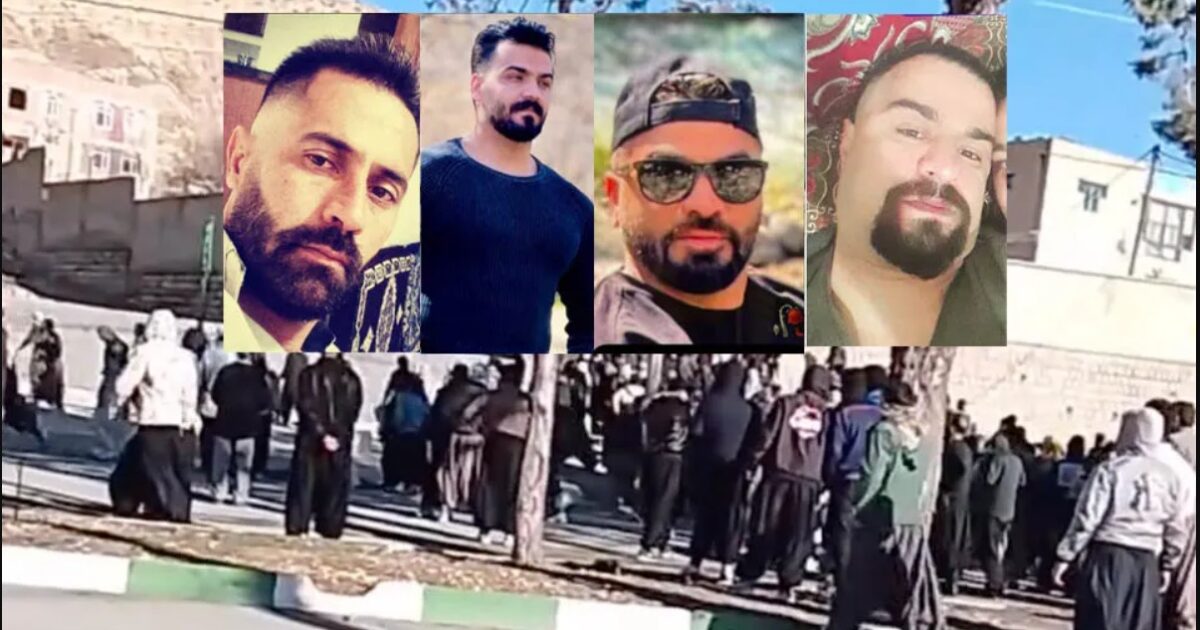
Kurds in Iranian Kurdistan suffer lethal force and mass arrests during anti-regime protests. Photo courtesy of the Democratic Party of Iranian Kurdistan (PDKI).
Iran’s ethnic minorities, who make up nearly half of the country’s population, played a central role in nationwide protests that began on December 28, 2025. Of Iran’s roughly 92 million people, about 61 percent are Persian, while the remainder includes Azerbaijanis at approximately 16 percent, Kurds at around 10 percent, Lurs at about 6 percent, Arabs and Baloch each at roughly 2 percent, and various Turkic groups at approximately 2 percent.
These minorities have opposed Tehran’s centralized governance with varying levels of organization and armed activity.
The Baloch, concentrated in Sistan and Baluchestan province along the borders with Pakistan and Afghanistan, have waged a low-intensity insurgency since 2004 through several Sunni militant groups, most recently consolidated under the People’s Fighters Front, which opposes the Velayat-e-Faqih system.
Baloch communities remain marginalized, with Sistan and Baluchestan ranking as Iran’s poorest province despite its natural resources.
Arab minorities are concentrated in Khuzestan province along the Persian Gulf and the Iraqi border.
Although Khuzestan holds much of Iran’s oil and gas wealth, Arab activists report systemic discrimination and exclusion from economic benefits.
Arab nationalist groups exist but have been less active militarily than Kurdish or Baloch organizations.
Azerbaijanis, Iran’s largest minority at approximately 16 percent of the population, live mainly in the northwest and are predominantly Shia, like Persians.
They are more integrated into Iranian political and social life and, despite some separatist sentiment, do not maintain armed resistance groups.
Across these communities, opposition centers on Tehran’s centralized, Persian-dominated system.
Armed ethnic groups generally demand either autonomy within a federal structure or independence, while Kurdish movements in particular advocate a decentralized, pluralistic system of self-administration and reject centralized rule as incompatible with ethnic self-governance.
On January 8, 2026, seven Kurdish opposition parties issued a unified statement calling for general strikes, marking rare coordination among groups including the Democratic Party of Iranian Kurdistan (PDKI), the Kurdistan Free Life Party (PJAK), and the Kurdistan Freedom Party (PAK).
Kurds in Iran have no autonomy, no official political representation, and no recognized self-governing authority. Kurdish language education is severely restricted.
Kurdish political parties do not seek separation but instead call for a federal Iran that guarantees Kurdish self-governing rights.
Kurds form the majority population in Kurdistan, Ilam, and Kermanshah provinces and, along with Azerbaijanis, are one of the two main ethnic groups in West Azerbaijan province.
Kurdish regions stretch across northwestern Iran along the borders with Turkey and Iraq, directly adjoining Iraqi Kurdistan.
Kurdish efforts at autonomy date back to the mid-twentieth century. In January 1946, Kurds established the Republic of Mahabad following an Azeri-led autonomy movement in December 1945, both with Soviet support.
Both collapsed later that year after Soviet forces withdrew. After the 1979 Islamic Revolution, Kurds initially supported the new regime in hopes of self-rule, but Ayatollah Khomeini declared jihad against Iran’s Kurds on August 19, 1979.
During the Kurdistan War from 1979 to 1983, many Kurdish villages were destroyed.
Iranian Kurdish armed groups have engaged in armed struggle against the government for decades. All Kurdish parties are illegal in Iran and classified as terrorist organizations by the state.
These groups operate primarily from bases in Iraq’s Kurdish region and include the PDKI, PJAK, the PAK with its military wing known as the Kurdistan National Army, and factions of the Komala Party.
During the protest period, the PAK’s military wing conducted operations against Islamic Revolutionary Guard Corps bases in Kermanshah, Isfahan, and Lorestan provinces.
Some fighters gained combat experience fighting ISIS alongside Peshmerga forces between 2014 and 2017.
Kurdish regions again became centers of resistance during the 2022 Mahsa Amini protests and subsequent unrest. Of 77 new arrests reported, 45 involved Kurds, and 17 of 27 civilian deaths were Kurdish.
In 2024, Kurds accounted for 77 percent of executed political and religious activists, with 136 Kurdish prisoners executed that year.
The Islamic Revolutionary Guard Corps Ground Forces were deployed to suppress protests in Kermanshah, Ilam, and Lorestan provinces.
On January 6, protesters briefly took control of towns including Malekshahi and Abdanan before security forces withdrew.
Economic conditions remain severe. In fall 2022, Kurdistan province recorded Iran’s highest unemployment rate at 13.8 percent, while Kermanshah reached 17.4 percent compared to a national average of 8.2 percent.
Opposition to Tehran remains fragmented, with ethnic minorities pursuing different political goals. Kurdish leaders have expressed reluctance to work with exiled Crown Prince Reza Pahlavi, citing his refusal to recognize the right of non-Persian nations to self-determination. Some monarchist supporters favor restoring a system under which Kurds faced repression similar to that experienced under the Islamic Republic.
Tensions also exist among minority groups themselves, including disputes between Kurds and Azerbaijanis in West Azerbaijan province and between Arabs and Lurs in Khuzestan over local power and resources.
Regional dynamics further complicate coordination, as Turkey and Azerbaijan promote Azeri nationalism inside Iran. Tehran exploits these divisions, portraying Kurdish dissent as separatism to weaken broader opposition.
Despite these fractures, limited cooperation has emerged. Most Kurdish groups advocate federalism and autonomy, while the Kurdistan Freedom Party (PAK) calls for independence.
Baloch groups tend toward independence, and Arab groups advance mixed demands. During the 2022–2023 Mahsa Amini protests, Kurdish and Baloch activists demonstrated solidarity.
Institutional efforts at coordination also exist, including the Congress of Nationalities for a Federal Iran, formed in 2005, and a joint memorandum signed in November 2018 by Kurdish, Baloch, and Arab opposition groups.
Several Iranian Kurdish parties have also jointly appealed to the international community to respond to
Tehran’s crackdown on protests, arguing that the scale of repression reflects broad public opposition to the ruling system.
The statement warned that continued international inaction would enable further abuses and was signed by multiple Kurdish political organizations.
The post Iran’s Kurds and Other Minorities Saw Window of Hope in Antiregime Protests appeared first on The Gateway Pundit.