
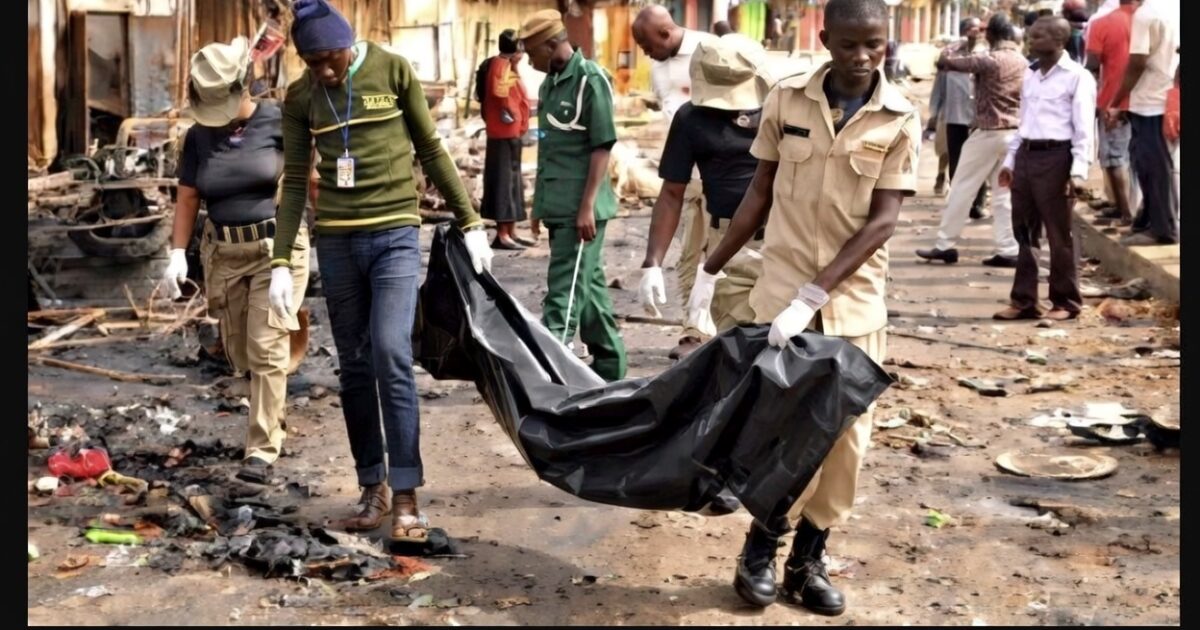
Christian community removing the dead after an attack by Islamist terrorists. Illustration generated by AI using user prompts.
Fulani Islamic extremists killed at least 13 Christians in a series of attacks across Benue State, Nigeria, in early January 2026, according to local residents and officials. The killings were part of a broader wave of Islamist violence against Christians that began on Christmas Eve and continued into the New Year.
In Otobi Akpa village, Otukpo County, gunmen arrived around midnight on January 12 and shot four Christians as they slept in their homes, with dozens of others reported missing. Separate attacks on January 5 and 6 killed nine more Christians in Kwande and Guma counties, where farmers were ambushed while working in their fields.
Community leaders described the violence as persistent and systematic. Earlier attacks in the same areas had killed Christians and destroyed dozens of homes, while December assaults included attacks on funerals, farming communities, and villages across Benue.
Local officials said the pattern includes ambushes, house-to-house raids, and the targeting of predominantly Christian communities, forcing families to flee and abandon farmland.
Christian leaders and analysts said the attacks are driven by land seizures, desertification pressures, and Islamist ideology among Fulani militias. A 2020 report by the All-Party Parliamentary Group for International Freedom or Belief found that extremist Fulani factions adopt tactics similar to Boko Haram and ISWAP and deliberately target Christians and Christian symbols. Nigeria remains one of the most dangerous countries for Christians, ranking seventh on the 2025 World Watch List published by Open Doors.
Nigeria entered 2026 amid coordinated Islamist and militia attacks that killed at least 70 people, mostly Christians, and displaced hundreds across the Middle Belt and northern regions during the Christmas and New Year period. The violence was attributed to ISWAP, Lakurawa, Boko Haram, and Fulani ethnic militias, with churches, homes, and markets deliberately targeted across Adamawa, Nasarawa, Plateau, and Niger states.
Among the deadliest incidents, at least 14 people were killed in Adamawa State on December 29, two Catholic priests were seriously wounded in Nasarawa on December 30, and Fulani militants killed at least nine Christians in Plateau State on New Year’s Eve. The single deadliest attack occurred on January 3 in Kasuwan Daji, Niger State, where at least 50 villagers were massacred and women and children abducted after militiamen burned the market and surrounding homes.
Church sites were desecrated, and the Catholic Diocese of Kontagora reported that militants operated freely without an effective security response. Communities had already been traumatized by mass kidnappings, including the November abduction of 315 students and teachers from St. Mary’s Catholic School in Papiri.
Residents said villages were under siege for more than a week with little or no security presence, forcing families to sleep in nearby bushes. Although no group formally claimed responsibility, Nigerian officials said the attackers were likely militants fleeing areas targeted by U.S. strikes, including elements linked to Lakurawa, an armed group affiliated with the Islamic State Sahel Province.
U.S. strikes on Christmas Day targeted Islamist militants in Sokoto State, with President Trump saying the action was intended to protect Christians from jihadist violence. The strikes highlighted Nigeria’s chronic insecurity, where rural communities remain exposed to bandits, jihadist groups, and militias amid limited state protection. Since 2018, Fulani militias have increasingly occupied Christian farmland in the Middle Belt, prompting Christian Solidarity International to issue a genocide warning in 2020.
Many Christians cautiously welcomed the airstrikes as long-overdue recognition of years of violence and insecurity. Catholic leaders emphasized framing the operation as a joint U.S.-Nigeria effort to avoid political backlash, while some viewed it as a warning to militant groups and a possible shift in security policy.
Pastors in hard-hit areas described the strikes as a rare moment of relief after years of burying congregants and watching communities flee, even as analysts warned that airstrikes alone cannot resolve Nigeria’s complex mix of extremism, weak governance, land disputes, and poverty.
President Trump redesignated Nigeria as a country of particular concern for religious freedom. Christian leaders said the move offered reassurance and renewed hope for the ability to worship openly, attend church safely, and send children to school without fear.
The post More Christians Killed in Wave of Islamist Attacks in Nigeria That Began on Christmas Eve appeared first on The Gateway Pundit.