
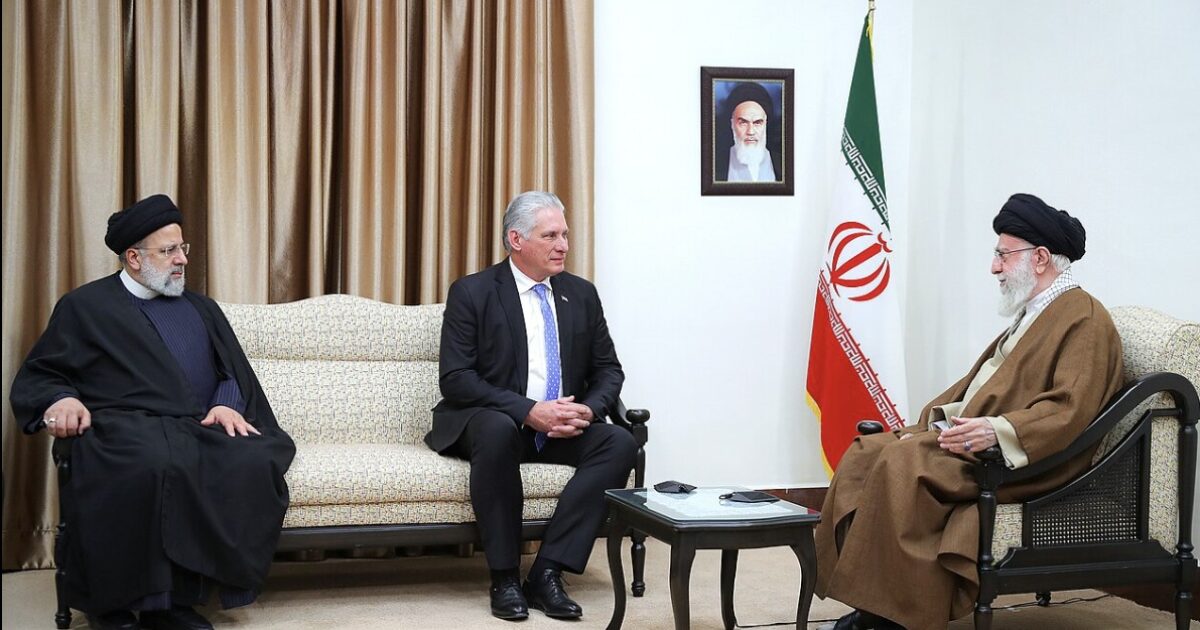
Cuban leader Miguel Díaz-Canel with Iran’s Supreme Leader Ali Khamenei and Iranian President Ebrahim Raisi. Photo by Khamenei.ir, CC BY 4.0, via Wikimedia Commons (https://commons.wikimedia.org/w/index.php?curid=151320680).
The Cuban exile community in the United States, concentrated primarily in Miami, has been waiting for regime change in Cuba for over six decades. Many left after Castro took power in 1959, bringing nothing with them and starting over as gas station attendants, maids, and small business owners after having been sugar mill owners and professionals.
Multiple waves followed, including the Freedom Flights of the 1960s-70s and the Mariel Boatlift of 1980. Over one million Cubans now live in the United States, having built Miami into a Latin American city while maintaining hopes of returning to a free Cuba.
Secretary of State Marco Rubio, son of Cuban immigrants, came of age in Miami’s exile community where memories of the island and opposition to socialism remained powerful forces. The community has historically been split between hardliners who support the embargo and maximum pressure, and moderates who favor dialogue and engagement. However, Trump’s recent actions against the Cuban regime have generated widespread anticipation among exiled Cubans that regime change may finally be approaching.
After Trump threatened Cuba to make a deal before it is too late, thousands of comments from Cubans flooded social media within hours. The majority celebrated Trump’s stance, with one Miami exile posting that this could end the 67-year nightmare.
Others called for strong measures, comparing the situation to Maduro’s recent arrest in Venezuela. Some advocated for peaceful transition without bloodshed, while others demanded action rather than negotiation with dictators. Many Cuban-Americans interpreted Trump’s message as a serious warning that could lead to forced transition.
Opposition figures inside Cuba also responded. José Daniel Ferrer, leader of the Patriotic Union of Cuba, described Trump’s message as a clear and necessary warning to the regime. Journalist Boris González Arenas stated that oppressed peoples require external help to free themselves.
Analysts noted that the regime’s situation is critical, driven by the loss of Venezuelan oil, Russia’s focus on Ukraine, China’s fatigue with unpaid debts, and an exhausted population. In response, the Trump administration has pursued economic strangulation rather than military intervention to force regime change in Cuba through a multi-part strategy.
First, the United States imposed a complete blockade on Venezuelan oil shipments to Cuba, with no tankers departing since January 3 following the capture of Nicolás Maduro. This cut off roughly 70 percent of Cuba’s oil imports. Venezuela had previously supplied up to 96,000 barrels per day and now provides none. Second, the administration has pressured alternative suppliers. After Secretary of State Marco Rubio’s visit to Mexico City, Mexican shipments dropped from 22,000 to about 7,000 barrels per day. Russia supplies approximately 7,500 barrels daily, but both Russia and other potential suppliers face U.S. reprisals for assisting Cuba. These volumes remain far below what Cuba requires.
Third, maximum economic sanctions remain in place. Cuba retains its State Sponsor of Terrorism designation, transactions with military-linked entities are blocked under the Cuba Restricted List, and the Helms-Burton Act continues to be enforced. Together, these measures have pushed Cuba into its worst crisis since 1991.
The impact is most visible in the energy sector. Cuba suffered at least five nationwide blackouts in 2025, with daily electricity deficits averaging 1,600 megawatts. Some provinces experience blackouts lasting more than 20 hours per day. The electrical grid, largely unchanged since the Cold War, depends on aging thermoelectric plants. In January 2026, deficits reached 1,830 megawatts on January 9, with consistent shortfalls of 1,400 to 1,800 megawatts throughout the month. Peak demand is about 3,200 megawatts, while available generation is only 1,500 to 1,600.
The broader economy continues to deteriorate. GDP has contracted 11 percent since 2020, with further declines expected. Inflation is approaching 30 percent annually, and the U.S. dollar trades at roughly 435 Cuban pesos on the informal market. Sugar production in the 2024–2025 season fell below 150,000 tons, the worst harvest in more than a century. Since 2021, the population has declined from 11.1 million to 9.7 million, a 12 percent drop driven by mass emigration.
Fourth, Trump terminated the Cuban Family Reunification Parole program and suspended all Cuban immigration applications. Fifth, the administration is conducting psychological warfare, with Trump and Rubio publicly predicting the regime will fall in 2026.
Trump has demanded Cuba make a deal but has not specified terms beyond addressing Cubans who left under duress. On January 12, he said details would be revealed soon. Cuban President Díaz-Canel denies any negotiations exist beyond technical migration contacts and has rejected Trump’s ultimatum, stating Cuba will defend itself to the last drop of blood.
The U.S. military operation that captured Maduro on January 3 killed 32 Cuban security personnel protecting him, including 21 from intelligence services and 11 from the military. The operation shocked Cubans and demonstrated Cuban forces’ vulnerability.
Arguments the strategy could succeed include the unprecedented combination of complete oil cutoff, collapsing infrastructure, mass emigration, and daily blackouts with no solution. A 2024 poll showed overwhelming dissatisfaction with the Communist Party. The Maduro operation demoralized Cuban military forces. No major power is positioned to rescue Cuba as the Soviet Union once did.
Arguments the strategy will fail include the regime’s survival of 60 years of pressure, including the Soviet collapse, Bay of Pigs invasion, and continuous embargo since 1962. Raúl Castro still controls the military, with three factions unlikely to break with the ruling elite. Civilians are unarmed, and the regime maintains a repression apparatus.
No major anti-government protests have occurred in Cuba in January 2026. Past protests include July 11, 2021, which resulted in 1,400 arrests and hundreds still imprisoned with sentences ranging 4-30 years, and March 2024 protests in Santiago de Cuba.
The government’s response to these protests, including long prison sentences, torture, and constant surveillance, has created a chilling effect. Over 1-2 million Cubans have emigrated since 2020, viewing departure as more viable than resistance.
Trump aims to force concrete concessions such as releasing political prisoners, opening the economy to U.S. firms, or realignment toward Washington. Cuba survived comparable crisis in the 1990s after the Soviet collapse by implementing rationing and tighter control rather than liberalization. The regime’s historical pattern favors endurance and repression over collapse.
The combination of the Venezuelan oil cutoff, collapsing infrastructure, and maximum U.S. pressure has placed Cuba in its most precarious position since 1991, but the regime may endure longer than Washington expects.
The post Trump’s Cuba Strategy and Prospects for Regime Change appeared first on The Gateway Pundit.