
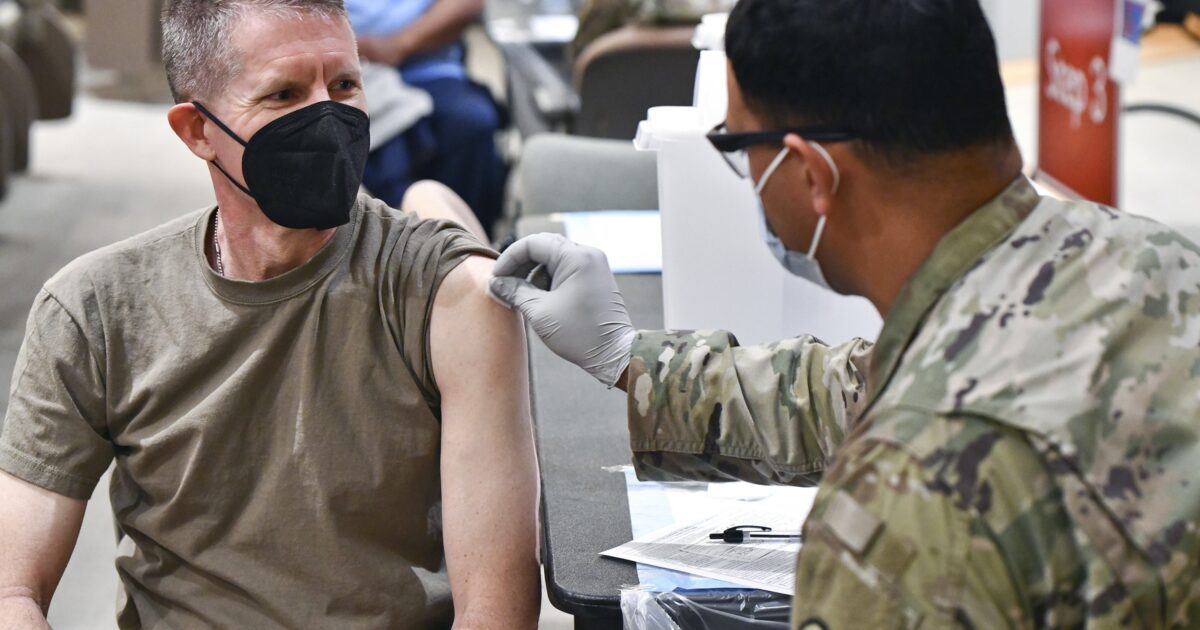
Photo courtesy of the U.S. Army
The War Department is reviewing discharges issued during the Biden administration involving service members separated under the COVID-19 vaccine mandate. Affected service members are seeking discharge upgrades, restoration of back pay and benefits, reinstatement to their former rank, and restoration of GI Bill education eligibility.
On August 24, 2021, Secretary of Defense Lloyd Austin issued a memorandum requiring all U.S. service members to begin COVID-19 vaccination, even though President Joe Biden, who was commander in chief at the time, never issued a direct order mandating vaccination for the military.
Critics raised legal and constitutional concerns, arguing that such a mandate should have come from the president or Congress, particularly because federal law requires informed consent for drugs administered under Emergency Use Authorization unless the president grants a national security waiver.
Although the FDA approved the Pfizer COVID-19 vaccine one day earlier, most vaccines available to the military at the time were still distributed under EUA, and no presidential waiver of informed consent was issued.
The requirement applied across all branches of the U.S. military, with implementation deadlines extending through late 2021 and early 2022. Between August 24, 2021, and January 10, 2023, approximately 8,400 service members were discharged for refusing the vaccine. While most received honorable discharges, more than 4,000 were given general discharges under honorable conditions, which made them ineligible for GI Bill education benefits. Some received other-than-honorable characterizations.
Thousands of additional service members faced career consequences short of discharge, including denial of promotions, blocked reenlistment, removal from training programs, administrative punishment, and, in some cases, loss of security clearances.
Requests for religious and medical exemptions became a major point of dispute. Tens of thousands of religious exemption requests were submitted across the services, while approval rates remained extremely low, often cited as less than one percent. Medical exemptions were also infrequently granted. Service members challenged the mandate on multiple grounds, including claims that Secretary Austin exceeded his authority, that troops were forced to take EUA vaccines without lawful consent, and that religious exemptions were improperly denied in violation of federal law and the Religious Freedom Restoration Act. Multiple federal courts later ruled that aspects of the military’s exemption process violated service members’ rights.
Despite ongoing litigation, the Department of Defense enforced the mandate for more than a year, leading to disciplinary action and the involuntary discharge of more than 8,000 service members by early 2023, many of them wartime veterans nearing retirement. In December 2022, Congress included language in the Fiscal Year 2023 National Defense Authorization Act directing the Department of Defense to rescind the COVID-19 vaccine requirement. The mandate was formally terminated on January 10, 2023.
President Trump signed Executive Order 14184 on January 27, 2025, directing the Department of War to reinstate service members discharged for vaccine refusal with full back pay, benefits, rank restoration, and GI Bill eligibility. In a December 6 memorandum, Secretary of War Pete Hegseth directed the military services to proactively review these cases and upgrade discharges where appropriate, stating that service members who acted based on personal or religious convictions should not have been separated with less-than-honorable characterizations.
Under the directive, former service members are not required to apply for reconsideration. The department will independently identify eligible individuals and forward their records to the appropriate discharge review boards. Eligibility is limited to those discharged solely for vaccine refusal who received a general discharge.
Cases involving additional factors, such as misconduct, may not qualify for automatic relief, though individuals may still apply directly to review boards with supporting evidence. All former service members whose records are upgraded will be notified by mail, and applications already submitted will continue to be processed and expedited.
As of November 2025, nearly 900 discharges had been upgraded, with more than 3,000 cases remaining under review through an accelerated Board for Correction of Military Records process. The Department of War has restored GI Bill benefits to 899 veterans who were previously ineligible due to discharge characterization.
The Department of Veterans Affairs has announced that thousands more may regain eligibility as additional cases are reviewed and has begun notifying veterans whose discharges have already been upgraded. Once a discharge is upgraded to fully honorable, veterans may reapply for education benefits through the VA. The review effort remains ongoing, with mandatory progress reports required every 13 months.
The post Secretary of War Hegseth Reviews Biden-Era COVID-Vaccine Discharges for Upgrade, Reinstatement, and Benefits Restoration appeared first on The Gateway Pundit.