
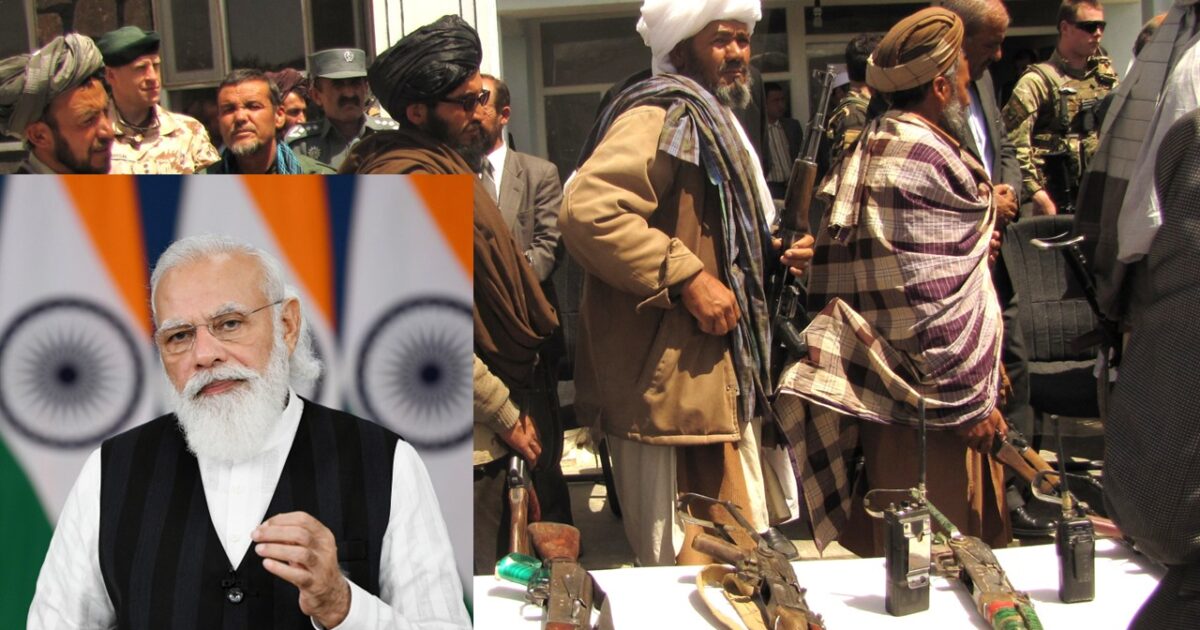
Indian Prime Minister Narendra Modi is increasing his engagement with the Taliban government in Afghanistan. Prime Minister’s Office (GODL-India), GODL-India, via Wikimedia Commons; fmedia, CC BY 2.0, via Wikimedia Commons.
Afghanistan and Pakistan are edging toward a new military escalation after deadly attacks on both sides of the border. Kabul accused Pakistan of conducting airstrikes that killed at least 10 civilians, mostly children, and vowed retaliation; Islamabad denied responsibility.
Pakistan blames the TTP (Tehrik-e-Taliban Pakistan, also called the Pakistani Taliban) for recent attacks, including a deadly assault on a paramilitary headquarters, and further accuses both the Afghan Taliban and India of supporting the group. Kabul and New Delhi deny the allegation.
Tensions are rising in part because India has expanded its outreach to the Taliban.
After an eight-day visit by Taliban Foreign Minister Amir Khan Muttaqi, New Delhi restored its diplomatic presence in Kabul and now plans to reopen its full embassy and accept a Taliban representative.
This marks a significant shift for India, which once backed anti-Taliban forces and evacuated its mission during the 2021 takeover.
Indian policymakers stress that engagement does not equal endorsement of Taliban rule.
New Delhi is expected to press the Taliban to ease restrictions on women and minorities even as it expands humanitarian and economic cooperation.
While India does not ideologically support the Taliban, it sees an opportunity to counter Pakistan as Islamabad’s relationship with the group collapses.
Economic and strategic motives also drive India’s outreach. Afghanistan holds major deposits of lithium, copper, and other minerals that India needs for its electric-vehicle and battery industries.
India’s deeper engagement also reflects its competition with China, particularly over access to Afghanistan’s critical minerals. For the Taliban, India’s involvement offers a much-needed economic lifeline after months of border closures and trade disruptions with Pakistan.
Taliban–Pakistan relations have deteriorated sharply since 2021 due to the Taliban’s continued support for the Pakistani Taliban (TTP), repeated cross-border clashes, and Pakistani airstrikes.
Pakistan views India–Taliban cooperation as a direct threat and has sharply criticized the Afghan regime as unreliable.
Islamabad has pressured the Taliban by expelling more than a million Afghans and restricting border trade, creating widespread economic hardship.
Pakistani officials argue that Afghanistan cannot realistically bypass Pakistani ports and supply routes, despite Kabul’s attempts to expand trade through Iran and Central Asia.
India’s policy shift has alarmed Afghan activists who say New Delhi is now legitimizing a regime responsible for severe human-rights abuses, including bans on women’s education, employment, and public participation.
The Taliban’s initial exclusion of female journalists during Muttaqi’s visit deepened concerns inside India about normalizing Taliban governance.
Families of Taliban victims, including relatives of murdered Indian journalist Danish Siddiqui, fear that India’s new approach removes political leverage that once pressured the Taliban for accountability.
Critics warn that the Taliban remain ideologically tied to militant networks hostile to India and are unlikely to shift loyalties away from Pakistan, regardless of temporary diplomatic gains.
Meanwhile, Afghanistan’s weak aviation sector underscores its limited ability to quickly deepen trade and investment ties with India.
An Ariana Afghan Airlines jet recently landed on the wrong runway in Delhi, highlighting serious safety problems as the Taliban explore new airfreight links.
Overall, worsening border violence, Pakistan’s frustration with the Taliban, and India’s growing engagement have deepened instability in a region where each country suspects the others of backing militant proxies.
India is not alone in engaging the Taliban, roughly a dozen nations maintain embassies in Kabul, though only Russia has formally recognized the regime.
India’s decision is driven by security concerns, fears that renewed instability could fuel militancy in Kashmir, and its interest in Afghanistan’s lithium, copper, and other critical minerals.
With Pakistan’s influence waning, the Taliban welcome India as a new trading partner and potential investor.
Experts say more Asian governments may follow. Indonesia has already held talks with Taliban officials, and Japan is weighing engagement as it searches for new energy and mineral supply chains.
India’s outreach reflects a broader regional recalibration as countries increasingly accept that the Taliban will remain in power for the foreseeable future.
The post India Moves Closer to Taliban as Afghanistan and Pakistan Edge Toward Conflict appeared first on The Gateway Pundit.