
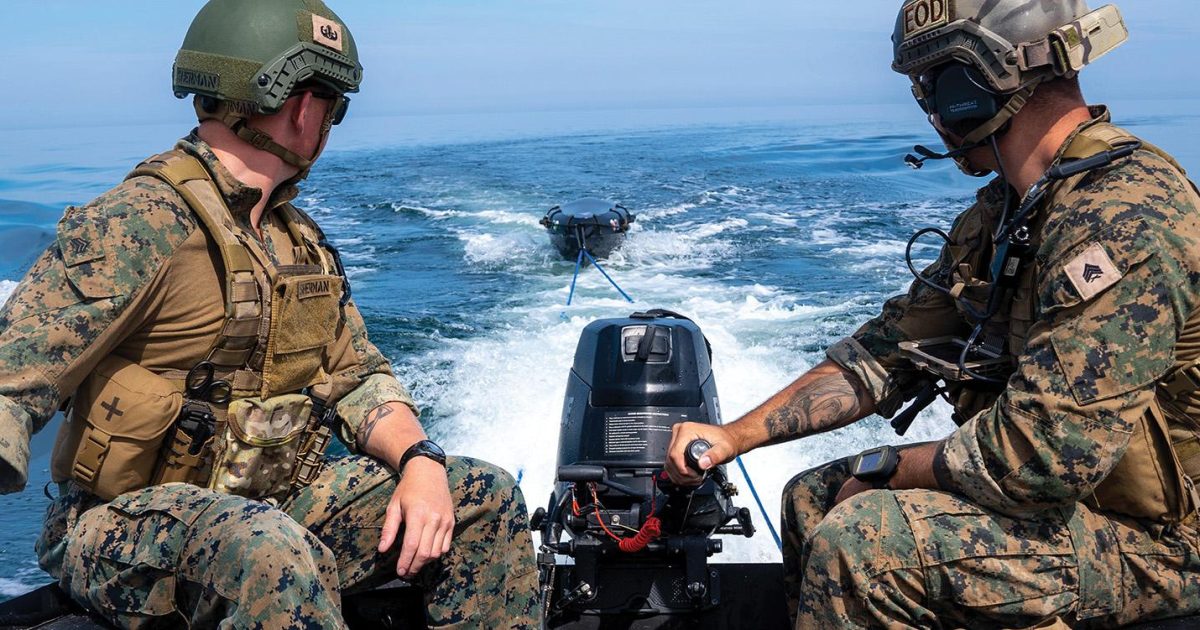
Explosive ordnance disposal Marines from the 1st Marine Company, 7th Engineer Support Battalion, tow an unmanned sea-floor-mapping and mine-detection vehicle during Baltic Operations 2021. Photo: U.S. Marine Corps (Robin Lewis).
IRGC Deputy Commander Ali Fadavi said on Iranian state broadcaster IRIB, “We have missiles that are launched from underwater, and their speed is 100 meters per second. We may use them in the coming days.” He also claimed that only Iran and Russia possess the technology for such weapons.
However, the claims have not been independently verified. Such statements are consistent with Iran’s broader pattern of using public statements to project deterrence. Tehran is attempting to scare the U.S. and Israel into disengaging.
Aside from advanced weapons that may or may not exist, the most concrete escalation is Iran’s mining of the Strait of Hormuz, one of the world’s most critical energy chokepoints through which roughly one-fifth of global crude oil passes.
U.S. intelligence sources told CNN that only a few dozen mines have been deployed so far, but Iran retains more than 80 percent of its small boats and mine-laying vessels and could deploy hundreds more.
A declassified report from the Directorate of Intelligence noted that Iran views mine warfare primarily as a deterrent strategy.
Iran’s Islamic Revolutionary Guard Corps, which shares control of the strait with Iran’s navy, has trained personnel in mine warfare and maintains multiple methods for deploying mines.
These include small boats, helicopters, midget submarines, and other naval platforms, while shore-based rocket artillery and explosive boats could be used to threaten vessels attempting to transit the waterway. Destroying surface minelayers would not eliminate the threat.
The waterway has effectively been closed since the war began, and Iran’s Revolutionary Guard had previously warned that ships passing through the strait could be attacked, with officials describing the passage as extremely dangerous for shipping and no U.S. naval escorts currently guiding vessels through the area.
The disruption has stranded approximately 15 million barrels per day of crude and another 4.5 million barrels per day of refined fuels in the Persian Gulf.
Countries such as Iraq and Kuwait rely on the strait to export oil and have few alternative routes. The G7 has signaled it may release strategic reserves to offset shortages.
President Trump warned on Truth Social that any mines must be removed immediately or Iran would face consequences “at a level never before seen,” adding that their removal would be a positive step.
Secretary of Defense Pete Hegseth subsequently announced that U.S. Central Command had begun destroying Iranian vessels associated with mine-laying operations.
CENTCOM confirmed it sank multiple Iranian naval vessels near the strait, including 16 minelayers. Trump later stated that 10 inactive minelaying ships had also been destroyed and suggested further action could follow.
Oil prices surged after the conflict began, approaching $120 per barrel before retreating, but futures remain high, above $90 per barrel.
Although Trump indicated the U.S. Navy might escort tankers through the strait, reports indicate the Navy has declined frequent requests from shipping companies due to security risks.
The possibility of the IRGC mining the strait becomes more of a threat because the U.S. Navy’s mine-clearing capability has been reduced.
Four Avenger-class minesweepers stationed in Bahrain were decommissioned in 2025, and their intended replacements, Independence-class littoral combat ships, have faced difficulties meeting operational mine countermeasure requirements.
Iran’s estimated stockpile ranges from 2,000 to 6,000 naval mines. Iran has been expanding its mine warfare capabilities by training personnel, developing minelaying techniques, and acquiring naval mines and related technology.
Intelligence assessments indicate Tehran views mine warfare as a practical response to military pressure in the Persian Gulf.
Rather than laying large numbers of mines at once, Iran would likely deploy a limited number over weeks or months to raise insurance costs and discourage shipping.
Although Iran’s minelaying capability is limited, even a few hundred contact mines could support such a campaign.
Analysts note that even limited mining, or the threat of mining, can disrupt shipping, deter vessels from entering the Persian Gulf, and function similarly to a blockade by forcing traffic into narrow channels more favorable for Iranian monitoring or attack.
Iran also operates three Kilo-class submarines, which are particularly effective at laying EM-52 rising mines, devices that sit on the ocean floor, sense a passing vessel overhead, and launch a rocket to strike it. Iran reportedly purchased the EM-52 from China.
The rugged coastlines of the Gulf of Oman and Persian Gulf complicate interdiction further, and the threat is not confined to the strait itself; adjacent sea lanes, anchorages, and loading terminals are also potential targets.
On January 25, 2025, Iranian state television revealed that the IRGC had used the Fajr-5 multiple launch rocket system to lay naval mines during exercises.
The Fajr-5 is a truck-mounted, medium-range system capable of firing rockets with a range of 80 to 100 kilometers and deploying mines from shore without putting vessels in the water, making interdiction significantly more difficult.
Iran has layered these delivery methods, small boats, submarines, shore-based rocket artillery, and aircraft, to complicate U.S. countermeasures, which is why CENTCOM’s destruction of minelayer vessels, while necessary, does not eliminate the threat entirely.
One strategic factor shapes Iran’s calculus: mining has historically been considered a last resort because it would also block Iran’s own shipping, cutting off petroleum exports essential to the regime’s finances.
Iran’s shadow fleet has continued exporting oil to China through the strait; mining would end that access.
The fact that Iran is proceeding despite this self-imposed cost indicates the regime has calculated that the threat from the current military campaign outweighs the economic damage to itself.
The post Iran’s Mine Warfare in the Strait of Hormuz appeared first on The Gateway Pundit.