
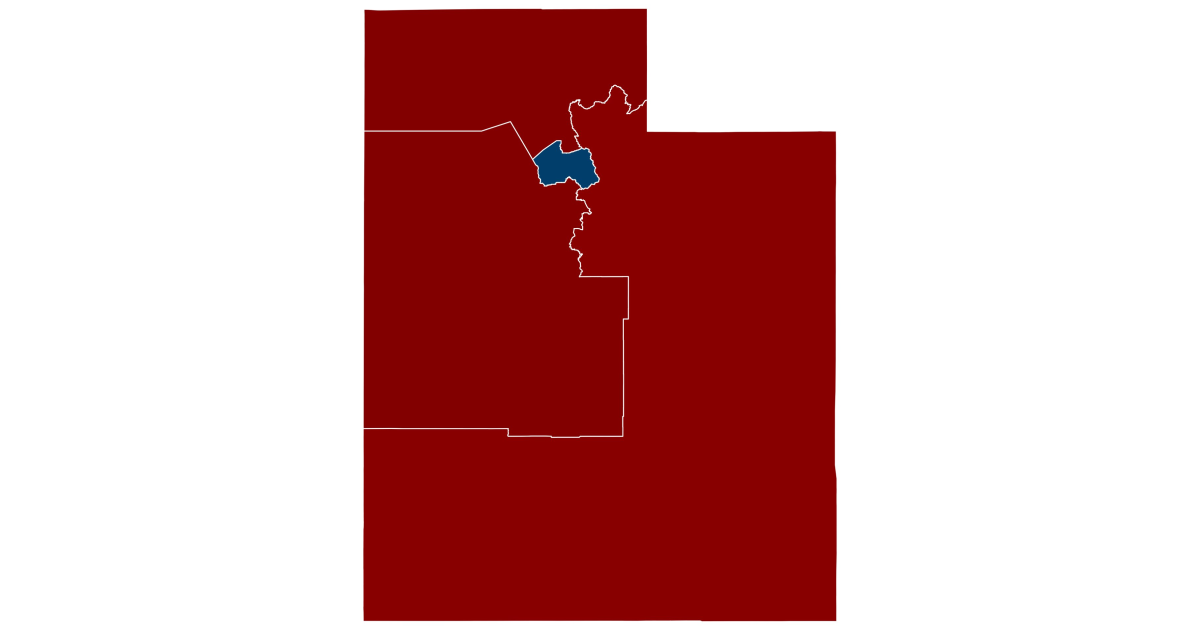
A federal court on Monday refused to block a new congressional map that could dramatically alter the state’s House delegation, potentially handing Democrats a seat they’ve never won in decades.
The ruling marks the second legal defeat for Republicans after Utah’s Supreme Court also declined to intervene in the escalating redistricting fight ahead of next year’s election cycle.
The controversy stems from a November decision by a Utah district judge who struck down congressional districts drawn by the Republican-led Legislature following the 2020 census.
Last year, the Utah Third District Court struck down the congressional map crafted by the Republican-led state legislature, labeling it an unconstitutional “gerrymander” and replacing it with a map drawn by left-wing plaintiffs.
The new map, which the court claims better complies with the state’s anti-gerrymandering initiative, is projected to give Democrats an additional seat in one of the nation’s deeply red states.
The Court, led by Judge Dianna M. Gibson, has thrown out the legislature’s S.B. 1012 (Map C) and S.B. 1011, both approved earlier this year by the state’s duly elected representatives.
And instead adopts “Map 1,” drawn by the plaintiffs themselves, after declaring that the legislature’s map “unduly favored Republicans.”
“Map C was drawn with partisan political data on display,” wrote Gibson.
“In short, [the Legislature’s map] does not comply with Utah law,” Gibson wrote in her ruling.
“Because the Lieutenant Governor’s November 10, 2025, deadline for a map to be finalized is upon us, the Court bears the unwelcome obligation to ensure that a lawful map is in place, which the Court discharges by adopting.”
Gibson’s opinion dismisses the legislature’s chosen criteria as “biased,” while elevating the plaintiffs’ computer-generated maps as the new standard for “neutrality.”
On Monday, the three-judge panel sitting in the U.S. District Court for the District of Utah denied the GOP’s attempt to halt the use of the new map ahead of the 2026 midterm elections, turning aside arguments from Republican lawmakers that a state judge exceeded her authority in imposing the plan.
The court ruled it was now too close to the election calendar to intervene, citing the Supreme Court’s Purcell principle, which discourages courts from altering election rules shortly before voting begins.
Utah’s congressional filing period opens March 9, 2026, just days away, and caucuses begin March 17.
The court wrote:
Caucuses are organized by precinct and, as the Lieutenant Governor explains, changing the map would require manually reassigning “thousands of precincts statewide.”
In sum, the candidate filing period opens in 14 days, the candidate selection process officially begins in just 22 days, and the requested relief would necessitate changing the voting districts for thousands of Utah voters.
Under Purcell, it is simply too close to Utah’s formal election process for this court to insert itself.
The court warned that stepping in now could cause “chaos and confusion” for voters and election officials.
Utah currently sends four Republicans to Congress. The legislature’s 2021 map divided Salt Lake County among four districts, preventing Democrats from consolidating a stronghold.
Critics of the new Map 1 argue it effectively restores a competitive or Democrat-friendly district, potentially flipping one seat blue in 2026.
WATCH:
JUST IN: A federal three-judge panel has unanimously REJECTED the GOP’s last-minute request to BLOCK Utah’s new court-ordered congressional map for the 2026 midterms.
Bret Baier: “The Utah judge imposed the districts last November after striking down the congressional map the… pic.twitter.com/B1DO2Bi7sW
— RedWave Press (@RedWavePress) February 24, 2026
The post Federal Court Hands Leftists a Victory in Utah, Paving the Way for Democrat Seat Grab in 2026 appeared first on The Gateway Pundit.