
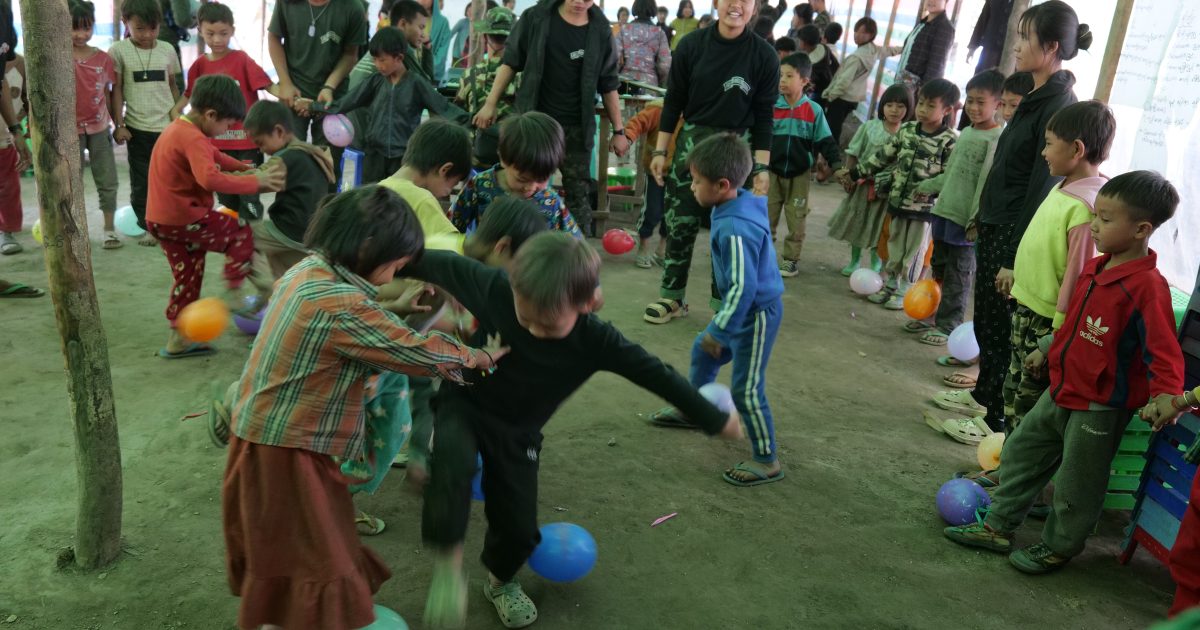
The school in the IDP camp. Photo by Antonio Graceffo.
Under a plastic tarp in a classroom at a school in a camp for internally displaced people (IDP) in Shan State, Burma (Myanmar), students and teachers told how they were displaced by the Burma army, lost family members, and had their lives turned upside down. Their ambitions and hopes have been frozen, and many have been displaced multiple times. A common thread among a significant percentage of the camp’s hundreds of residents is that their previous IDP camp was bombed repeatedly, including the destruction of their church.
IDP camps are not protected by the UN. Most exist inside resistance-controlled areas. Across the country, more than 4 million people are internally displaced. They receive almost no international aid. Most face food and water shortages, with residents living under plastic tarps that were meant to be temporary housing but have now been used for as long as five years since the military coup that sparked the revolution.
Families in the camps are often incomplete, with some members killed, young men in the resistance, and others separated by war. IDP life is a life of suffering, and to make matters worse, their own government continues to bomb them.
A teacher named Saw Ayar Soe Htoo recounted how, when the Burma army attacked his village, his family escaped to an IDP camp. Sadly, just a few months later, the camp was hit by an airstrike, and his wife and son were killed.
“I couldn’t teach for two months because when I saw the students, I missed my son so much,” he said, the emotion visible on his face.
After that, he and many of the residents took refuge in this camp, hidden in a valley with thick jungle overhead, making it difficult to spot from the air. He explained that the students struggled to learn because of the trauma of displacement and the deaths they had witnessed, as well as the constant fear and privation under which they lived.
Most of Burma’s population is Buddhist, but people of the Karenni ethnicity, the majority in this region, are Christian. When asked what he prays for, Saw Ayar Soe Htoo said, “I pray that I will see my daughter again.”
His nine-year-old daughter had been studying at a boarding school in Shan State. When the attack came, he had to prioritize helping his wife and son escape and could not reach the school to collect his daughter. He is now living in a resistance-controlled area, while his daughter, now twelve years old, remains in school in a government-controlled area.
If he returns to bring her back, he risks arrest. She is too young to travel alone across a war zone to join him. As a result, father and daughter remain separated, possibly until the war ends. It has now been five years since the coup that sparked the civil war, and there is no sign of it ending soon.
Children in an internally displaced persons camp enjoying the Good Life Club, a children’s program led by the Free Burma Rangers. Photo by Antonio Graceffo.
The next interviewee was fifteen-year-old Angela. She explained that when the SAC military arrived at her village, she and her family ran to the mountains.
Water was scarce, and they had to walk a long distance to fill a bucket. The jungle school was far away and inadequate. They then moved to Bangkok IDP camp, which was bombed repeatedly. In one airstrike, her house was destroyed, her brother was killed, and she was injured and hospitalized. Unrelated to the airstrikes, her oldest brother drowned.
Angela, like most of the residents of this camp, is Christian. When asked what she prays for, she said, “I pray for our country to get peace. And I pray for my IDP camp to be safe. And no more airstrikes.” She continued, “I pray that I will be able to continue in my studies.” She is currently in grade eight.
She said she hopes one day “to work abroad, especially in Japan.” She wants to work in a shopping center because she believes she can earn a high salary there.
When asked what she wanted the world to know, she said she wanted to tell everyone how hard it is in Burma. “We face difficulty daily. We have a shortage of supplies, especially food.” She added, “I want the world to pray for our country to be better.”
The next student interviewed was eighteen-year-old July. She said that she and her family left their village because of the military coup.
“At first, we moved to the mountain near our village,” she said. “But even there, we could not stay. So my whole family moved again to another place, where we are living now.”
July explained that they fled after hearing heavy weapons fired by the army. Shells landed in the village, some houses burned, and aircraft dropped bombs. “Six people died because of the bombing,” she said. She also heard reports that soldiers were taking girls and raping them. “That is why we felt we were not safe,” she said.
Most families left by motorcycle. Some used a tricycle, and older relatives without motorcycles walked. “It was really difficult, especially for those who had no motorcycle,” July said. She added that it was hard for her because the new place was not like her hometown.
The school is one of the nicest buildings in the camp. Photo by Antonio Graceffo.
When they fled, they left almost everything behind. “At first, we thought we would stay away only one week or maybe one month,” she said. They brought only a bag of rice and some clothes to the mountain. Later, they were unable to return. After a year, they heard that houses in their village had burned and that the belongings they left behind had been stolen.
On the mountain, they moved between three different camps. Conditions were difficult. “We used plastic tarps and a very thin mat,” she said. “We slept on the ground.” Because of the cold weather, her whole family became sick.
After some time, they moved to another IDP camp, which was hit by at least three government airstrikes. July said that her brother, her sister-in-law, and one niece were killed in an airstrike.
Eventually, she arrived at her current IDP camp, which has one of the best schools in the region, although classes are held under a plastic tarp. Government schools teach a curriculum in Burmese, while in resistance-controlled areas students study Burmese and English as well as their native language. “I am happy at my school,” she said.
Rangers bringing God’s hope and love to the internally displaced. Photo by Antonio Graceffo.
July explained that her parents had no way to earn money in the camp. Eventually, they returned to the area near their original home to work as migrant agricultural workers.
They went from having their own home and farm to working as day laborers, constantly in fear of being discovered by the government for having a daughter attending school in a resistance-controlled area.
She concluded by saying, “I always pray to overcome the obstacles the war has created. I pray for the people who fight for democracy and for peace. I thank God for giving me the chance to live until now and for keeping my parents alive. I do not want anyone to experience these kinds of problems.”
The author, Antonio Graceffo, reporting from Burma.
The post Displaced and Bombed: Stories from an IDP Camp School Underscore the Depth of Burma’s Suffering appeared first on The Gateway Pundit.