
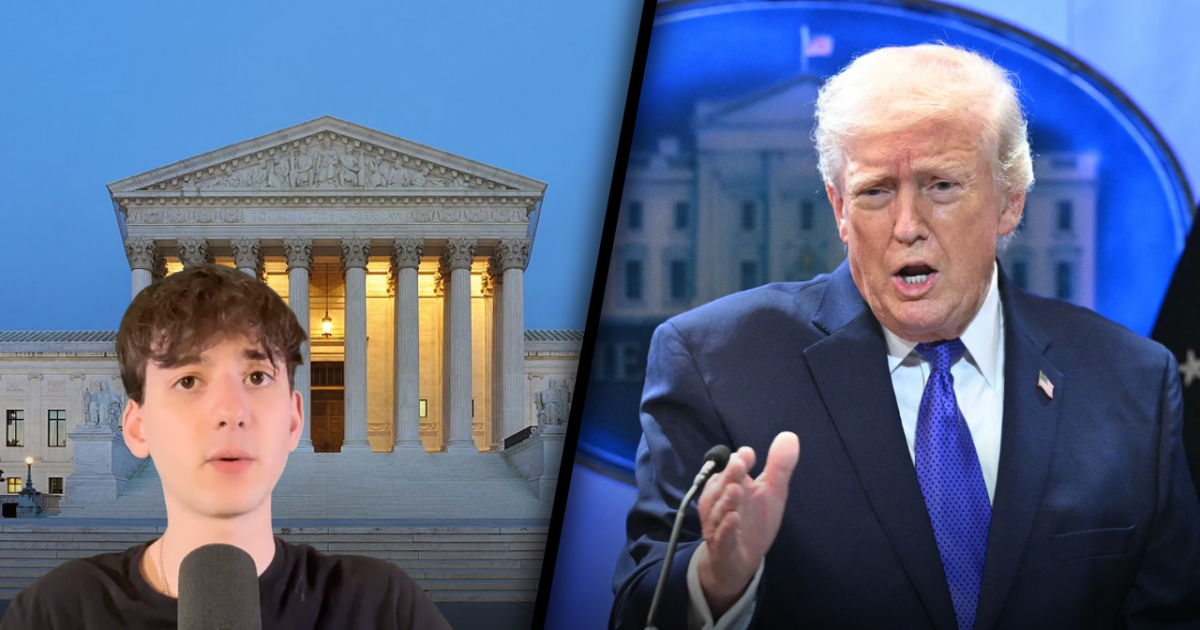
WATCH: I Read the Supreme Court’s Tariff Ruling So You Don’t Have To
In a 6–3 ruling, the Supreme Court held that the president may not rely on the International Emergency Economic Powers Act of 1977 to impose broad, long-term tariffs without clear congressional authorization.
The decision imposes structural limits on the use of emergency powers in trade policy, even as it leaves intact the broader debate over tariffs.
As previously reported by The Gateway Pundit, three conservative justices joined the Court’s three liberal justices to form the majority, underscoring that the outcome did not divide neatly along ideological lines.
The alignment reflected a constitutional question rather than a partisan one: whether Congress, through the International Emergency Economic Powers Act, clearly delegated tariff-imposing authority to the executive branch.
The administration argued that the fentanyl crisis and persistent trade imbalances constituted national emergencies within the meaning of the statute.
Under the law, a president may “regulate” economic transactions after declaring an emergency tied to an unusual and extraordinary threat. The White House maintained that this language encompassed the authority to adjust import duties as part of a broader strategy to confront China and disrupt supply chains linked to fentanyl trafficking.
The Court disagreed, concluding that while the statute permits significant economic restrictions, it does not explicitly authorize sweeping tariff programs of the magnitude at issue. Because Article I of the Constitution assigns to Congress the authority to lay and collect taxes, including duties and imposts, the majority required a clear statement from lawmakers before recognizing such expansive executive power.
The ruling narrows the statutory pathway used in this instance, but it does not invalidate tariffs as a policy instrument.
Congress has previously delegated targeted trade authority through other statutes, including Section 232 of the Trade Expansion Act and Section 301 of the Trade Act, both of which remain available tools for addressing unfair trade practices and national security concerns.
From a policy perspective, the broader strategic case for tariffs remains intact.
President Donald Trump has long argued that the United States cannot sustain a structural goods trade deficit that has hovered around or above $1.2 trillion in recent years. His approach treated tariffs not as an end in themselves, but as leverage to compel renegotiation of trade relationships and to pressure adversarial governments, particularly China.
The fentanyl crisis further complicates the landscape. Tens of thousands of Americans die annually from synthetic opioid overdoses, and administration officials have characterized cross-border trafficking networks and precursor supply chains as a national security threat. Whether tariffs represent the most effective instrument to combat that crisis is a matter of strategy, not constitutional design.
The Court’s position is that such sweeping economic measures require unmistakable legislative backing.
The political implications are equally notable. A cross-ideological majority signals that separation-of-powers concerns can override partisan loyalties.
For conservatives who favor a strong executive branch, the decision serves as a reminder that constitutional boundaries apply regardless of which party occupies the Oval Office. For Trump supporters, the path forward lies not in abandoning the tariff agenda, but in urging Congress to codify it with precision.
The ruling therefore reshapes the procedural terrain without extinguishing the substantive debate.
If lawmakers conclude that broader emergency tariff authority is necessary to address trade imbalances or foreign supply chain threats, they can explicitly grant it. Until then, the executive branch must operate within the confines of existing statutory language.
President Trump’s larger economic argument—that America should not tolerate chronic trade imbalances or strategic dependence on adversaries—remains central to ongoing policy discussions.
The Supreme Court’s decision does not repudiate that vision. Rather, it clarifies that enduring trade measures of this scale must be enacted by Congress or justified under a statute other than the IEEPA.
In the months ahead, the focus will likely shift from the judiciary to Capitol Hill. President Trump can still impose tariffs under other statutory authorities, but doing so will be more limited and procedurally complex than relying on the IEEPA.
The post I Read the Supreme Court’s Tariff Ruling So You Don’t Have To appeared first on The Gateway Pundit.