
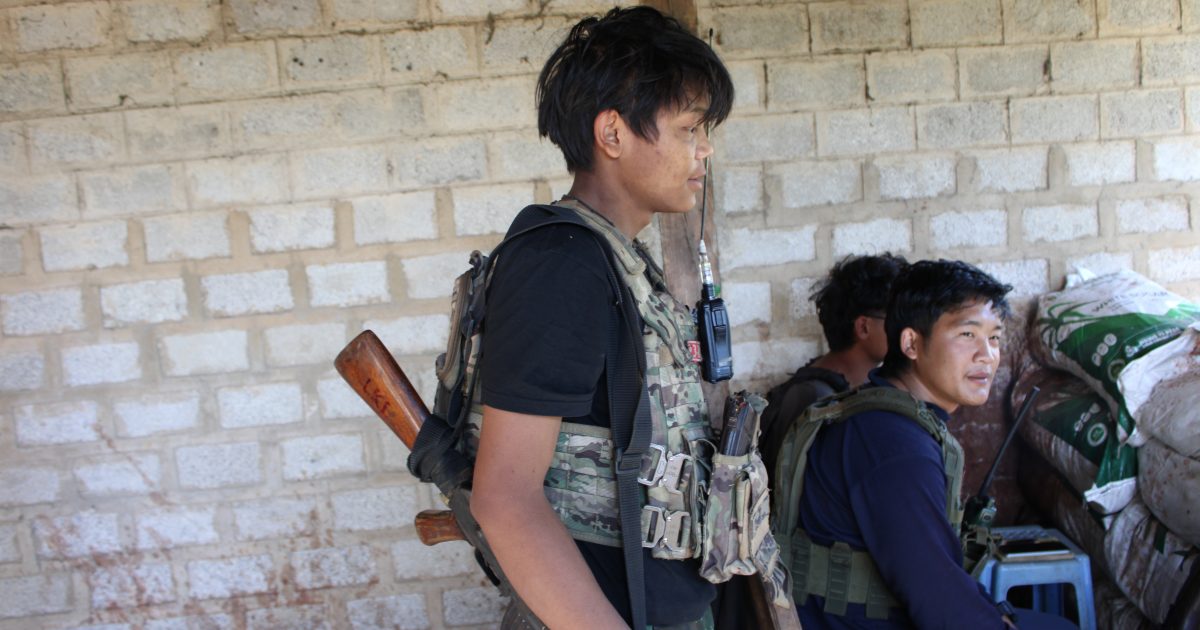
Burma’s resistance fighters are heavily outgunned, but they continue to fight for their freedom and to defend their homes and families. Photo by Antonio Graceffo
This week, the Global Light of Myanmar, the mouthpiece publication of the junta that seized control of Burma, referred to the pro-democracy resistance as terrorists, as they always do. They also lambasted Timor-Leste, a small Southeast Asian nation, for accepting a criminal complaint filed by the Chin Human Rights Organization (CHRO) that accuses junta leaders, including Senior General Min Aung Hlaing, of war crimes and crimes against humanity. The complaint includes evidence of massacres, airstrikes on hospitals, and sexual violence.
The Global Light of Myanmar wrote, “Timor Leste’s leaders have cavorted with terrorists who have butchered and seek to kill Myanmar citizens further. Its President, Jose Ramos Horta, has disgustingly validated representatives of a group of terrorist grifters and philanderers now sliding into irrelevance with each passing day.”
The same junta leaders accused of war crimes expelled Timor-Leste’s ambassador.
Also this week, Burma resistance soldiers continued to fight while horribly outgunned by the junta’s drones and aircraft and suffering from a severe lack of munitions. The Free Burma Rangers just came off several weeks of frontline medic work at a battle in Karen State, where they treated more than one hundred wounded. This morning, I saw two soldiers with prosthetic legs heading back into action. The people’s will has not been broken. As one resistance fighter put it, “We will not stop until Burma is free.”
This resistance unit includes several amputees, but they continue to fight. Photo by Antonio Graceffo
Several Gateway Pundit readers have asked why I always refer to the country as Burma rather than Myanmar. The short answer is that I call it Burma because much of the resistance and the Free Burma Rangers call it Burma. Conversely, organizations or institutions using the name Myanmar, such as The Global Light of Myanmar, are linked to the junta.
For generations, the country was known as Burma, named after the dominant Burman ethnic group. In 1989, a year after violently crushing a pro-democracy uprising, the State Law and Order Restoration Council, the ruling military junta, changed the English name to Myanmar. The generals claimed they were discarding a colonial-era name and promoting ethnic unity, arguing that “Burma” excluded minority groups.
In the Burmese language, however, Myanmar is simply the more formal version of Burma, and the change applies only in English. Because the decision was made by military decree rather than through a public referendum or an act of parliament, opposition groups argue it is illegal. By saying “Burma,” they signal that the military’s laws and decrees are invalid.
For decades, the name Burma has functioned as a linguistic act of defiance against the generals. Aung San Suu Kyi for years preferred “Burma” for the same reason, as it represented the country before the military rewrote its identity.
Over the years, several anti-junta armed groups have even included Burma in their names. The All Burma Students’ Democratic Front (ABSDF) was formed after the 1988 student uprisings and remains one of the most well-known “Burma”-named groups, made up of students who fled to the jungles to take up arms against the military.
The Burma National Revolutionary Army (BNRA) is a more recent coalition of various resistance forces, including People’s Defense Forces (PDFs), that deliberately chose the name Burma to signal its rejection of the junta’s Myanmar identity.
The National Unity Government (NUG) and its armed wing, the People’s Defense Force (PDF), use Myanmar in their formal titles. However, many local units and related legislation, such as the U.S.-backed BURMA Act, continue to use the name Burma to denote the struggle for democracy.
The issue is no longer as clear-cut as it once was. While Aung San Suu Kyi and many pro-democracy forces continue to use the term Burma, a number of ethnic armed groups have shifted toward calling the country Myanmar. Their argument is that the name Burma references the Burman ethnic majority.
This is significant because much of the ethnic resistance stems from decades of exclusion from political power and abuses carried out by Burman-dominated governments. Many now argue that the ruling authorities should be referred to simply as “the military,” while the country itself should be called Myanmar as a sign of inclusion for all 135 recognized ethnic groups.
Many governments and organizations globally rejected the new name as a symbolic attempt by the junta to gain legitimacy. Unfortunately, a number of countries and media outlets, including The Associated Press, began using Myanmar.
The United States, however, continued to officially use Burma. Even so, the stance softened over time. During a 2012 visit, President Barack Obama used both names, which an adviser to Myanmar’s president described as “very positive” and an “acknowledgement of Myanmar’s government.”
The author, Antonio Graceffo reporting from Burma
The post Why Some Call the Country Burma Rather Than Myanmar appeared first on The Gateway Pundit.