
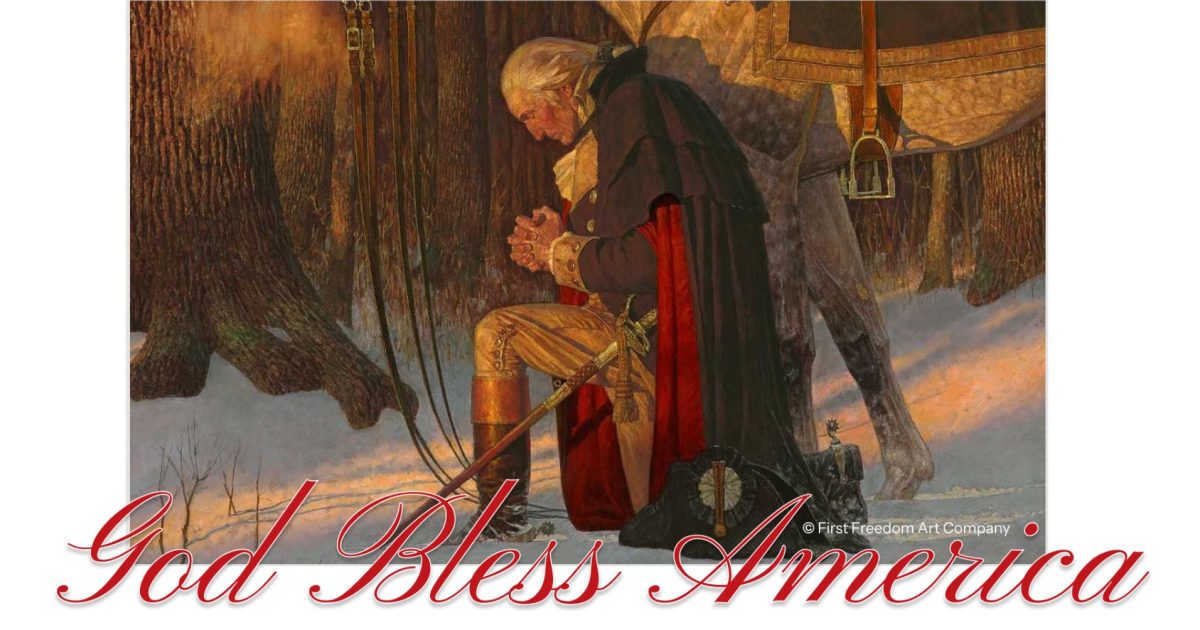
President Trump has announced the May 17, 2026, National Mall rededication ceremony. Photo courtesy of the White House.
President Trump announced that the United States will hold a nationwide prayer gathering on May 17, 2026, on the National Mall, inviting Americans to come together “to pray, to give thanks” and to “rededicate America as one nation under God.” He described the event as part of a broader spiritual renewal he said is unfolding across the country.
According to Trump, the pace of this revival has exceeded expectations, with developments he anticipated taking years occurring within a single year. He linked national momentum and success to what he called a renewed spirit that includes religion.
Trump emphasized that faith is foundational to both national strength and personal responsibility, stating, “You just can’t have a great country unless you have religion. You have to believe in something.” He argued that belief provides meaning, purpose, and accountability in life and leadership. The May 17 gathering is being framed as a public moment of gratitude and reaffirmation of America’s identity as “one nation under God,” with Trump presenting it as a defining step in the country’s spiritual and civic renewal.
Last year, on July 3, he asked Americans to begin praying at least one hour per week. “As we prepare to celebrate two and a half centuries of freedom, I am inviting America’s great religious communities to pray for our nation and for our people. From the beginning, this has always been a country sustained and strengthened by prayer. So important, if we bring religion back stronger, you’re going to see everything get better and better and better.” President Trump, Iowa, July 3, 2025.
Under President Trump, faith-based initiatives have increasingly shaped the culture and operations of the federal government. Government meetings at agencies such as the Consumer Financial Protection Bureau have opened with Christian prayers. Secretary of War Pete Hegseth regularly prays with and for our soldiers, and Bible verses and Christian imagery have appeared on official government social media accounts.
Some agencies now host prayer services. Supporters say these changes correct what they view as anti-religious bias in prior administrations, while critics argue they blur the long-standing separation between church and state.
The phrase “separation of church and state” has become a mantra, a dogma that when liberals utter it, they mistakenly believe they have won the argument. However, the term “separation of church and state” does not exist in the Constitution, nor in any of the foundational documents of the United States. The phrase was first used in a private letter written by Thomas Jefferson in 1802 to the Danbury Baptist Association.
The context was that the Baptists were worried about religious persecution. Jefferson wrote back to reassure them, saying the First Amendment built a “wall of separation between Church & State.” The intent, as many historians and the current administration argue, was that the state should not interfere with the church. The term does not mean that Congress cannot pray, that departments cannot hold prayer breakfasts, or that President Trump cannot hold a prayer revival at the White House.
There is nothing unconstitutional about shifting toward greater faith. However, there was a great deal of unconstitutional repression and persecution of Christians under the Biden administration. For that reason, on May 1, 2025, President Trump signed an executive order inaugurating the Religious Liberty Commission (RLC), a high-level advisory body. The commission is led by Texas Lt. Gov. Dan Patrick as chairman and Dr. Ben Carson as vice chair, and it is housed within the Department of Justice.
The commission’s official mandate is to “vigorously enforce” religious protections and root out what the administration calls “anti-Christian bias” in the federal government. Its primary goal is to produce a comprehensive report by July 4, 2026, the 250th anniversary of the United States, outlining how to permanently strengthen and institutionalize these protections.
Since its inception, the commission has been active in shifting federal policy. In February 2026, based on the RLC’s recommendations, the Department of Education issued updated federal guidance explicitly protecting the right of students and teachers to pray and engage in religious expression in public schools, superseding the 2023 Biden-era guidelines.
The commission is also investigating the alleged “debanking” of religious organizations, a practice in which banks close the accounts of faith-based groups due to their social or political views. It is pushing for legislation to prohibit such actions. Working alongside Attorney General Pam Bondi, the RLC helped launch the “Task Force to Eradicate Anti-Christian Bias” to investigate federal agencies, including the FBI and IRS, for past targeting of religious groups.
The RLC also provided the legal and historical framework for the May 17, 2026, National Mall rededication ceremony. It produced a 22-page document for the White House arguing that the Christian roots of the United States are a matter of historical fact.
The commission’s influence is already visible in agency actions. The Department of Education warned schools they could lose funding if they block prayer, echoing proposals discussed by the commission. The Defense Department has signaled a renewed emphasis on chaplains and public worship services, and new White House guidance encourages federal employees to express their faith at work. The Internal Revenue Service has indicated it will not enforce a longstanding rule prohibiting houses of worship from endorsing political candidates. Supporters argue these steps protect free exercise rights across faiths.
These changes are unfolding alongside a Supreme Court that has moved toward accommodating religious expression in public life. Recent rulings have expanded access to public funding for faith-based institutions and supported public displays of religion. Some commission members believe the current legal climate presents an opportunity to advance broader reforms, including challenging existing laws are hostile to religion.
The Democrats, of course, are livid, as they believe the only way to be liberal and inclusive is to exclude and eliminate Christians. This administration has done more to restore Christianity in government than any administration in history. By doing so, President Trump is upholding, not trampling on, the Constitution.
The post Trump Linking Church and State – NOT Unconstitutional appeared first on The Gateway Pundit.