
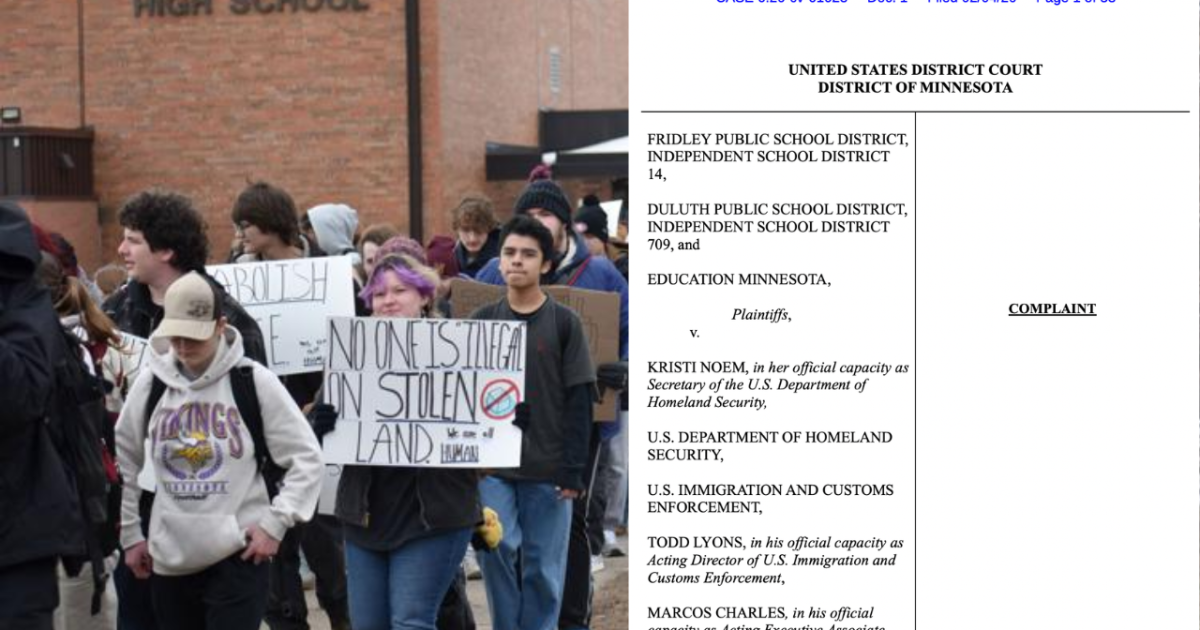
WATCH: Teachers Union and School Districts SUE Trump Administration Over ICE
Two Minnesota school districts and the state’s largest teachers union have filed a federal lawsuit against the Trump administration, challenging a new immigration enforcement policy that allows federal agents to operate at or near schools and bus stops.
The complaint, filed February 4 in the U.S. District Court for the District of Minnesota, names the Department of Homeland Security, Secretary Kristi Noem, and subagencies including U.S. Immigration and Customs Enforcement as defendants.
The plaintiffs—Fridley Public Schools, Duluth Public Schools, and Education Minnesota—argue that the administration’s decision to rescind a decades-old “sensitive locations” policy has disrupted school operations across the Twin Cities region.
They contend that enforcement activity near school grounds has reduced attendance, forced districts to expand remote learning, and diverted administrative resources.
The lawsuit seeks to reinstate restrictions that previously limited immigration enforcement at schools absent exigent circumstances or supervisory approval.
The policy change at the center of the dispute occurred in January 2025, when DHS formally revoked prior guidance that discouraged immigration arrests at schools, churches, and similar locations.
The updated directive replaced categorical restrictions with officer discretion, stating that federal agents would rely on “common sense” rather than bright-line prohibitions.
DHS defended the move as necessary to prevent criminals from exploiting geographic safe havens to avoid apprehension.
The litigation follows “Operation Metro Surge,” a high-profile federal enforcement initiative in the Minneapolis–St. Paul metropolitan area.
As The Gateway Pundit previously reported, the operation deployed thousands of agents to address what officials described as a backlog of criminal and fraud-related investigations.
Just days after the lawsuit, thousands of high school students across the country—including students in several Minnesota districts involved in the litigation—staged walkouts to protest ICE and call for the agency’s abolition.
Videos circulated rapidly on social media, showing coordinated demonstrations framed as acts of civic resistance.
In some districts, students who had walked out to protest immigration enforcement are now enrolled in systems suing the very agency responsible for carrying it out.
Immigration law is written by Congress and enforced by the executive branch. The prior “sensitive locations” guidance was an internal policy, not a statute.
Its rescission does not eliminate constitutional protections, judicial warrants, or due process. Instead, it restores operational flexibility to agents tasked with enforcing federal law.
Democrats maintain that enforcement presence near schools generates fear that undermines educational stability. District officials point to funding formulas tied to attendance and argue that declines in enrollment threaten budgets.
The complaint alleges that DHS failed to provide sufficient justification for abandoning the prior policy and violated administrative rulemaking procedures under the Administrative Procedure Act.
Yet the broader context shapes the administration’s position. Over the past several years, record levels of unlawful border crossings strained federal enforcement capacity.
Communities nationwide have absorbed fiscal and social pressures associated with irregular migration.
Federal officials argue that limiting enforcement zones created predictable gaps that individuals with outstanding removal orders could exploit.
The legal question before the court will center on administrative procedure: whether DHS adequately justified rescinding prior guidance and whether notice-and-comment rulemaking was required.
The political question is larger. Should immigration enforcement be geographically restricted by internal executive policy, or should agents retain discretion to act wherever lawful authority permits?
For families concerned about safety, the administration frames its approach as a restoration of order.
DHS has emphasized that operations prioritize individuals with criminal histories and outstanding warrants.
Officials maintain that law enforcement cannot function effectively if entire categories of locations are functionally off-limits.
School districts argue that education must remain insulated from federal enforcement activity.
The administration counters that public safety and immigration law do not disappear at the edge of a parking lot.
The courts will ultimately decide whether DHS’s policy shift withstands scrutiny.
At its core, the lawsuit presents two competing visions of governance. One views restrictions on law enforcement as necessary buffers protecting schools from federal action.
The other views uniform enforcement of duly enacted laws as foundational to public safety.
The post Teachers Union and School Districts SUE Trump Administration Over ICE appeared first on The Gateway Pundit.