
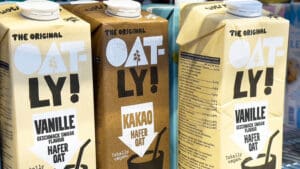
Plant-based drinks maker Oatly has lost a long-running legal fight over its use of the word “milk” in marketing, after the UK Supreme Court ruled that it cannot trademark or use the slogan “post-milk generation” in connection with dairy alternatives.
The case, brought by Dairy UK, centred on whether the term “milk”, which is protected under EU-derived food labelling rules still in force in the UK, can be used in a trade mark for plant-based products.
On Wednesday, the UK Supreme Court upheld an earlier Court of Appeal ruling that “milk” is a reserved term that can only refer to animal-derived products. Judges said the phrase “post-milk generation” could confuse consumers about whether Oatly’s products were entirely milk-free or merely contained reduced levels of dairy.
The decision reinstates the original position of the UK Intellectual Property Office (UKIPO), which had refused Oatly’s 2021 trade mark application.
Oatly’s UK and Ireland general manager, Bryan Carroll, criticised the outcome, calling it “a way to stifle competition” that creates “an uneven playing field for plant-based products that solely benefits Big Dairy”.
Under the ruling, Oatly must cancel its UK trade mark registration for “POST MILK GENERATION” and cannot use the phrase to market dairy-free alternatives. However, because the regulation applies only to food products, the company is still permitted to sell pre-existing merchandise such as T-shirts bearing the slogan.
The dispute reflects a broader regulatory framework under which certain food designations, including milk, cheese, butter and yoghurt, are legally reserved for animal-derived products. Although the UK has left the EU, the relevant regulation continues to apply as “assimilated law”.
Richard May, partner at law firm Osborne Clarke, said the ruling confirms the UK’s alignment with EU standards. “The key principle is straightforward: if a product is not derived from animal milk, it cannot be marketed using reserved dairy designations such as ‘milk’ or ‘cheese’,” he said.
Laurie Bray, senior associate and trade mark attorney at Withers & Rogers, said the judgment was decisive. “It has taken the highest court in the land to decide once and for all whether a plant-based milk alternative can be branded as ‘milk’. The outcome is not what Oatly was hoping for,” she said.
Bray added that the ruling may prompt Dairy UK or its European counterparts to challenge Oatly’s EU trade mark registrations covering similar wording.
The case comes amid growing debate across Europe over the labelling of plant-based foods. Last year, the European Parliament voted to tighten rules on the use of terms such as “oat milk” and “veggie burger”, although the measures have yet to be formally adopted.
European farming groups argue that such terms mislead consumers and dilute established product definitions. Environmental campaigners and alternative protein producers, by contrast, have warned that overly restrictive labelling harms innovation and sustainability goals.
For UK plant-based brands, the Supreme Court’s decision sends a clear signal. While factual descriptors such as “dairy-free” remain permissible, the use of protected dairy terminology in branding or trade marks is likely to face legal challenge.
The ruling marks the end of a protracted dispute for Oatly, and underscores how regulatory definitions can shape the fast-growing plant-based food and drink market.
Read more:
Oatly loses ‘milk’ branding battle in UK Supreme Court