
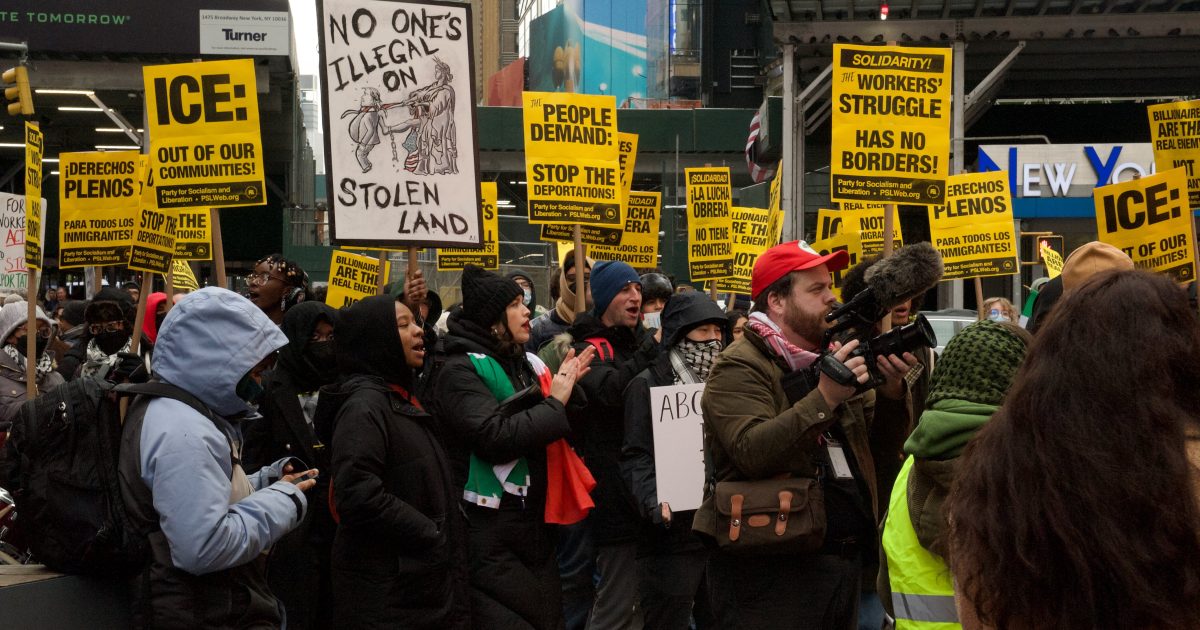
Anti-ICE protesters demonstrate in Times Square, New York City. Photo by SWinxy, CC BY 4.0, via Wikimedia Commons.
An activist group called No ICE Philly staged a protest inside a Target store in South Philadelphia, leading to the arrest of about 40 demonstrators on February 6th. More than 100 protesters entered the store chanting “ICE out of Target now,” playing instruments, and urging the company to publicly oppose U.S. Immigration and Customs Enforcement actions at its locations.
After police warned the group to leave, dozens exited the store, but roughly 40 remained seated on the floor and were arrested. No ICE Philly has organized similar demonstrations at Target stores across Philadelphia, framing the protests as pressure on the company to deny ICE access to its stores and parking lots without judicial warrants.
Group leaders, including Rabbi Linda Holtzman, argue that Target has effectively aligned itself with ICE and must take a public stand, describing the in-store protest as a necessary response to deportations.
The protest is part of a broader, decentralized “whistle kit” strategy modeled on campaigns in Chicago and Minneapolis. Beyond physical whistles, the kits include “know your rights” pamphlets, often printed using materials from the Pennsylvania Immigration Coalition and the New Sanctuary Movement, both funded through larger philanthropic pass-throughs such as the Tides Foundation.
Although No ICE Philly describes itself as “all-volunteer,” its infrastructure is supported by affiliated organizations. The Party for Socialism and Liberation organized the group’s January 26 rally at City Hall and is currently under Congressional investigation over ties to billionaire Neville Singham and potential CCP-linked dark money.
Protesters who are arrested are referred to bail and legal support networks including the NSM Community Fund and the Juntos Commissary Fund, which draw from the same liberal foundation networks that support SURJ.
Showing Up for Racial Justice (SURJ) is a national network founded in 2009 to organize white activists in support of racial and economic justice movements, operating on the premise that white people have a “mutual interest” in dismantling white supremacy and working under the leadership of Black, Indigenous, and People of Color organizations.
From cause to cause, SURJ functions as a professional protest organization, repeatedly shifting its focus to the next issue. Over the past decade, it has organized campaigns around anti-Trump and anti-MAGA resistance, Black Lives Matter protests, Defund the Police, prison abolition, ending cash bail, Stop Cop City, justice for Manuel “Tortuguita” Terán, anti-RICO legal advocacy, ICE Out for Good, ending 287(g) agreements, anti-detention center mobilization, labor and economic justice, healthcare equity, and abortion rights.
It strains credibility that the same activists would repeatedly take time off work to protest successive causes, often in different cities and states, while assuming ongoing legal and financial risk. The constant rotation of causes raises questions about what happens to earlier causes once activists shift to a new one. Do climate change, Ukraine, or Gaza no longer matter now that they are focused on ICE? The larger question is how participants sustain the time, travel, and expense involved.
One notable case study is Jamie (James) Marsicano, a well-documented example of cause overlap and repeated arrests within SURJ-aligned movements. In 2016, Marsicano was arrested in Charlotte while protesting the police shooting of Keith Lamont Scott. In 2017, he was arrested at Charlotte Douglas Airport protesting the Trump travel ban.
In 2020, he was arrested during the George Floyd protests and charged with assaulting a government official. In 2023, he was arrested and charged with domestic terrorism at a Stop Cop City music festival in Atlanta. By 2025–2026, Marsicano had become the lead plaintiff in a civil rights lawsuit against the Atlanta Police Department while remaining a central figure in ongoing anti-repression digital campaigns.
No ICE Philly is part of the broader “ICE Out” coalition and frequently coordinates with the Solidarity Organizing Initiative (SOI), which is the same organization that SURJ explicitly partners with to train its members in “nonviolent resistance” and “intervention tactics.”
In practice, SURJ provides the national infrastructure, meaning the webinars, toolkits, and funding links, while No ICE Philly functions as the local ground team executing those strategies in Philadelphia.
SURJ has coordinated with unions such as SEIU on a national day of action spanning from Seattle to Boston, centered on events in Minneapolis. SURJ organizers have also been present at the Bishop Henry Whipple Federal Building in Fort Snelling, providing “solidarity” to protesters confronting federal agents. At the same time, SURJ is running “Solidarity Mobilization” trainings that instruct white members on how to physically intervene or hinder ICE agents during neighborhood enforcement actions.
Members of SURJ and affiliated groups have been arrested on a range of charges, including a pending RICO case, as the federal government takes a more aggressive stance against “Business as Usual” tactics and broader anti-ICE demonstrations. On January 28, 2026, Attorney General Pam Bondi announced the federal arrest of 16 individuals in Minneapolis on charges of assaulting, resisting, or impeding federal officers. Prosecutors are also exploring the use of the 1871 KKK Act and the Stop FUNDERS Act to apply RICO statutes against organizations accused of coordinating protests classified as riots.
During the January 23 National Day of Action, dozens were arrested across the Twin Cities. While many local arrests for protest-related interruptions resulted in misdemeanors, federal authorities are prioritizing cases involving physical obstruction of agents or interference with operations.
On February 2, 2026, Georgia Attorney General Chris Carr appealed the December dismissal of RICO charges against 61 Stop Cop City protesters, prompting SURJ to launch digital pressure campaigns targeting the Georgia Supreme Court and local officials. Although the RICO charges were dismissed on procedural grounds, domestic terrorism charges against five defendants, known as the “Tactical 5,” were not dropped and are still proceeding to trial.
Tracing the funding behind SURJ and other leftist groups consistently leads to a tangled web of familiar donors and pass-through organizations, with money moving through multiple layers that obscure its original source. One documented connection is to George Soros–linked networks, often indirectly through re-granting organizations rather than direct transfers.
The Open Society Foundations (OSF), founded by George Soros, have historically provided millions of dollars in grants to organizations SURJ identifies as partners, including the ACLU and Indivisible. Organizations such as the Solidaire Network and Borealis Philanthropy, both recipients of OSF funding, have in turn contributed to the Atlanta Solidarity Fund, the bail fund supporting Stop Cop City protesters.
SURJ’s 501(c)(3) arm, the SURJ Education Fund, reported approximately $2.1 million in revenue in 2022. While its largest share of funding comes from individual donors and grassroots “resource redistribution,” it has also received support from donor-advised funds such as the Tides Foundation.
Tides functions as a major clearinghouse for liberal philanthropic money, including contributions from Soros-linked entities, and allows original donors to remain anonymous. Donor-advised funds are one of the primary mechanisms through which large-scale funding reaches groups like SURJ while masking its origins. Borealis Philanthropy similarly operates as a pass-through organization and manages the Black-Led Movement Fund, which has provided grants to the Atlanta Solidarity Fund.
Although SURJ is a U.S.-based nonprofit, there are ongoing investigations into dark-money networks linking radical leftist groups to foreign interests. In June 2025, House Oversight Republicans launched an investigation into Neville Singham, a billionaire residing in China who is accused of funding a network of far-left organizations, including the Party for Socialism and Liberation and Code Pink. These groups have been involved in civil unrest and Stop Cop City solidarity actions, and lawmakers allege the network functions as a vehicle for CCP propaganda.
Separately, a November 2025 report by Americans for Public Trust identified five foreign-based entities that funneled nearly $2 billion into U.S.-based social justice and climate agendas. One of those entities is reportedly linked to the CCP, and the report highlights a disclosure loophole that allows such groups to avoid identifying their specific U.S. grantees.
The post Protest Groups Keep Rotating Causes, While Funding Traces to the Same Leftist Donors appeared first on The Gateway Pundit.