
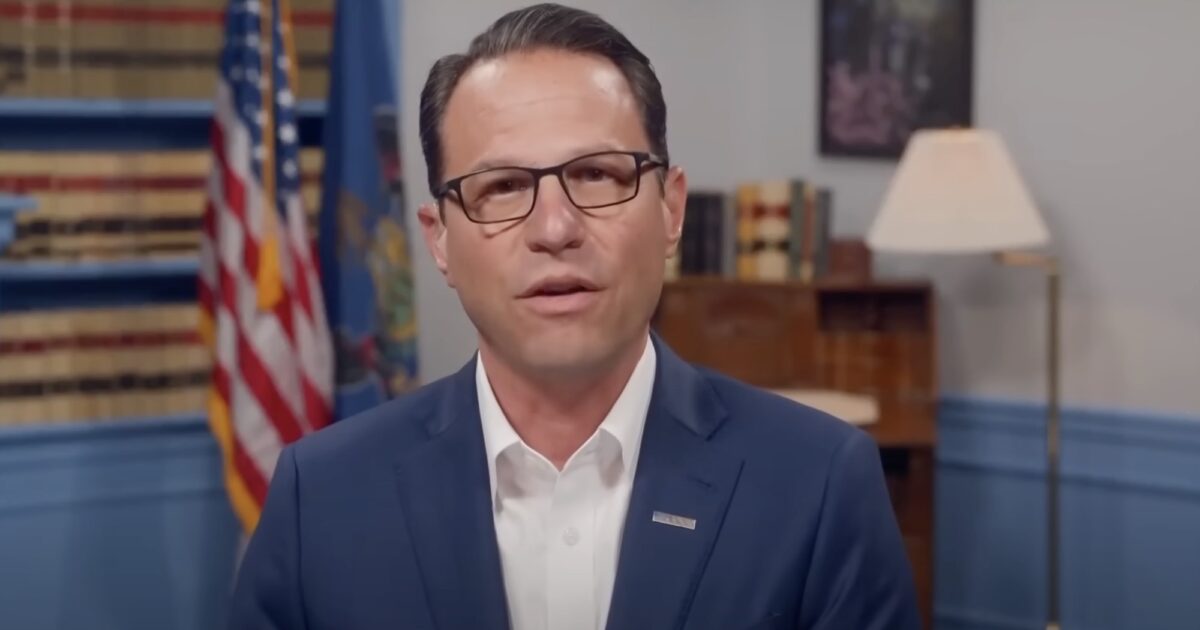
Josh Shapiro (Screenshot: MSNBC/Youtube)
This story originally was published by Real Clear Wire
By OLIVER LEE BATEMAN
The Republican leader of Pennsylvania’s state Senate saluted his allies in labor earlier this month after their successful, years-long effort to defeat what they saw as a job-killing climate initiative.
“Thanks to this repeal, the members of this union won’t have to pack suitcases to go to a job,” Sen. Joe Pittman declared while introducing business agent Shawn Steffee of Boilermakers Local 154 in Pittsburgh. “They’ll pack lunchboxes.”
In the years since state leaders had committed Pennsylvania to joining the Regional Greenhouse Gas Initiative (RGGI), membership in the union had dropped by 650 workers – roughly 30% of the total – between 2019 and 2024 as energy projects fled the state. During those six years, members of the Boilermakers had logged more hours building fossil-fuel power plants across the border in Ohio and West Virginia than in all of Pennsylvania.
Now their lunchbox era has arrived. The former Homer City generating station in Indiana County is converting from coal to natural gas, a project requiring roughly 400 boilermakers. Project Hummingbird in Greene County will pair power generation with data centers. The shuttered Bruce Mansfield plant in Beaver County is exploring natural gas and data center development. Keystone and Conemaugh, Pennsylvania’s two remaining major coal plants that had been slated to close in 2028, are withdrawing their retirement notices and pursuing upgrades to extend operations. Local 154 just took on 106 new apprentices and wants another hundred.
What changed? On Jan. 6, the Pennsylvania Supreme Court formally dismissed all litigation over the state’s attempt to join RGGI – pronounced “Reggie” – a multistate cap-and-trade program that requires power plant owners to purchase carbon emissions allowances at quarterly auctions. The dismissal followed a November budget deal in which the Republican-controlled Senate demanded, and Democrats accepted, full repeal of the regulation.
As the Trump administration pushes expanded energy production to power artificial intelligence and data centers, and grid operators warn that demand is outpacing supply, Pennsylvania’s experience illuminates what’s at stake nationally. The administration has called for “energy dominance” and removing regulatory barriers to new fossil fuel generation while also attempting to halt offshore wind projects already underway on the East Coast.
Pennsylvania opens an important window on these state-level debates because, after Texas, it produces the most natural gas in the U.S. Despite that production, PJM Interconnection – the regional grid operator serving 13 states including Pennsylvania and Washington, D.C. – came up more than 6,600 megawatts short in its December capacity auction, a deficit roughly equivalent to two major power plants’ worth of capacity. During a June 2025 heat wave, electricity demand surged 70%, and coal plants had to double their output to keep the lights on.
The country needs more power, and Pennsylvania shows what happens when major players in both parties, and the labor that depends on the energy sector for jobs, finally circle the wagons around fossil fuels, even if doing so poses long-term climate risks.
Killing Jobs
RGGI launched in 2009 across ten northeastern states – Connecticut, Delaware, Maine, Maryland, Massachusetts, New Hampshire, New Jersey, New York, Rhode Island, and Vermont. Power plants in member states, which have some of the highest electricity costs in the country, must purchase allowances at quarterly auctions for each ton of carbon dioxide they emit. In October 2019, then-Gov. Tom Wolf announced Pennsylvania would join via executive order, citing an allowance price of $5.20 per ton.
Pennsylvania never actually participated in the regime. The Commonwealth Court ruled in November 2023 that the regulation constituted a tax requiring legislative approval and blocked implementation. But six years of uncertainty had already frozen investment.
Patrick Henderson, vice president of government affairs at the Marcellus Shale Coalition, tracked the pattern. From 2012 through 2019, his organization counted roughly 15 fossil fuel projects totaling more than $13 billion in power plant construction and conversion. “And that all dried up post-2019,” Henderson said. “I cannot think of a new baseload power generation facility in Pennsylvania post-2019. You could point directly to RGGI for that.”
The economics were unforgiving. PJM Interconnection selects the lowest-cost generators to meet demand. If Pennsylvania plants were forced to shoulder the added cost of carbon allowances while Ohio and West Virginia plants were not, Pennsylvania would lose bid after bid. “Why would you site a facility here and pay a carbon tax when you can go next door?” Henderson asked. “Eastern Ohio saw development. West Virginia saw development. Pennsylvania did not.”
Carl Marrara, executive director of the Pennsylvania Manufacturers’ Association, put it simply: “You don’t build a brewery in a dry town.”
Rising Prices
Pennsylvania’s situation differed fundamentally from RGGI states. Sitting atop the Marcellus Shale, it produces roughly 7.7 trillion cubic feet of natural gas annually – about 20% of U.S. output. According to the Pennsylvania Independent Fiscal Office, the state generated 242 million megawatt-hours in 2024 while consuming only 141 million, making it a major electricity exporter.
The other RGGI states are predominantly importers. They set emissions caps and collect auction revenue while buying power from states that don’t participate. Rachel Gleason, executive director of the Pennsylvania Coal Alliance, tracked allowance prices from Gov. Wolf’s initial $5.20 to the most recent auction at $26.73. Based on current prices and Pennsylvania’s electric load, participation would have cost ratepayers $1.6 billion this year.
The environmental case for RGGI rests on a 46% regional emissions decline since 2009, with auctions generating more than $9 billion for clean energy investment.
But Henderson pointed to Pennsylvania’s own Department of Environmental Protection modeling, which projected the program would reduce in-state emissions by less than two-tenths of 1% over eight years. The reason: When Pennsylvania generators became more expensive, out-of-state plants would simply pick up the load.
Whether that emissions “leakage” to neighboring states would actually harm the climate depends on what those states burn. West Virginia generates 94% of its electricity from coal and has the second-highest carbon intensity of any state economy in the nation. Ohio still relies heavily on coal and natural gas. Pennsylvania, by contrast, now generates 60% of its electricity from natural gas and 30% from nuclear power, with coal down to just 5%. Shifting generation to dirtier neighbors could increase regional emissions even as Pennsylvania’s declined on paper.
Meanwhile, Pennsylvania, one of the top carbon-emitting states, achieved comparable emissions reductions without RGGI, through market forces. Cheap Marcellus gas displaced coal plants, cutting carbon output without any cap-and-trade program.
Mike Blackhurst, an environmental studies professor at the University of Pittsburgh, offered a nuanced perspective. The RGGI carbon price was initially modest, he argued, but sufficient to “root out some of the worst polluters” while generating revenue that could fund cleaner technologies.
“If we had it on the books now, we might be disincentivizing some further really expensive and dirty coal plants that are being used for data centers,” Blackhurst said, “and we might have revenue to support even cleaner energy technologies for data centers.”
A carbon price, Blackhurst noted, is a market-based approach that Republicans once championed. “George H.W. Bush was on the precipice of a national carbon tax. Maybe there’s a way to rekindle conservative interest in managing emissions efficiently.”
State Representative Greg Vitali, a Democrat who chairs the House Environmental Resources and Energy Committee, shared that view. When Gov. Josh Shapiro dropped the state’s appeal of the adverse court ruling and seemingly allowed RGGI to become a bargaining chip in budget negotiations, Vitali objected publicly.
“RGGI has worked well,” Vitali wrote, expressing approval of the emissions reductions achieved and disappointment with Shapiro for “throwing RGGI under the bus to get a budget deal.”
Unlikely Alliance
The opposition to RGGI produced an alliance that would have seemed improbable a decade earlier: trade unions and business groups on the same side.
Marrara of the manufacturers’ association traced its origins to pipeline hearings between 2014 and 2016. Pennsylvania had become a natural gas superpower, but its infrastructure pointed in the wrong direction – pipelines built to import gas from the Gulf, not export Marcellus production. New projects faced determined opposition from environmental groups. The Boilermakers, LIUNA, pipefitters, and operating engineers showed up at public hearings alongside business associations, finding themselves on the opposite side from activists they’d once considered allies.
The pattern crystallized when then-New York Gov. Andrew Cuomo killed the Constitution Pipeline, which would have connected northeast Pennsylvania to New England markets. “New York approved almost every single permit until the last one,” Henderson recalled. “That was by design – string investors along until they throw up their hands and quit.” New England now imports liquefied natural gas by tanker from overseas rather than taking pipeline gas from Pennsylvania, a few hundred miles away.
When Wolf signed the RGGI executive order, Steffee saw it as “a nail in the coffin.” For five years, he heard the same message from environmental groups and legislators: Develop the skills needed for green energy jobs.
Pennsylvania did and does offer significant workforce development and reskilling programs. The state has nearly 300 training programs in clean energy fields, and Gov. Shapiro’s Commonwealth Workforce Transformation Program commits up to $400 million for workforce development and on-the-job training. But Steffee’s objection was that the specific jobs he was told to pursue didn’t exist for his members.
“I asked what retraining would look like for boilermakers who are already extremely skilled in welding, rigging, and construction,” Steffee said. “I never got an answer.”
The suggestion to move into solar ignored how union jurisdictions work. The boilermakers have been building power infrastructure in Pittsburgh for 130 years, but renewables aren’t part of their remit. “The International Brotherhood of Electrical Workers does solar farms,” Steffee explained. “Were they going to hand over their work to us? That’s not how it works. It was eliminating us.”
Marrara, though he represents management, framed the coalition as pragmatic rather than ideological. “These workers are realizing the left isn’t for their jobs at all. Telling a skilled boilermaker you’ll find him work in the wind sector is insulting. There’s always going to be disagreement between management and labor, but we’re at least for their jobs to exist.”
Repeal and Replace?
By fall 2025, Gov. Shapiro’s administration filed to discontinue its appeal of the Commonwealth Court ruling. RGGI repeal became a Republican demand in budget negotiations, and Democrats, facing a prolonged impasse, conceded. The November budget deal included fiscal code language explicitly abrogating the carbon trading regulation. The Sierra Club called the result “a major setback for Pennsylvania’s environment, economy and public health.” Senate Majority Leader Pittman called the budget “an imperfect product,” reflecting compromise.
Shapiro proposed alternative legislation – the Pennsylvania Climate Emissions Reduction Act (PACER) and the Pennsylvania Reliable Energy Sustainability Standard (PRESS) – framed as a Pennsylvania-specific approach to carbon reduction. But Henderson noted PACER essentially replicated RGGI’s structure: “They’d raise the same money through allowances, then return a portion to ratepayers. Pay a dollar, get 70 cents back, and get told you should be happy.”
Shapiro’s own House committee, with a Democratic majority, has not advanced the bill, which was strongly opposed by the fossil fuel lobby. Environmental groups were not convinced the package would substitute for RGGI’s immediacy, but their objections carried less political weight than the workers who showed up at hearings.
Former U.S. Rep. Conor Lamb, who represented parts of Pittsburgh from 2018 to 2023, supported Shapiro’s retreat from RGGI. “Climate change is a global problem for nation states to solve,” Lamb said. “All RGGI was doing was making it harder for Pennsylvania to compete against Ohio.”
State Rep. Vitali remained pessimistic: “Given Republican control of the Senate and tenuous Democratic control of the House, new legislation wasn’t going anywhere. RGGI was the only chance Pennsylvania had to meaningfully continue addressing climate change.”
Increasing Demand
Pennsylvania’s exit from RGGI arrives as the regional grid strains under accelerating demand. Data centers, electrification, and manufacturing reshoring are driving load growth that PJM hasn’t seen in decades. The December capacity auction fell 6,623 megawatts short of reliability targets, which serves as a warning that the system is standing on thin ice when it comes to both thunderstorms and blizzards.
Gleason testified about the June 2025 heat wave, when electricity demand surged 70% to exceed 160 gigawatts. Coal-fired generation across PJM doubled, rising from 14.5 to 31 gigawatts. Plants that environmental groups had targeted for closure proved essential when air conditioners across the mid-Atlantic ran at full blast. The system held, but just barely.
Pennsylvania has not invested heavily in renewables. The state ranks 49th in the nation for percentage growth in solar, wind, and geothermal generation over the past decade. Wind power accounts for about 4% of electricity, generated by 27 wind farms with 1,550 megawatts of capacity; solar provides less than 1%. The state’s Alternative Energy Portfolio Standard requires just 8% from renewable sources, which is far below neighboring states, with the exception of West Virginia.
The Keystone and Conemaugh power generation stations, which together provide 3,400 megawatts of baseload capacity, had planned to close in 2028. With RGGI’s $26.73 per-ton cost no longer on the horizon, both are pursuing consent decrees to make environmental upgrades by the end of 2026 and extend their operating lives.
“Is it coincidental that RGGI’s repealed and now this is happening?” Gleason asked. “Without that anticipated burden, they could continue operations well beyond 2028.”
The Buildout
Henderson cautioned that it remains early – “only two weeks out from RGGI being officially dead.” But the calculus has shifted.
Homer City already has air quality permits from DEP and easy access to natural gas transmission. “That moved relatively expeditiously,” Henderson noted. “They have transmission lines to the grid as they ramp up to serve data centers.” Project Hummingbird and the Bruce Mansfield redevelopment are advancing. A potential tech fusion facility in Westmoreland County would combine power generation with AI data centers. Developers who spent six years building in Ohio are taking another look at Pennsylvania’s resources and infrastructure.
“We were watching our members go to other states and build in Ohio and West Virginia,” Steffee said. “I kept asking, what are we doing? We’re throwing it all away.”
The apprentice classes are filling with young workers on the cusp of building trades careers, combining six-figure incomes with real retirement benefits. The permitting process at Homer City moved briskly. The state’s two biggest coal plants have a shot at extended, cleaner operation with upgraded emissions controls.
The Template
What happened in Pennsylvania holds lessons for a country grappling with the same tensions. This purplest of purple states is a microcosm of America: politically divided, energy-rich, caught between climate ambitions and economic realities. Its cities vote Democratic while its rural areas vote Republican. Its economy spans finance and tech in Philadelphia and Pittsburgh, manufacturing in the middle, and natural resource extraction in the west and north.
The fossil fuel coalition’s logic applies beyond Pennsylvania: Policies that cost jobs will almost always generate opposition from people who need to earn a living. Workers told to “retrain” for jobs that don’t exist in their trade will resist change and vote accordingly. And a grid that can’t keep the lights on during a heat wave needs more power sources of all kinds – both fossil fuels and renewables.
Lamb, the former congressman, framed the larger point: “Natural gas production in Pennsylvania is going to be cleaner than fossil production elsewhere in the world. If the data center gets built here instead of India, maybe that’s a promising thing.”
Steffee put it in more personal terms. “I was born and raised in southwestern Pennsylvania. My family, my grandchildren – everybody lives here. I want clean air and clean water. I also want a job. I think we can get both.”
The post Power On: What PA’s Battle Over Climate Change Can Teach the Nation appeared first on The Gateway Pundit.