
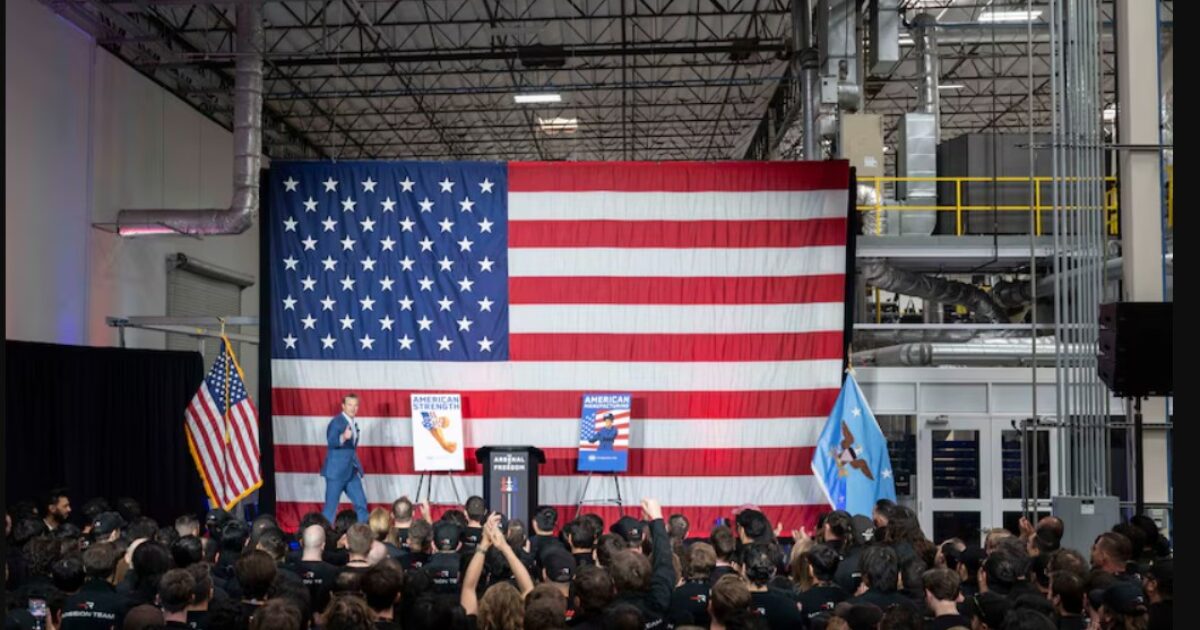
Secretary of War Pete Hegseth outlines the new National Defense Strategy during a speech at the Reagan Library. Photo courtesy of the U.S. Department of War.
“We will defend the Homeland and ensure that our interests in the Western Hemisphere are protected. We will deter China in the Indo-Pacific through strength, not confrontation. We will increase burden-sharing with allies and partners around the world. And we will rebuild the U.S. defense industrial base as part of the President’s once-in-a-century revival of American industry,” said Secretary of War Pete Hegseth in his opening message for the 2026 U.S. National Defense Strategy.
The Department of War released its 2026 National Defense Strategy on January 23, presenting a 34-page framework that reorients U.S. military priorities around homeland defense, deterrence through strength, and allied burden-sharing.
Secretary Hegseth frames the strategy as a break from past U.S. foreign policy, criticizing previous administrations for sidelining American interests through nation-building projects and pledges to uphold what he calls “cloud-castle abstractions like the rules-based international order.”
Hegseth argues these efforts weakened U.S. security and military readiness, while President Trump has prioritized Americans’ concrete interests and restored the U.S. military as the world’s strongest and most capable.
The strategy emphasizes restoring the warrior ethos and rebuilding the Joint Force so that America’s enemies never doubt U.S. resolve or its ability to respond decisively.
The strategy identifies four main lines of effort. The top priority is defending the U.S. homeland and American interests across the Western Hemisphere, including strengthening border, airspace, cyber, and nuclear defenses, countering terrorism and emerging threats through the Golden Dome missile defense initiative, and maintaining readiness to act decisively when U.S. interests are challenged.
It also commits to securing U.S. land, maritime, and air approaches, targeting narco-terrorist networks throughout the Western Hemisphere, and guaranteeing U.S. access to strategic terrain, including the Panama Canal, Greenland, and the Gulf of America.
The document describes this posture as the Trump Corollary to the Monroe Doctrine and references recent military operations, including Operation ABSOLUTE RESOLVE against Venezuela’s Maduro regime, Operation MIDNIGHT HAMMER strikes on Iran’s nuclear program, and Operation ROUGH RIDER operations against the Houthis.
China is identified as the primary long-term strategic challenge in the Indo-Pacific.
The strategy emphasizes deterrence without unnecessary confrontation, calling for negotiation from a position of military strength, improved military-to-military communication with the PLA to reduce escalation risks, and stronger defenses along the First Island Chain.
The stated objective is to ensure that no single power can dominate the region and that negotiations occur from strength rather than through containment or humiliation.
The strategy makes no mention of or guarantee to Taiwan, marking a shift from the 2022 National Defense Strategy, which stated that the U.S. would support Taiwan’s asymmetric self-defense.
The document stresses increased burden-sharing with U.S. allies and partners, arguing that long-term peace requires higher defense spending and shared responsibility rather than dependency on U.S. protection.
President Trump established a new global defense spending benchmark of 5 percent of GDP at the NATO Hague Summit, combining 3.5 percent for core military capabilities and 1.5 percent for security-related spending.
European NATO allies are expected to take primary responsibility for Europe’s conventional defense with critical but more limited U.S. support, while the strategy describes Russia as a persistent but manageable threat.
South Korea is described as capable of assuming primary responsibility for deterring North Korea, again with critical but more limited U.S. support.
Israel is characterized as a model ally that should be further empowered, while regional allies are expected to play a larger role in collective security across the Middle East and other theaters.
The strategy also prioritizes revitalizing the U.S. defense industrial base by reshoring production, expanding capacity, adopting advanced technologies such as artificial intelligence, and cutting outdated regulations.
The document calls for large-scale reinvestment in domestic defense manufacturing, removal of regulatory bottlenecks, and coordinated production with allies to restore the United States as the world’s primary arsenal, capable of rapid, high-quality production for itself and trusted partners.
The 2026 National Defense Strategy represents a significant pivot toward America First principles, with reduced emphasis on global engagement compared to previous defense strategies.
It frames President Trump’s second term as a corrective response to what it describes as a degraded global security environment inherited in January 2025, arguing that weak border enforcement, erosion of the Monroe Doctrine, hollowed-out alliances, and years of industrial outsourcing left the United States vulnerable to simultaneous major conflicts across multiple theaters.
The document emphasizes a return to warfighting readiness, modernization, and a renewed warrior ethos, while rejecting what it characterizes as prior neglect of military culture and readiness.
The post Secretary of War Unveils America First 2026 U.S. Defense Strategy appeared first on The Gateway Pundit.