
Mar Mattai Monastery (the Monastery of Saint Matthew) , Iraqi Kurdistan. Photo by Antonio Graceffo
“So Jonah arose, and went unto Nineveh, according to the word of the LORD. Now Nineveh was an exceeding great city of three days’ journey. And Jonah began to enter into the city a day’s journey, and he cried, and said, Yet forty days, and Nineveh shall be overthrown.” (Jonah 3:3–4)
The drive from the Kurdish capital of Erbil to the Mar Mattai Monastery (the Monastery of Saint Matthew) cuts across the Nineveh Plains, a region in northern Iraq stretching east from the Tigris River near Mosul, across from the ruins of the ancient city of Nineveh, and encompassing roughly 3,600 square kilometers of relatively flat, fertile land. We traveled in an armored SUV, its thick glass and doors weighing nearly 200 pounds each, rolling steadily across open terrain of agricultural fields.
We passed scattered villages composed of low concrete houses with flat roofs, surrounded by walls, water tanks perched on rooftops, and power lines sagging across empty space. Occasionally, we saw shepherds tending their flocks on horseback. The plains are bordered by mountains to the north and east, their presence constant on the horizon.
These long, exposed stretches of land are home to some of the oldest continuous Christian communities in existence. This is the heartland of ancient Assyria, where the prophet Jonah was famously sent to call the city to repentance. Assyrian Christians have made their home here since the first century AD. According to early Church tradition, these communities trace their origins to the apostolic age through the missions of Addai and Mar Mari, disciples of the Apostle Thomas. They are ethnic Assyrians who still speak dialects of Aramaic, the language Jesus spoke, and their liturgical language, the language of their Mass prayers, remains ancient Aramaic.
“Woe to the bloody city! It is all full of lies and robbery; the prey departeth not.” (Nahum 3:1)
Nahum called Nineveh the “bloody city,” a place where violence never ceased. Twenty-six centuries later, on the same ground, ISIS brought that ancient prophecy full circle. Before 2014, the Nineveh Plain hosted the largest remaining concentration of Christians in Iraq, with estimates ranging from 150,000 to 200,000, primarily Assyrian Christians, including Chaldean Catholics, Syriac Orthodox, Syriac Catholics, and members of the Church of the East. These communities were centered in historic towns such as Qaraqosh (Baghdeda), Bartella, Karamlesh, Tel Keppe, and Alqosh.
Mar Mattai Monastery (the Monastery of Saint Matthew) , Iraqi Kurdistan. Photo by Antonio Graceffo
The region contains key religious sites tied to this long Christian presence. The tomb traditionally identified as that of the prophet Jonah, Nebi Yunus, stood in Mosul until ISIS destroyed it in 2014, while the prophet Nahum’s tomb is believed to be in Alqosh. Numerous early Christian saints and martyrs are venerated across the plain, and ancient monasteries served as burial places for generations of monks and church leaders, including Mar Mattai, the oldest Syriac Orthodox monastery in the world, founded in AD 363, and Rabban Hormizd, along with countless historic churches scattered throughout the region.
During the ISIS period from 2014 to 2017, that presence was nearly erased. When ISIS swept through the region in August 2014, virtually the entire Christian population fled overnight, marking one of the largest Christian displacements in modern history. ISIS systematically destroyed or desecrated churches, some dating back to the fourth century, burned libraries of ancient manuscripts, demolished Mar Behnam monastery and other heritage sites, used Christian villages as military positions, and appropriated homes and property. The Christian population fled primarily to Erbil and the Kurdistan Region, where families lived in churches, schools, and displacement camps.
My translator and companions on this trip were Dlo, who works for the frontline aid organization Free Burma Rangers (FBR), and his brother Omar, a high-ranking member of the Kurdish security forces. Both men have extensive experience fighting ISIS, having served alongside American and coalition forces.
Iraqi Kurdistan is a unique outpost in the Middle East. Although located within Iraq, it has its own government, military, and even visa stamps at the airport. Kurds are quick to explain that they are not Arabs, and although they are Muslim, they are highly accepting of Christians, Yazidis, and other minorities.
As Mar Mattai monastery came into view, built into the living rock of the mountains ahead, Dlo recalled those desperate days roughly a decade ago, when he and his brother stood with the Peshmerga and American forces and the Rangers to hold off ISIS fighters pouring out of their capital in Mosul. “ISIS tried to take the monastery, but the Peshmerga stopped them,” he said.
Along the way, Dlo pointed to villages scattered across the plain, naming them one by one. “And this is another village. It’s called Al-Faf. They’re all Christian. And that’s another one. Maghara. It’s called Maghara.” Maghara contained a playground sponsored by Reload Love, an NGO that funds playgrounds for children in war zones. It was installed by Free Burma Rangers during the fighting.
Speaking about the families and children there, Dlo said, “ISIS tried to murder them because this village is very close to the front line.” Omar added that they received intelligence one day that ISIS planned to blow up the monastery. “They wanted to sneak up the mountain and destroy it, the same way they did in Mosul. ISIS blew up all the holy places, all the prophets, everything they could. They wanted to destroy the very ancient history.”
Mar Mattai Monastery (the Monastery of Saint Matthew) , Iraqi Kurdistan. Photo by Antonio Graceffo
Often, during long drives in the desert, Dlo explained that, from a Kurdish perspective, Christians and Muslims are children of Abraham and therefore brothers under God. For this reason, he said, Kurds have historically protected Christians. “This mountain is called Maqloub. It is a place where we, Christians, Yazidis, and Kurdish Muslims, have been living together for many, many years.” He added that ISIS killed more Muslims and Yazidis than Christians. “ISIS was also killing Kurds. They consider that we are not Muslim.” He explained that ISIS regarded Kurds and Yazidis, as well as Alawites and Druze in Syria, as infidels. “They hate us.”
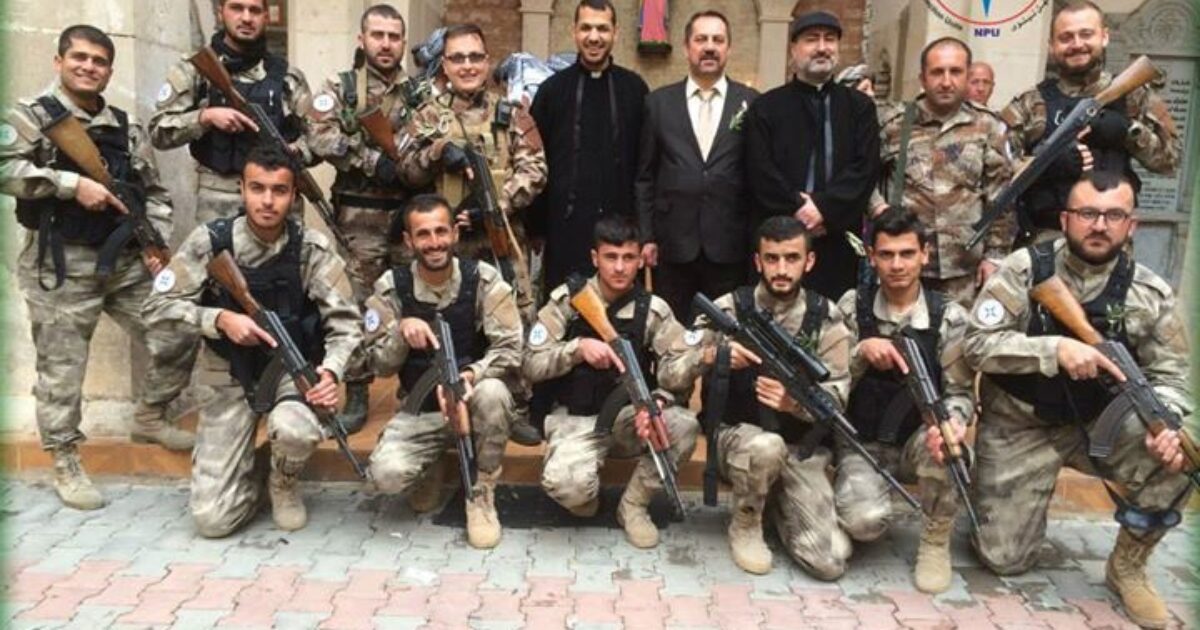
At the time of the ISIS attacks in 2014, Christians formed multiple militias to defend their ancestral homeland. The Nineveh Plain Protection Units (NPU), affiliated with the Assyrian Democratic Movement, became the largest and most legitimate Christian defense force. Dwekh Nawsha (meaning “Self-Sacrificing” in Syriac), affiliated with the Assyrian Patriotic Party, drew international attention by accepting Western volunteers. The Nineveh Plain Forces (NPF), working with Kurdish Peshmerga, participated in the liberation campaigns.
Today, Christian villages, churches throughout Kurdistan, and Christian neighborhoods like Ankawa in Erbil maintain their own Christian police and security forces, primarily through the NPU, which was recently restored as an independent force in October 2025 after community protests against Iranian-backed militia interference.
We turned up a steep, winding road leading to the Mar Mattai Monastery, where we met Father Joseph. He explained that the Syriac Orthodox Church is not in communion with Rome. Its patriarch, His Holiness Mor Ignatius Aphrem II, is based at the Cathedral of Saint George in Bab Tuma, Damascus, Syria, and holds the full title Patriarch of Antioch and All the East, Supreme Head of the Syriac Orthodox Church. According to Syriac Orthodox tradition, he is the 122nd successor to Saint Peter, who is believed to have served as the first Bishop of Antioch before going to Rome. This tradition and ecclesial structure are distinct from the Assyrian Church of the East and other Eastern Christian and Catholic rites in the region.
Father Joseph. Photo by Antonio Graceffo
Father Joseph gave a brief history of the monastery, tracing its origins to the early spread of Christianity in the first centuries after Christ. As the ancient world was divided between the Roman and Persian empires, persecution periodically forced Christians to flee Roman-controlled territory. After Christianity was legalized under Emperor Constantine, his pagan successor renewed harsh persecution, driving many believers eastward into safer regions beyond Roman control.
According to Syriac Orthodox tradition, Saint Matthew, known as Mar Mattai, fled with 25 fellow monks along the Tigris River and eventually took refuge on this mountain in the fourth century. They initially lived in caves before establishing the monastery, founded in AD 363. “They were living in the caves first,” Father Joseph said, “until miracles led them to build this monastery here.”
He noted that the monastery’s miraculous survival through centuries of war and persecution continued into modern times, when it was spared destruction by ISIS while many other churches and religious sites across the region were destroyed.
Father Joseph described how the collapse of Mosul unfolded rapidly in early June 2014. ISIS began its assault on the city on June 4, advancing from the northwest. Within days, fighters entered western Mosul, activated sleeper cells, and seized key government facilities. By June 9, heavy fighting had overtaken the city, and ISIS had effectively taken control.
“ISIS entered Mosul city and they seized everything there,” Father Joseph said. Two weeks later, ISIS issued an ultimatum to Christians and other minorities to convert to Islam, pay the jizya tax, or leave. Nearly the entire Christian population fled. Mar Mattai received about 70 displaced families, who stayed at the monastery for roughly two months.
By August, ISIS expanded its offensive into the Nineveh Plain. Father Joseph recalled that the situation deteriorated quickly as security forces collapsed. The Peshmerga withdrew to the Gwer Bridge, a strategic crossing linking Erbil, Mosul, and Kirkuk. With villages left undefended, church leaders advised civilians to flee to the Kurdistan Region, which was considered safer. Entire towns emptied almost overnight.
The monastery itself was nearly overrun. Father Joseph said ISIS vehicles reached the road near the village below Mar Mattai and remained there for about 20 minutes before retreating toward Bashiqa. “We were expecting that they were going to seize the monastery also,” he said.
Within hours, Peshmerga forces regrouped and moved back into position, forming a defensive line between ISIS-held territory and the Kurdistan Region. For more than two years, ISIS repeatedly attempted to breach those defenses, often attacking during fog, sandstorms, or heavy rain. “Sometimes it was a real battle,” Father Joseph said. Coalition airstrikes were frequently called in, and explosions shook the monastery “just like an earthquake.”
Throughout the conflict, monks remained at Mar Mattai alongside displaced Christians, while the bishop and clergy moved among refugee communities in Erbil, Dohuk, and other areas. Father Joseph said the Kurdistan Regional Government (KRG), particularly the Barzani family (the president’s family), opened its doors to those fleeing ISIS. “They opened their hearts before the gates,” he said, though he noted their resources were limited due to an embargo imposed by Baghdad.
With support from the KRG and international aid organizations, the Church coordinated shelter, food, and basic needs for displaced families. Despite the conditions, Father Joseph said the goal was to ensure that refugees lived in safety and dignity during their displacement.
hristian militia of the Assyrian Democratic Movement (ADM) who were protecting Alqosh. The militia later became part of the Nineveh Plain Protection Units (NPU), founded in 2014. Photo courtesy of Athra Kado.
ISIS was finally defeated in 2017. Father Joseph explained that throughout the conflict, Mar Mattai remained dangerously close to the front lines, often less than three kilometers from ISIS positions. “During all the period of ISIS, we were here in the nearest point to the battle,” he said. “After the liberation operation began, most of our places were completely destroyed.”
In the aftermath, the Church assumed responsibility for helping communities rebuild. Working with partner organizations, church leaders focused on restoring basic services and housing in Christian towns and villages. Entire villages had been destroyed, but reconstruction efforts made it possible for families to return. Father Joseph said the rebuilding of homes and essential infrastructure encouraged displaced Christians to come back to their ancestral communities.
He concluded by placing ISIS within the longer and turbulent history of Christianity in Iraq. “At that time, when you were hearing the explosions and all this, you knew that it’s not new for us,” he said. “The age of the monastery is more than 1,600 years. We have seen many wars. And by the blessing of Jesus Christ, through all these circumstances, the monastery survived. For that, it represents a very great value for all the believers here.”
He explained that despite repeated violence, displacement, and persecution, the Christian presence has endured across centuries.
“We are living here in the country,” he said. “And that’s what keeps us, keeps our faith, that this is just a period and it’s going to end.”
While many Christians fled to Erbil or left Iraq altogether, he said others chose to return to their villages and continue the communities their ancestors began more than a thousand years ago.
“The Church exists much longer than any problem,” Father Joseph said. “And that’s the promise of our Lord. We say that the gates of hell cannot stand against the Church.”
Father Joseph, Omar, and Antonio Graceffo. Photo courtesy of Antonio Graceffo
The post Exclusive: On the Nineveh Plain, Iraq’s Ancient Christian Communities Survived ISIS appeared first on The Gateway Pundit.