
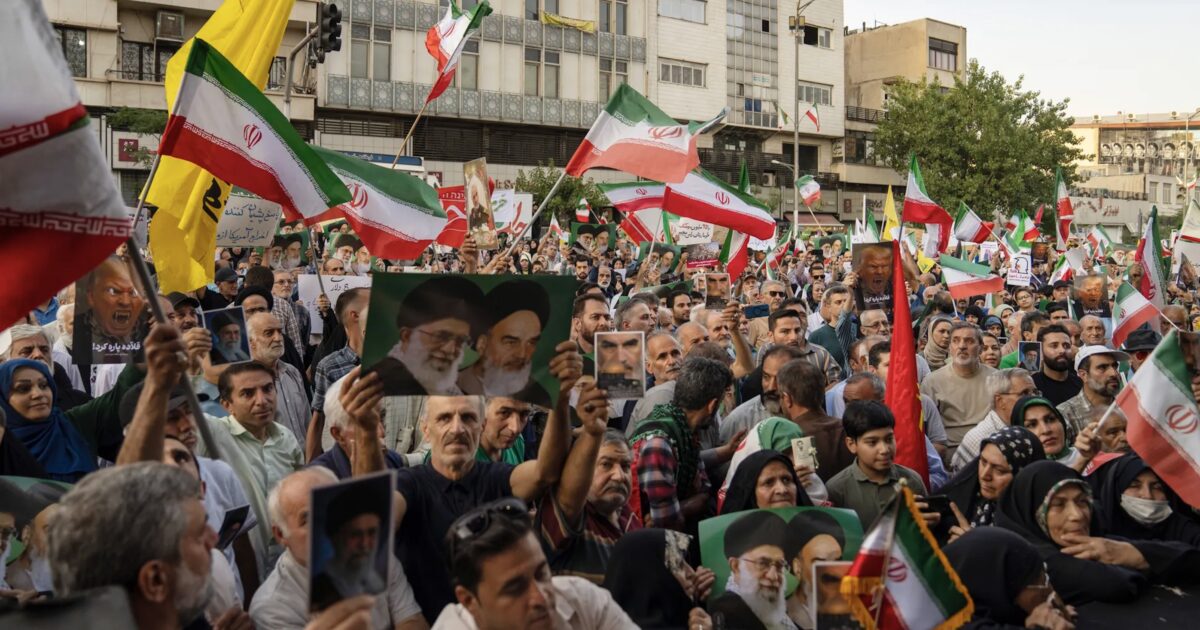
Iranians protest U.S. attacks on nuclear sites in Iran on June 22 in Tehran. (Photo: Getty Images)
Regime change is becoming unavoidable in several authoritarian states. Venezuela’s president has already been arrested and removed, while Iran and Cuba now face mounting pressure that could lead to collapse. History shows that outcomes depend less on whether regimes fall than on how transitions are managed.
Postwar Germany and Japan demonstrated that regime change can succeed when institutions are preserved, while failures in Afghanistan and Iraq resulted from misguided nation-building and external interference, not from regime removal itself.
Claims that the United States is inherently bad at regime change conflate military performance with political outcomes.
Militarily, the United States has been effective, removing Noriega in 1989, the Taliban in 2001, Saddam Hussein in 2003, Gaddafi in 2011 with NATO support, and Maduro in 2026. Strategically, results have varied.
Afghanistan absorbed $2.3 trillion over two decades before the Taliban returned to power.
Iraq lost more than 4,400 Americans and hundreds of thousands of civilians after its military was disbanded, creating the conditions for ISIS and sectarian war.
Libya descended into lawlessness, a failure Barack Obama later called his biggest mistake.
Earlier regime change efforts produced even deeper instability. The 1953 coup against Mohammad Mosaddegh succeeded tactically but led to decades of blowback, including the 1979 Islamic Revolution.
Guatemala’s 1954 coup triggered 36 years of civil war and 200,000 deaths. Chile’s 1973 coup installed Pinochet, who killed thousands and tortured many more.
Political scientists Alexander Downes and Stephen Gent distinguish between overthrowing regimes and creating stability, noting that the latter requires domestic legitimacy and internal political participation.
Economist Jeffrey Sachs documented roughly 100 regime change operations since 1947, most of which produced chaos or unintended consequences.
Germany and Japan after 1945 stand out as rare successes due to intact bureaucracies, total Allied commitment under existential threat, and Cold War pressure.
Panama in 1989 also succeeded because legitimate civilian authority was empowered quickly after Noriega’s removal.
Donald Trump’s Venezuela strategy is the model most likely to succeed because it separates leadership removal from state collapse.
Maduro was removed while the civilian government remained intact, preserving institutional continuity rather than dismantling the state.
Elections are intended to follow as a condition for U.S. aid, allowing political change through the ballot box rather than external engineering.
This approach should have been applied in Iraq and possibly Libya, but it likely would have failed in Afghanistan because the entire state apparatus was Taliban.
Trump has maintained pressure without immediate political rupture by removing Maduro while keeping Vice President Delcy Rodríguez as interim leader and leaving most of the government in place.
He has said Venezuela is being run through pressure on Rodríguez and that elections must wait until stabilization, estimating reconstruction could take up to 18 months.
According to Senators Lindsey Graham and Tom Cotton, the United States will rebuild Venezuela before transitioning to elections, which they say should follow a period of stabilization rather than occur immediately.
Nation-building is always risky, and this strategy, while sound, carries real dangers.
Trump sidelined Nobel Peace Prize winner María Corina Machado and worked with Maduro’s vice president instead of the opposition that won Venezuela’s 2024 election, in which Edmundo González defeated Maduro two-to-one based on tally sheets.
Analysts warn this increases the risk of domestic rejection, international fragmentation, and internal sabotage due to the lack of democratic legitimacy.
In Iran, regime change now appears possible as widespread anti-regime protests openly call for the return of exiled Crown Prince Reza Pahlavi.
Claims that something worse would inevitably replace the current system function largely as deterrence narratives meant to preserve a collapsing regime.
Avoiding regime change risks reinforcing repression and alienating a population that is broadly pro-American.
The unrest began on December 28, 2025, amid economic collapse and soaring inflation, and quickly spread nationwide into demands for the end of the Islamic Republic.
Protests have been reported in roughly 185 to 190 cities across all 31 provinces. The currency has lost more than 40 percent of its value, with inflation estimated at up to 60 percent.
At least 2,000 people have been killed and between 18,000 and 20,000 arrested as the regime responded with extreme violence, mass trials, and a near-total internet blackout.
Demonstrators have stormed government buildings and openly called for the death of Supreme Leader Ali Khamenei.
Iranian officials have privately described the government as operating in survival mode, and analysts suggest the country may be entering an early stage of regime crisis.
If Khamenei flees or is killed, the Islamic Revolutionary Guard Corps could fracture or require a purge. Either outcome would open space for Iranians to elect and build a secular government of their choosing.
Cuba’s collapse has been predicted for decades, but the current economic crisis is more severe than in the past. Venezuela was once the regime’s main supporter, but with Maduro in U.S. custody and Caracas unable to provide assistance, Cuba has lost its primary lifeline.
China abandoned Venezuela and is unlikely to risk war or economic sanctions by intervening, while Russia is tied down in the Ukraine war and Iran is consumed by internal unrest. Cuba is now effectively on its own.
The government is nearing failure amid an energy and economic crisis it can no longer manage.
Nationwide blackouts, decaying infrastructure, the loss of Venezuelan oil subsidies, and the advanced age of the ruling Communist leadership have pushed the system toward breakdown.
Mass emigration has drained human capital, and collapsing state revenues raise doubts about the government’s ability to continue paying its security forces.
Public sentiment inside Cuba remains difficult to measure. Independent polling is not allowed, and a 2024 survey showing widespread dissatisfaction cannot be verified due to unknown methodology and sample size.
Since 2020, an estimated 1 to 2 million Cubans, roughly 10 to 18 percent of the population, have left the country, suggesting deep dissatisfaction, though emigrants are self-selecting and tend to be those with the means or opportunity to leave.
Many who remain may be exhausted or fearful rather than supportive, while others, particularly among the older generation, retain revolutionary loyalty.
Cuba has experienced unrest before. July 2021 saw the largest protests since 1959, resulting in more than 1,400 arrests and prison sentences of up to 30 years.
Protests also occurred in March 2024 in Santiago and other cities, followed by crackdowns. Despite worsening conditions, January 2026 has seen no major nationwide anti-government protests.
Analyst Bert Hoffmann has noted that deteriorating living conditions do not necessarily translate into rebellion.
A Havana resident summarized prevailing attitudes by saying people focus first on food, electricity, housing, and work, and only then on politics.
Exiled Cubans are overwhelmingly anti-regime, but sentiment on the island likely ranges from support to resignation to opposition, with the proportions unknowable.
The post Venezuela, Iran, and Cuba: Trump Remaking the Global Political Landscape appeared first on The Gateway Pundit.