
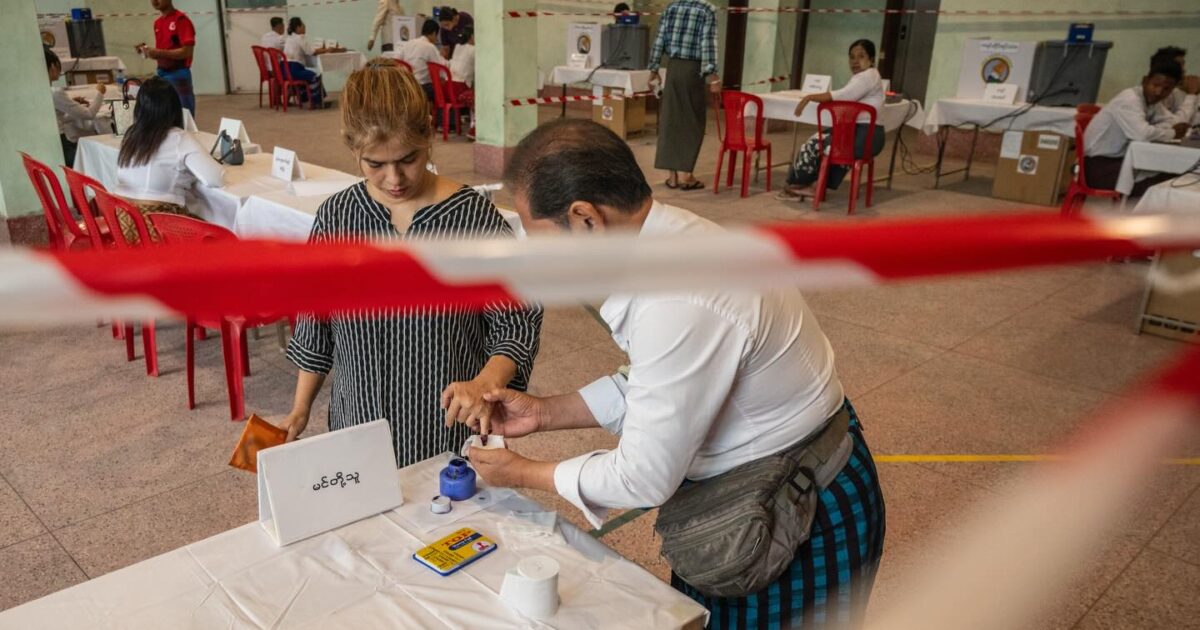
Burma (Myanmar)’s junta is holding its first election since seizing the country in a 2021 coup. The military is currently winning, as opposition parties and much of the population have been barred from participating. Photo courtesy of Shin Sirachai Arunrugstichai via Facebook.
The first round of Burma (Myanmar)’s three-phase elections began on December 28, 2025, under a framework imposed by the military junta that seized power in January 2021. With major opposition parties barred, voting canceled in 65 of the country’s 330 townships due to ongoing fighting, and further cancellations expected, the military-aligned Union Solidarity and Development Party is leading, an outcome critics say was predetermined.
The results defy logic. If the people wanted to be ruled by generals, they would not have been fighting the military for the past eight decades in what is widely recognized as the world’s longest-running conflict.
Opposition groups argue the vote is neither free nor fair and serves to legitimize continued military rule through tightly controlled elections that exclude major parties and suppress dissent, prompting several groups to call for a boycott.
The military government said more than six million people voted in the Dec. 28 first phase, claiming a turnout of about 52 percent of eligible voters in participating areas and calling it a success. The Union Election Commission said the USDP won 38 seats in the 330-seat lower house, with results still pending.
Party leader Khin Yi, a former general and police chief closely aligned with junta leader Min Aung Hlaing, was declared the winner in his Naypyitaw constituency. Naypyitaw is the military-built administrative capital established after the coup.
According to a senior USDP official speaking anonymously, the party has secured 88 of the 102 seats contested in the first phase, including 29 constituencies where it ran unopposed. The Shan Nationalities Democratic Party and the Mon Unity Party each won one seat. The official also claimed the USDP captured about 85 percent of contested regional legislature seats, though full results will only be known after later phases.
Myanmar’s parliament consists of two houses with 664 total seats, and the party controlling a combined majority can select the president and form a government. Under the constitution, the military is guaranteed 25 percent of seats in each chamber, giving it decisive built-in power regardless of election outcomes. Only six parties are competing nationwide with any realistic chance of parliamentary influence, with the USDP far ahead of its rivals.
Voting is being held in three phases because of ongoing fighting across the country. The first round covered 102 townships, with additional voting scheduled for Jan. 11 and Jan. 25, while 65 townships are excluded entirely due to conflict. Although thousands of candidates from dozens of parties are nominally contesting seats, political competition remains tightly restricted.
Military rule began after the February 2021 coup that removed the elected government of Aung San Suu Kyi. Her National League for Democracy was blocked from taking office despite a landslide victory in the 2020 election and was dissolved in 2023, along with dozens of other parties, for refusing to comply with new military registration rules. The coup sparked widespread resistance that has since escalated into a nationwide civil war.
Sai Loung, a 65-year-old Shan resident of Taunggyi, the capital of Shan State with an estimated population of 200,000, said political opinion in the city is sharply divided between supporters of the military-backed USDP and those opposed to military involvement in politics. Taunggyi lies in an ethnically diverse area with significant Pa-O, Shan, Bamar, and other communities, creating competing political loyalties and local tensions.
The Pa-O National Organization militia warned residents that abstaining from voting could lead to future problems, with village heads saying they would not take responsibility for consequences if people did not vote. The PNO, a junta-allied party, won six seats in the Pa-O Self-Administered Zone. While some Pa-O residents view the PNO as a vehicle for ethnic representation, others say intensified security operations by the junta and the PNO have generated fear.
Residents reported that participation appeared driven more by security pressure than voluntary political choice, with warnings that those who failed to vote could face arrest or other repercussions. In Taunggyi, a man was sentenced to seven years of hard labor for a Facebook post criticizing the junta’s election priorities.
Sai Loung said residents who support the military largely participated and voted for the USDP, while many opponents of military rule rejected the election and chose not to vote. The National League for Democracy, which won landslide victories in previous civilian-led elections, was dissolved after refusing to participate under military rules, citing concerns over legitimacy and fairness. Its leaders, including Aung San Suu Kyi, remain imprisoned, sharply narrowing political competition and leaving many voters without their preferred party.
He estimated that only about half of Taunggyi’s population participated, with the rest boycotting the vote. This assessment aligns with official turnout figures. The uneven participation, particularly the absence of anti-military voters, significantly contributed to the USDP’s victory.
According to Sai Loung, the USDP benefits from strong institutional backing from personnel embedded across key government departments and ministries that remain under military influence or control. These include ministries overseeing defense, internal security, foreign affairs, finance, energy, transportation, education, health, justice, and immigration.
After the coup, the junta replaced the civilian Union Election Commission with a military-appointed body chaired by Than Soe, who previously led the military bloc in parliament’s upper house. Under the 2008 Constitution, the military automatically controls 25 percent of parliamentary seats, ensuring that Min Aung Hlaing remains the country’s de facto ruler regardless of electoral outcomes. Observers say this institutional alignment provides the USDP with a reliable support base in an election marked by widespread boycotts and restricted political participation.
Sai Loung said the USDP is likely to win the remaining two rounds by a wide margin, arguing that the structure of the electoral process favors military-backed parties. He said this reinforces the view that the election is designed to legitimize continued military control rather than reflect popular will.
Richard Horsey of the International Crisis Group said the election is primarily an opportunity for the military to reverse what it viewed as an unacceptable outcome five years ago, when the National League for Democracy won a second landslide term. Regional and international observers, including representatives from the European Union and the United Nations, have questioned the vote’s credibility, with think tanks, human rights organizations, and media outlets widely describing it as a sham election.
The post No Surprise: Burma Army Leads Stilted Elections appeared first on The Gateway Pundit.