
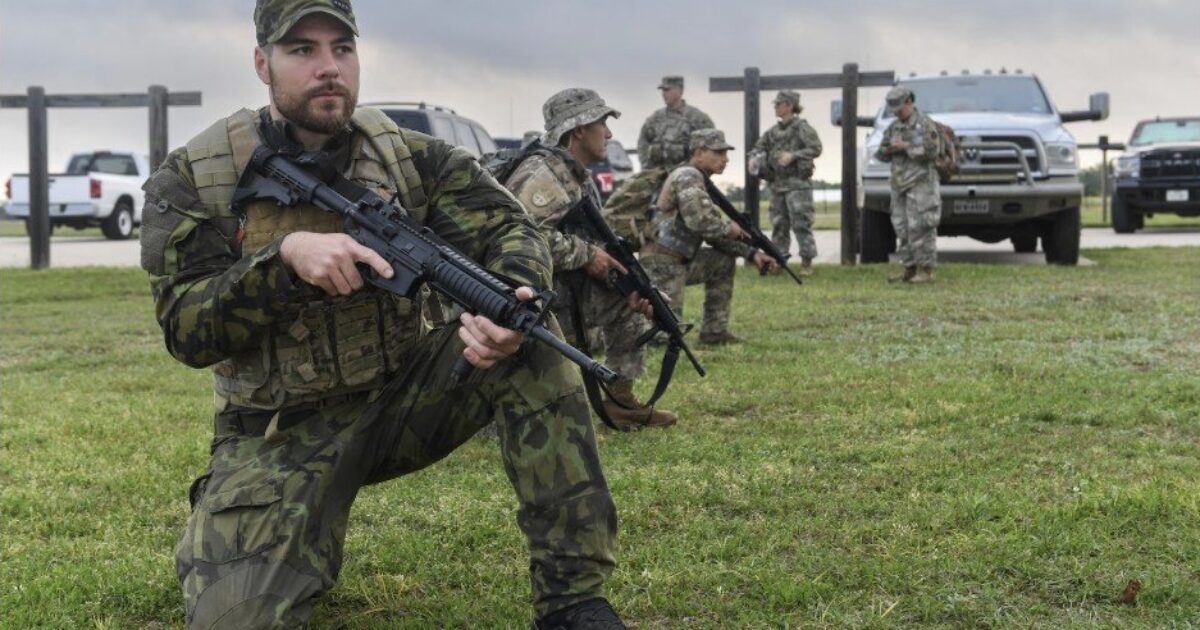
National Bolivarian Armed Forces of Venezuela (Fuerza Armada Nacional Bolivariana). Photo courtesy of Defensa.
The ability of U.S. forces to infiltrate Venezuela and seize President Nicolás Maduro, the most heavily guarded man in the country, without a single U.S. casualty raises serious questions about the effectiveness of Venezuela’s armed forces.
The January 2026 operation, completed in under 24 hours with minimal resistance, confirmed long-standing assessments that Venezuela’s military suffers from degraded equipment, inadequate training, and poor readiness despite its numerical strength.
This article was originally conceived as a firepower comparison between the U.S. and Venezuelan militaries, but the disparity proved so extreme that the comparison was narrowed to Texas versus Venezuela. Even then, Venezuela still comes out on the bottom.
The Texas State Guard, the official state militia separate from the National Guard, has approximately 1,925 to 2,000 authorized volunteer members as of 2025, making it the largest State Defense Force in the United States.
Texas’s population stands at roughly 31.85 million, the second-largest in the country.
The state has the highest total number of firearms in the United States, with estimates ranging from 32.9 million to 54.9 million.
About 36 percent of Texans, approximately 10.98 million people, own at least one firearm, with household gun ownership estimated at 45 percent. Additionally, Texas has more than one million registered firearms, most are unregistered.
Texas also has the largest veteran population of any U.S. state, estimated at 1.4 to 1.5 million veterans, or roughly 6 to 7 percent of the adult population. Veterans, the State Guard, and civilian gun owners are mentioned only because much of Venezuela’s force structure consists of paramilitary elements rather than professional soldiers.
For the purposes of this assessment, civilians, veterans, and state militia forces are excluded, and the comparison is limited strictly to the Texas National Guard and the Venezuelan military.
The analysis focuses on equipment quality, training standards, operational readiness, and demonstrated combat effectiveness, underscoring that in modern warfare these factors outweigh raw numbers.
The Texas National Guard’s integration with U.S. logistics, intelligence, and support systems provides force multiplication that offsets its smaller personnel base.
As of mid-2025, the Texas National Guard, combining Army and Air components, fields approximately 22,000 to 23,000 personnel, making it the largest National Guard force in the country.
The Texas Military Forces operated on a $1.851 billion budget in 2023 and maintain 117 armories across 102 communities statewide. The force comprises more than 22,000 personnel, including about 19,000 soldiers in the Army National Guard and 3,300 airmen in the Air National Guard.
Organized under the 36th Infantry Division, the Texas Army National Guard includes Joint Force Headquarters, and the 71st Troop Command.
Major formations include the 56th and 72nd Infantry Brigade Combat Teams, supported by specialized units such as the 36th Combat Aviation Brigade, 176th Engineer Brigade, 278th Armored Cavalry Regiment, and the 36th Sustainment Brigade.
Venezuela’s military budget is estimated at $3.9–4.6 million USD (millions, not billions). According to Global Firepower’s 2025 rankings, Venezuela fields approximately 115,000 personnel in the army, 25,500 in the navy, and 20,000 in the air force, in addition to militia forces.
President Nicolás Maduro has claimed to have activated up to 4.5 million militia members, though these forces reportedly have little to no training or equipment and would pose a greater danger to themselves and each other than to U.S. forces.
The Texas Air National Guard operates three flying wings: the 149th Fighter Wing with F-16C/D Fighting Falcons, the 147th Attack Wing with MQ-9 Reaper drones, and the 136th Airlift Wing flying C-130H Hercules aircraft.
While the TXANG does not operate attack helicopters, strike missions are conducted using fighters and unmanned aircraft.
Attack helicopter capability resides with the Texas Army National Guard, which operates AH-64 Apache helicopters, with units such as the 1-108th Assault Helicopter Battalion flying UH-60 Black Hawks.
Venezuela’s air force fields 24 Sukhoi Su-30MK2 fighters, but maintenance issues severely limit readiness. At least three aircraft have crashed, and spare parts for Russian engines and avionics are scarce.
Venezuela also operates 21 F-16A/B fighters, most of which have been grounded since the 2006 U.S. arms embargo.
Texas received an armored cavalry squadron in 2021, returning M1A1 Abrams tanks to the Texas National Guard for the first time since 2004.
The 3rd Squadron, 278th Armored Cavalry Regiment was transferred from Pennsylvania with tanks, recovery vehicles, and associated equipment.
Venezuela, by comparison, purchased 92 T-72 tanks from Russia, but its armored force suffers from low operational readiness.
Venezuela’s T-72 tanks, BMP-3 vehicles, Msta-S howitzers, and Smerch rocket launchers have been degraded by fuel shortages, limited training, and years of equipment cannibalization.
The U.S. operation in Venezuela on January 3, 2026 involved more than 150 aircraft launched from 20 bases across the Western Hemisphere. Helicopters entered Venezuelan airspace flying as low as 100 feet above the water.
Venezuela’s air defense network included Chinese-supplied systems, including three JYL-1 long-range 3D surveillance radars purchased from China in 2005 for $150 million, as well as S-300VM, Buk-M2, and Pechora systems.
An analysis by Zona Militar concluded that the U.S. operation, which neutralized air bases, military barracks, and strategic nodes nationwide, exposed a core structural weakness of the Venezuelan Armed Forces: the fragility of Chinese-origin air defense systems when confronted by an adversary with dominance in electronic warfare, intelligence, and precision strike capabilities.
One analyst noted that the strike on command-and-control facilities at Fuerte Tiuna in Caracas left the military unable to respond.
The Texas National Guard trains to U.S. Army standards and maintains partnerships with Egypt, Chile, and the Czech Republic.
Texas Guard soldiers also participated in NATO’s Falcon Leap 2021, NATO’s largest technical airborne exercise, where they earned allied Airborne wings from France, Germany, Italy, the Netherlands, and Poland.
By contrast, Venezuelan forces acquired Russian equipment under President Hugo Chávez, and the regime’s deep politicization of the military is reflected in its bloated officer corps.
By 2019, Venezuela was estimated to have roughly 2,000 generals and admirals, compared to approximately 838 across all branches of the U.S. military as of 2025.
In Venezuela, promotions are routinely awarded for political loyalty rather than competence, a distorted command structure that likely contributed to the Venezuelan military’s humiliating failure.
Overall, the Texas National Guard’s combined air and ground components are assessed to possess 70 to 85 percent of the combat capability of Venezuela’s entire military.
However, if Venezuela were to invade Texas, the combined Texas force, including the State Guard, Texas Rangers, Highway Patrol, veterans, and the armed citizenry, would leave the Venezuelan military with very little chance of success.
The post Military Firepower Analysis: Texas National Guard vs. Venezuelan Army appeared first on The Gateway Pundit.