
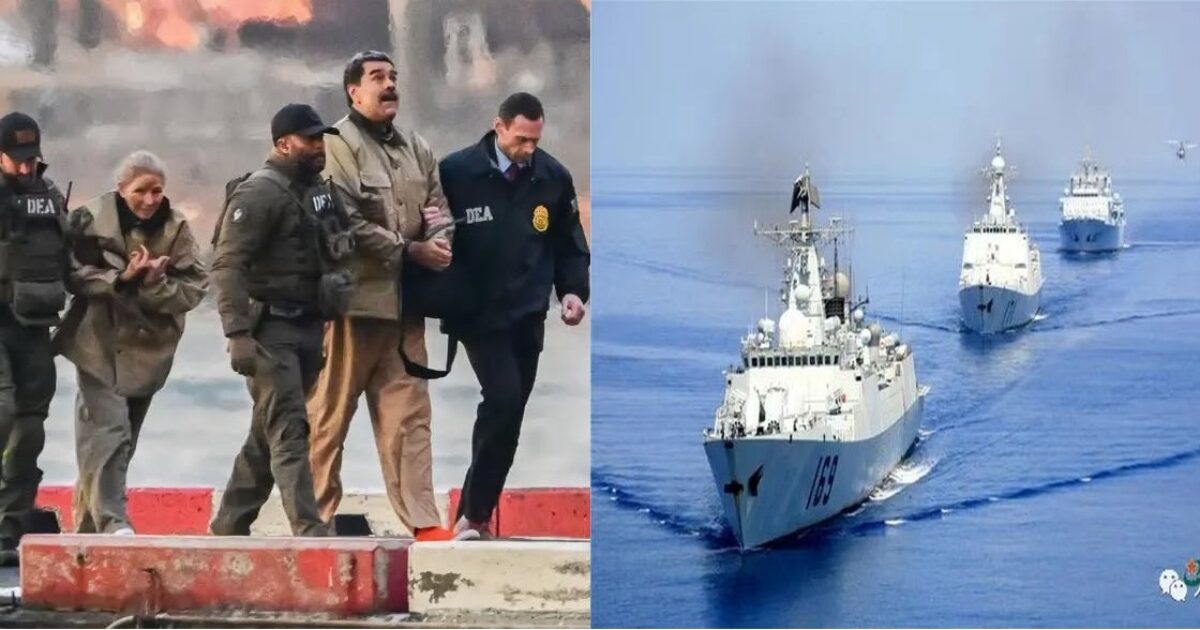
U.S. forces arrested Venezuelan President Nicolás Maduro. China has lodged a protest but is incapable of a military response. Image composite from People’s Liberation Army and Getty Images.
China’s response to the U.S. military operation in Venezuela, which resulted in the arrest of President Nicolás Maduro, exposed fundamental weaknesses in its ability to project power beyond its immediate region.
Beijing called the operation “deeply shocking” and a “serious violation of international law,” demanded Maduro’s immediate release, and attempted to position itself as a defender of the “rules-based international order.”
Xi Jinping condemned what he described as “unilateral bullying,” a thinly veiled reference to the operation.
China called for a United Nations Security Council meeting, which accomplished nothing. Beyond diplomatic statements, China did absolutely nothing.
China and Venezuela have long maintained strong economic and military ties, with China serving as Venezuela’s second-largest trading partner after the United States. V
Venezuela is one of China’s key so-called “all-weather” strategic partners in Latin America.
On January 2, Chinese diplomat Qiu Xiaoqi met with Maduro, reiterating that “China and Venezuela are long-standing strategic partners” and pledging to strengthen bilateral ties. Within 24 hours, the United States launched its operation and captured Maduro.
In Beijing’s defense, there is not much China can do, either economically or militarily. China is a major exporter to the United States.
Cutting off exports would only damage the Chinese economy while strengthening President Trump’s efforts to decouple the U.S. economy from China.
The media often claims that China is a major lender to the United States, but these reports usually refer to China’s purchases of U.S. debt instruments, such as Treasury securities and U.S. agency bonds, rather than direct loans.
These bonds are debt obligations with specific maturity dates in the future. Even if China were to dump them on the open market today, the United States would not have to repay the principal until those maturity dates arrive.
As a result, such a move would do little direct damage to the U.S. economy.
Furthermore, a sudden surge of bond sales would drive prices down, reducing the value of China’s own holdings.
At that point, the U.S. Treasury could step in and repurchase the bonds on the open market at a discount, which would actually benefit the United States.
From a military standpoint, China, despite being the world’s third most powerful military, lacks the ability to project power far from its shores. It has only two military bases outside of China, while the United States maintains roughly 800.
More importantly, China has no ability to project military power in Latin America. Beijing deployed a hospital ship and an intelligence vessel to the region in 2025, but when the United States acted, China was completely impotent.
China has generally been unwilling to risk sending warships into the Caribbean. The only exception was a limited deployment of three Chinese warships to Cuba in 2015, when they visited to commemorate the 55th anniversary of diplomatic relations and participate in a joint naval exercise with the Cuban Navy.
Venezuela’s Chinese-origin air defense system, including JYL-1 radars and other systems from China Electronics Technology Group, completely collapsed when confronted by U.S. electronic warfare and precision strikes.
The operation exposed that Chinese military hardware cannot operate effectively under intense interference and multidomain attacks from a sophisticated adversary.
U.S. forces entered Venezuela undetected and captured the president alive with no U.S. casualties. He was the most heavily guarded individual in the country.
Despite China having invested massively in Venezuela, with more than $50 billion in loans, roughly one-third of all Chinese lending to Latin America, extensive military equipment sales totaling about $615 million over the past decade, and Venezuela being a major oil producing country, this was still not enough reason for China to commit to military action.
President Trump snatching Maduro just hours after Maduro met with the Chinese foreign ministry shows that Trump has no regard for China. He is not threatened by China and will do what he believes is best for the U.S. even if China objects.
China’s lack of any substantive reaction should send a message to all of China’s allies that China is an unreliable partner and that its so-called “all-weather strategic partnership” with Venezuela, its iron brotherhood with Pakistan, and its no-limits partnership with Russia all have clear limits.
If these are the limits for China’s closest and most strategically important partners, how much more restrictive must those limits be for other global partners like Iran, and even more so for Latin American partners, which, while strategically consequential, have relatively low importance in China’s overall plans and strategy.
At this point, it remains likely, although unclear whether China would fight for Taiwan, but we already know China will not risk being dragged into a war for Russia and is steering clear of war when it comes to Iran. There is no reason to believe China would ever go to war for Venezuela.
The operation sent a clear message to Latin America that “there’s only one great power in the Americas.”
The Venezuela operation exposed China as exactly what critics have long claimed: strong rhetoric, economic investment, but fundamentally unable to back up its diplomatic positions with actual hard power when challenged by the United States.
The post Did the US Snatching Maduro Prove China Is a Paper Tiger? appeared first on The Gateway Pundit.