
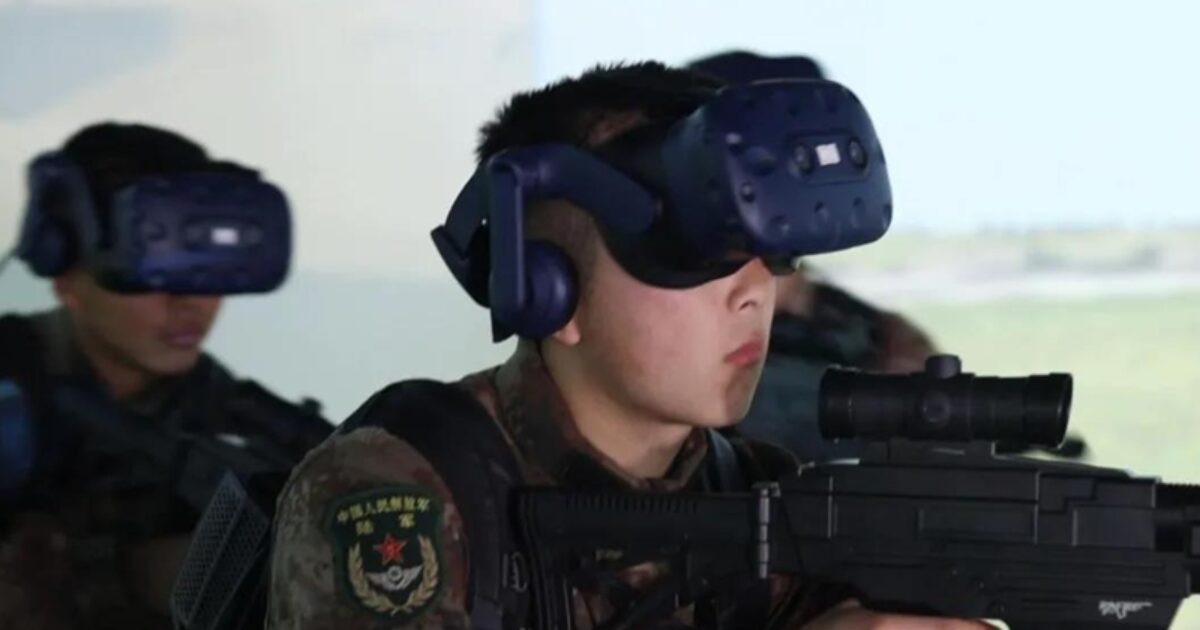
Soldiers in a brigade attached to the 83rd Group Army of the Chinese People’s Liberation Army conduct virtual reality exercises. Photo: Screenshot from China Central Television
Soldiers in a brigade attached to the 83rd Group Army of the Chinese People’s Liberation Army conduct virtual reality exercises. Photo: Screenshot from China Central Television
According to a congressional report, the People’s Liberation Army continues to exploit military-civil fusion to integrate commercial and academic research into military systems. Military-Civil Fusion is China’s national strategy to merge civilian technology, research institutions, and industry with the defense sector in order to build a world-class military.
The strategy aligns commercial innovation with military requirements across fields ranging from artificial intelligence to semiconductors, pooling state and private resources to accelerate military development. Chinese authorities describe military-civil fusion as a core component of comprehensive national power and a central driver of long-term military modernization.
Through state laboratories, funding programs, conferences, and industrial parks, China has ensured sustained private-sector participation in this effort. As a result, it has made significant advances in artificial intelligence and large language models that underpin many emerging PLA technologies. AI reasoning systems support cyber operations, command decision-making, and influence campaigns, while also enabling autonomous and unmanned platforms, drone swarms, and loyal wingman UAVs.
These capabilities increasingly intersect with developments in quantum computing, quantum sensing, and quantum communications, which China has identified as priorities for national security and future warfare.
Chinese leader Xi Jinping has described quantum technologies as drivers of industrial transformation, and Beijing is investing in post-quantum cryptography, military applications of quantum sensing, and ground- and space-based infrastructure for a global quantum communications network with both civilian and military uses.
Quantum communications support nuclear command, control, and communications by enabling hardened and interception-resistant links, while quantum sensing has potential applications in anti-submarine warfare by enabling detection methods that do not rely on active sonar.
Semiconductor self-sufficiency remains a parallel strategic objective. In 2024, firms including Semiconductor Manufacturing International Corp and Huawei Technologies received substantial local government funding to accelerate chip indigenization. Although China continues to lag the West in the most advanced GPUs, it is pursuing alternative pathways through nontraditional microchip technologies, including photonic components developed by state research institutes.
Domestic chip production underpins military resilience by enabling continued weapons manufacturing under sanctions and securing supply chains for missiles, drones, and radar systems. Alternative chip architectures support AI processing and reduce reliance on advanced Western GPUs, sustaining production capacity during conflict.
Beyond artificial intelligence, China is advancing biotechnology through PLA-linked medical institutions that function as hubs for dual-use research. Key areas include synthetic biology, brain-computer interfaces, human performance enhancement, biomimetic robotics, and human-machine collaboration. Taken together, these efforts reflect a coordinated approach to integrating emerging civilian technologies into military systems under centralized institutional control.
Brain-computer interfaces have entered expanded clinical trials, bringing them closer to practical use, while PLA-linked institutions increasingly partner with industry on military-relevant applications. BCIs could enable neural control of weapons platforms, drones, and other equipment, bypassing physical input devices.
BCIs also affect command-and-control systems. When integrated into command posts, they enable faster decision-making, AI-assisted targeting, and reduced latency in missile launch authorization chains, altering decision cycles and escalation timelines during high-pressure scenarios. Additional applications include neural-controlled prosthetics for wounded soldiers and communications systems that are less vulnerable to conventional interception.
Human performance enhancement research focuses on improving physical endurance and cognitive capacity in soldiers. Military applications include extended endurance for special operations forces, more reliable decision-making under combat stress, increased resistance to fatigue, pain, and psychological trauma, and accelerated training for complex military tasks.
These capabilities are most relevant to PLA special operations brigades, Taiwan contingency forces, internal security units, and strategic forces such as Rocket Force missile crews, nuclear command personnel, and early-warning and space operations teams, where sustained alertness is required.
Synthetic biology research has implications for both coercive tools and force protection. Dual-use research enables population-specific biological agents, incapacitating agents for military or internal use, and engineered pathogens designed to disrupt logistics. At the same time, synthetic biology supports rapid vaccine development, biological detection systems, and biological materials relevant to logistics and force protection, affecting attribution, survivability, and sustainment during prolonged conflict.
Biomimetic robotics research centers on systems modeled on insects or animals for surveillance and reconnaissance. Platforms include insect-like drones, animal-inspired ground sensors, and systems designed for urban or maritime infiltration. Biomimetic movement also supports swarm-based systems, including distributed attack platforms and attritable systems that interact with naval and air defense environments.
Human-machine collaboration research integrates human cognition with AI-enabled systems. Military applications include swarm control that allows a single operator to manage multiple autonomous platforms, improved situational awareness through AI-assisted cognition, and cybersecurity uses such as neural monitoring to detect insider threats.
These capabilities support swarm warfare and anti-access and area-denial operations by improving anti-ship missile targeting, coordinated drone and missile attacks, and real-time adaptation during engagements, affecting naval operations and response timelines.
Human-machine teaming is also central to unmanned and autonomous systems, including drone swarms across air, maritime, and undersea domains, loyal wingman UAVs paired with PLA Air Force fighters, and autonomous ground vehicles for urban and mountainous environments.
Together, these systems shorten human-to-machine command loops, enable multi-platform control by a single operator, and reduce reliance on radio or datalink signals, complicating electronic warfare and interception.
The U.S. military is also developing autonomous and AI-driven weapons, suggesting the battlefield of the near future will differ sharply from anything previously experienced. It remains unclear whether the U.S. military’s advantage in real-world combat experience will translate fully to a form of warfare defined by autonomy, speed, and machine-driven decision-making rather than human judgment shaped by past conflicts.
Regardless, slowing China’s technological advancement remains critical. This includes restricting access to advanced chips, safeguarding sensitive technologies from Chinese espionage, and weakening the economic base that supports military modernization. Targeted tariffs and trade restrictions remain one tool for constraining China’s ability to fund and scale these emerging capabilities.
The post China’s Military AI and Biotechnology Directed at the United States appeared first on The Gateway Pundit.