
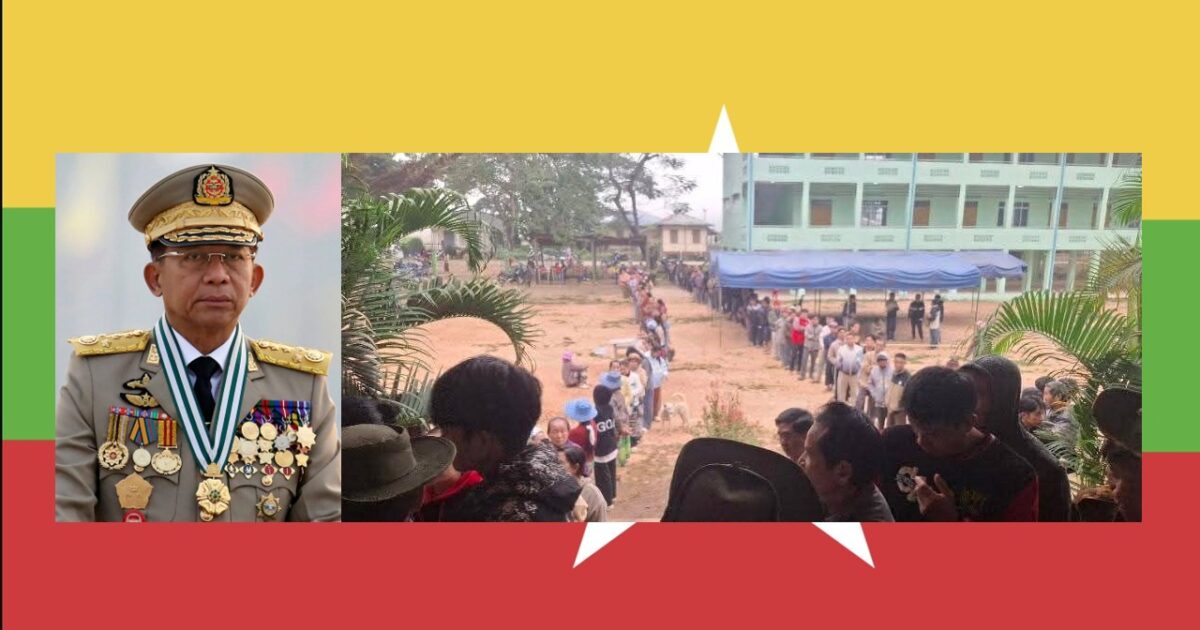
The junta ruling Burma (Myanmar) has allowed its first post-coup election but banned the participation of pro-democracy and opposition parties and barred much of the population from taking part.
The Burma (Myanmar) election leaves observers asking whether it can truly be called a legitimate election when opposition parties and much of the population are prohibited from participating.
Burma’s military junta held the first round of its 2025 election on December 28, marking the first vote since overthrowing the country’s democratically elected government in 2021. Participation was sharply limited, with only about one-third of eligible voters casting ballots. Voting took place only in areas under military control, effectively disenfranchising large segments of the population living in conflict zones that comprise roughly 70 percent of the country’s territory.
As voting began, the Union Election Commission announced that nine additional townships had been added to the list where voting could not take place due to ongoing armed conflict. The newly excluded areas included three townships in Chin State, two in Sagaing Division, and four in Rakhine State, bringing the total number of townships entirely excluded from elections to 65, up from 56.
The UEC also confirmed that Phases 1 and 2 could not be held in 51 village tracts in Karenni State, and that Phase 3 elections scheduled for January 25 would not take place in 10 village tracts in Pekhon Township. In total, 134 townships are now affected either fully or partially, setting a record for the highest number of areas where elections could not be conducted in Burma’s history.
The election is being held in three phases across 265 of 330 townships, with the second round on January 11 and third round on January 25. Final results are expected to be announced by the end of January 2026.
One Yangon polling station recorded turnout of just under 37 percent, well below participation levels in the 2020 election won by Aung San Suu Kyi’s National League for Democracy. In Karenni State and other areas controlled by revolutionary forces, residents rejected the process, saying the election is neither free nor fair and excludes large portions of the population displaced by war.
Local residents questioned how voting could occur in places like Hpruso Township, where most civilians have fled, calling any announced results fraudulent. While Hpruso did not vote in Phase 1 on December 28, the Union Election Commission has scheduled both Hpruso and Demoso townships in Kayah State to participate in Phase 2 on January 11, 2026, despite ongoing displacement and insecurity.
Six parties, led by the military-backed Union Solidarity and Development Party, are contesting nationwide, while around 40 parties, including Aung San Suu Kyi’s National League for Democracy, remain banned. The pro-military USDP is widely expected to emerge as the largest party, with Senior General Min Aung Hlaing expected to assume the presidency.
Major political parties have been dissolved, opposition leaders jailed or exiled, and as much as half the country is excluded from voting due to the ongoing civil war. More than 3.6 million people have been displaced and tens of thousands killed since the coup. The war has devastated the economy and deepened a humanitarian crisis worsened by a major earthquake and aid cuts.
The vote drew strong international criticism. U.N. human rights rapporteur Tom Andrews condemned the process as “theater of the absurd performed at gunpoint,” citing continued airstrikes on civilians, mass arrests of political leaders, and the criminalization of dissent. Western governments rejected the election’s legitimacy.
Leading up to the election, the junta charged more than 200 people under a new law criminalizing opposition to the polls, with penalties that can include the death sentence. The election law, passed in July, imposes sentences ranging from three years in prison to life imprisonment or death for criticizing the vote and has been used to charge at least 229 people, including artists, activists, and civilians accused of online dissent.
By November, nearly 100 people had been detained under the election protection law, a figure that more than doubled by late December, including individuals charged for social media posts criticizing the election or for merely “liking” someone else’s post.
In Yangon’s Hlaingthaya Township, three youths were sentenced to between 42 and 49 years in prison for hanging anti-election posters. Film director Mike Tee, actor Kyaw Win Htut, and comedian Ohn Daing were each sentenced to seven years in prison for undermining public trust after criticizing a pro-election propaganda film.
Significant violence occurred in the lead-up to the election. The self-declared “Yangon Army” bombed local administration offices in Hlegu and North Okkalapa on November 18-19, injuring several election staff and vowing to continue attacking election organizers.
Amnesty International documented a deadly manned paraglider bombing at a festival in central Myanmar where people had gathered to demonstrate against the election, killing civilians including children after motorized paragliders dropped mortars into the crowd. On December 10, the military bombed a hospital held by the Arakan Army in Rakhine State’s Mrauk-U township, killing more than 30 people.
Election day itself was relatively calm in areas where voting occurred, though opposition organizations and armed resistance groups had vowed to disrupt the electoral process. Armed guards were stationed outside polling stations and military trucks patrolled the roads, with security visibly stiffened and stations cordoned off overnight. Reports of explosions, rocket attacks, air strikes, and civilian casualties accompanied voting day across multiple regions. Myanmar now ranks third in the world for drone strikes and casualties behind only Ukraine and Russia, with air and drone attacks by the military increasing roughly 30 percent this year, recording 2,602 air attacks that killed 1,971 people.
The junta has paired legal repression with intensified military violence, including rising air strikes in resistance controlled areas where it is attempting to assert control to hold voting. Amnesty documented attacks on civilians, hospitals, and public gatherings. At least 56 of Burma’s 330 townships are under martial law.
Major pro-democracy and ethnic armed groups rejected the election months before it occurred. The National Unity Government issued a statement declaring that the military has neither the authority nor legitimacy to organize elections, noting the Committee Representing Pyidaungsu Hluttaw abolished the 2008 Constitution on March 30, 2021, and the results of the 2020 general election remain valid. On January 29, 2023, the NUG declared that individuals cooperating with the election would be deemed “accomplices of high treason.”
The Karen National Union issued a statement on August 26, 2025, calling the upcoming election a “sham” designed to select individuals and parties serving the interests of the Myanmar Tatmadaw. KNU spokesperson Padoh Saw Taw Nee stated the so-called election was nothing more than a vote to serve the military and its allied parties, urging the Karen public, armed organizations, and political parties to resist peacefully through non-violent means.
The KNU’s Nyaunglebin District and Brigade 3 issued a warning on September 11 that anyone supporting the junta’s election would be considered as giving the regime an “official license to kill,” and stated they would monitor and take action under Kawthoolei law if necessary. Twenty-five Karen civil society groups led by the KNU released a statement condemning the regime’s elections and requesting the international community not recognize the results.
The Karenni Nationalities Defense Force chairman Khun Bedu stated the regime’s talk of elections and ceasefires was unacceptable, saying that behind this, the generals aim to maintain power and reestablish centralized authority, and warned that if we are united militarily and politically, the regime will not be able to hold elections or fight back. The KNDF rejected the junta’s election and stated they will not recognize the results.
Major ethnic armed organizations including the Chin National Front, Karenni National Progressive Party, Kachin Independence Organisation, and Ta’ang National Liberation Army criticized the planned election. The Arakan Army, which controls 90 percent of Rakhine State, also rejected the junta’s election and stated they will not recognize the results.
Amnesty International urged the international community to reject the election’s legitimacy and focus on accountability for ongoing abuses, including suspending jet fuel shipments that enable air strikes and pursuing international justice.
The organization called on the International Criminal Court to advance arrest warrants against junta leader Min Aung Hlaing and other officials, warning that the election is an attempt to entrench military rule through the ballot box after nearly five years of war.
The elections in 2015, and particularly in 2020, when people were able to vote for the pro-democracy party, were among the most hopeful moments in the long and painful story of Burma’s struggle for freedom, which has been going for nearly 80 years. Unfortunately, this year’s election offered no such hope. Freedom and a federal democratic system remain far off, perhaps even further away once the junta claims victory in its manufactured election.
The post Burma Election Phase 1: No Hope for Federal Democracy With Opposition Banned appeared first on The Gateway Pundit.