
Paingpeace, CC BY-SA 4.0 <https://creativecommons.org/licenses/by-sa/4.0>, via Wikimedia Commons
Four years after the Myanmar military seized power in a February 2021 coup, overthrowing the democratically elected government of Aung San Suu Kyi, the junta is staging a sham election on December 28, 2025. The coup sparked nationwide resistance that evolved into armed conflict, with the military battling both the People’s Defense Force (PDF), a grassroots civilian resistance movement, and numerous ethnic armed organizations that have fought for autonomy for decades.
The country remains engulfed in civil war, with millions displaced, approximately 80% of the country controlled by resistance forces, and no resolution in sight to the conflict that has claimed thousands of lives.
Major opposition parties, including Aung San Suu Kyi’s National League for Democracy (NLD) and key ethnic political organizations like the Shan Nationalities League for Democracy (SNLD), have refused to participate, calling the election illegitimate.
aith legitimate leaders imprisoned or in exile and millions of citizens displaced, in hiding from military conscription, or living under threat of violence, the conditions for a free and fair election don’t exist. The military’s Union Solidarity and Development Party (USDP) is widely expected to claim victory in an electoral process designed to provide a veneer of legitimacy to continued military rule rather than reflect the will of the people.
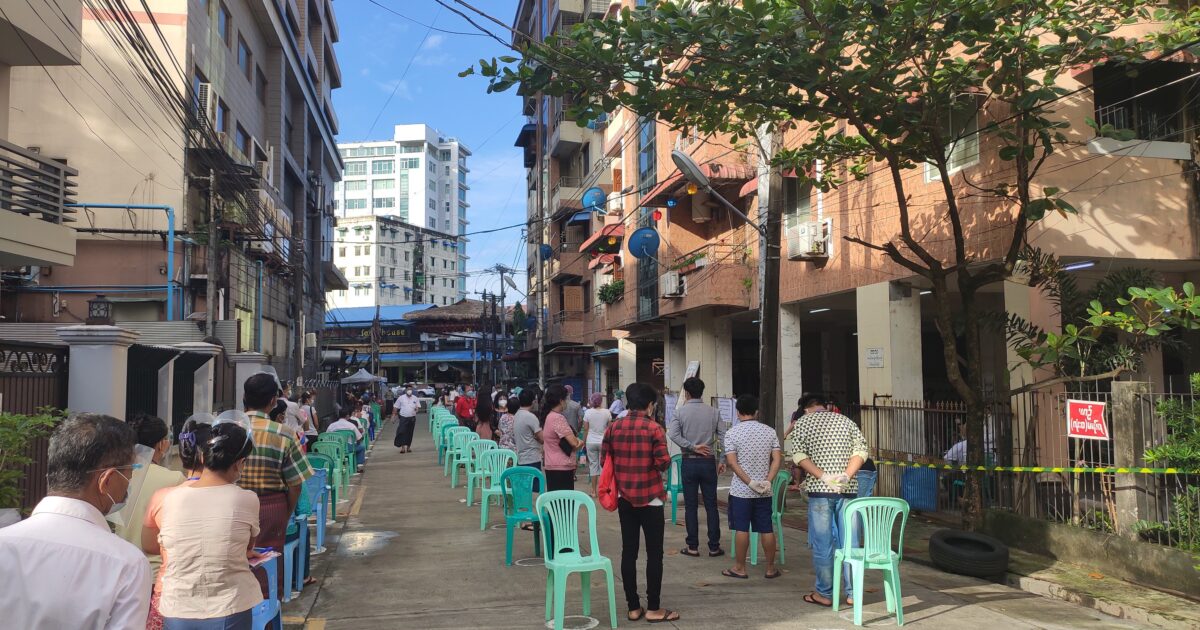
Much of the civilian population, particularly in ethnic minority areas, lacked passports or national ID cards prior to the coup. But to inflate participation numbers, the junta’s government is aggressively expanding ID card issuance.
In November 2025, authorities in eastern Shan State, particularly in Tachileik near the Mae Sai border in Thailand, opened registration for people who had lost their national identification cards or never possessed one. Students who had reached 18 years of age were also required to obtain a national ID.
According to Pa Oo, a 59-year-old Shan woman, this initiative is an attempt by the military junta to expand the pool of voters likely to support them in the December 25, 2025 general election.
“The junta government permits illegal activities to keep young people distracted from political movements, making it easier for authorities to exert control over the population,” Pa Oo explained.
She observed that gambling venues, drug dens, and KTV establishments operate openly with China-linked transnational crime organizations and militia groups. This environment has fueled a rise in drug addiction among young people, leading to multiple cases of overdose-related deaths. Many young women struggling with addiction are pushed into sex work simply to sustain their drug dependence.
Chinese scam syndicates, protected by armed groups, have become deeply embedded in local communities. These operations attract young people with high-paying offers, and many young women are drawn or coerced into sex work within these networks.
While ordinary families face increasing hardship, militia groups and transnational crime networks continue to wield power and enjoy economic gains.
Major political parties, including the National League for Democracy (NLD) led by Daw Aung San Suu Kyi and the Shan Nationalities League for Democracy (SNLD), have decided not to participate. Many citizens view the upcoming election as illegitimate, asserting that the military junta intends to use it to consolidate power.
Representatives of pro-democracy parties, NGO workers, cross-border aid organizations, and activists assisting internally displaced persons (IDPs) all share the view that the upcoming election is unfair. They emphasize that the country’s internal conflicts, including ongoing armed clashes and the unresolved plight of IDPs, remain unaddressed.
At present, at least 3.6 million people remain internally displaced and cut off from international assistance. In the absence of foreign peacekeepers or international observers, IDPs remain vulnerable to junta airstrikes, attacks, and abuses. Holding an election under such conditions raises serious concerns about how citizens in conflict zones can meaningfully exercise their right to vote.
Nang Kham Ing, a medical service worker, explained the political landscape:
Myanmar’s political landscape divides along clear lines. At the national level, the National League for Democracy (NLD), Aung San Suu Kyi’s party that won landslide victories in 2015 and 2020, represents the pro-democracy movement. Opposing it is the Union Solidarity and Development Party (USDP), which is essentially the military’s political vehicle, created and controlled by the junta to maintain a façade of civilian governance.
This same dynamic plays out among ethnic minority parties. Nang Kham Ing, a medical service worker, explained the political alignment: “In Myanmar, there are two main parties—the NLD and the USDP. The NLD is pro-democracy, while the USDP supports the military junta. Among ethnic parties, especially the Shan, there are two main groups, the SNLD and the SNDP. The SNLD aligns with the NLD, and the SNDP is close to the USDP. The NLD and SNLD are not involved in this election, but the SNDP is participating.”
In Shan State, Myanmar’s largest state by area, the Shan Nationalities League for Democracy (SNLD) has historically mirrored the NLD’s pro-democracy stance, while the Shan Nationalities Democratic Party (SNDP) maintains ties to the military-backed USDP. The boycott by both the NLD and SNLD means the only parties participating in the December 28 election are those willing to operate within the junta’s framework, parties like the SNDP that pose no genuine challenge to military rule. It’s an election featuring only candidates acceptable to the regime.
Despite widespread recognition that the election is rigged, some candidates are participating anyway.
Sai Sur Han, a candidate applicant from the Shan Nationalities Democratic Party (SNDP), told me: “I know this is an unfair election, but there is no choice. Doing something is better than doing nothing. If I win in my area, at least I can help the villagers in my hometown.”
Meanwhile, Sai Loi Kham, a member of the Shan Nationalities League for Democracy (SNLD), was dismissive: “I’m not interested in this election, and I have no comment about it.”
From across the border in Thailand, Sai Si Ha, a Shan migrant worker, expressed what many believe: “I know the military junta’s party, the USDP, will win for sure because all the parties running in the election are pro-USDP. Once the military party wins, they will continue fighting against the People’s Defense Force (PDF) and other ethnic armed groups, claiming these organizations are terrorists.”
Pa Oo noted that it is widely acknowledged the upcoming election will not be free or fair. Nevertheless, many believe that limited participation is better than complete silence. It is broadly expected that the junta-backed Union Solidarity and Development Party (USDP) will secure victory.
“If the USDP remains in power, smaller political parties and ethnic organizations will be compelled to operate under its influence and directives,” Pa Oo remarked. “Some ethnic parties may win in their own regions, but none will have national-level influence.”
The absurdity of the election is underscored by the reality on the ground: potential voters are either dodging landmines in Shan State villages, fleeing conscription in Thailand, or too terrified of militia reprisals to participate in any political process.
The military junta is preparing for an election, but the people of Myanmar, scattered across borders, trapped in conflict zones, or silenced by fear, will have no meaningful voice in the outcome.
Given President Trump’s recent overtures to the Syrian interim government, which seized power in a coup, the people of Burma fear that the Trump administration and other Western governments may legitimize the election results or normalize relations with the military junta. Many are holding out hope that America or the West will meaningfully intervene in their struggle for a genuine federal democracy. For now, the resistance continues to fight a David-and-Goliath battle against the junta’s army, which has a seemingly unlimited supply of cash, weapons, and munitions from China and Russia.
The post Myanmar Junta Prepares for Predetermined Election Victory appeared first on The Gateway Pundit.