
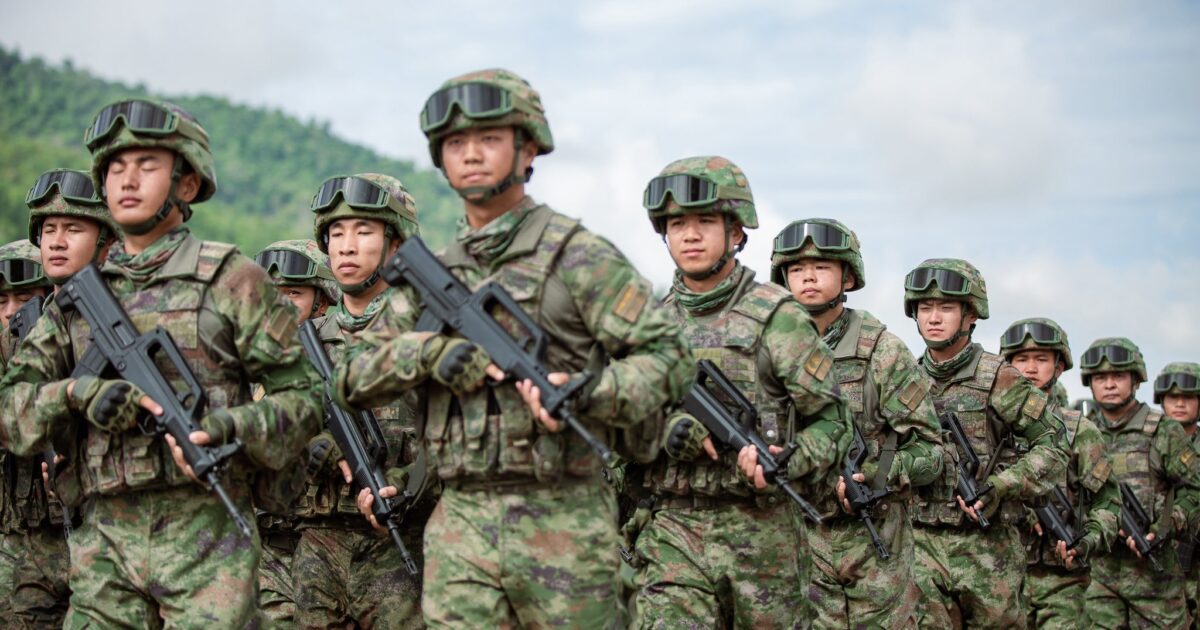
Royal Cambodian Army. Photo courtesy of Prime Minister Hun Manet via Facebook.
Fighting has erupted again along the Thailand–Cambodia border, collapsing a ceasefire brokered in July with involvement from President Donald Trump and Malaysia. Both sides accuse the other of firing first. Thailand launched F-16 airstrikes after reporting the death of a Thai soldier in cross-border fire, while Cambodia reported civilian casualties from Thai attacks.
The dispute traces back to unresolved colonial-era borders, particularly around contested temple sites such as Preah Vihear. A 1962 International Court of Justice ruling placed the temple under Cambodian sovereignty but left surrounding territory undefined, a gap that has fueled repeated military clashes.
The issue re-emerged forcefully in 2008 after Cambodia sought UNESCO recognition for the site, triggering nationalist backlash and renewed clashes. A later ICJ clarification reaffirmed Cambodia’s claim to the temple while failing to settle adjacent land disputes, allowing tensions to persist.
The current crisis began on May 28, 2025, when a Cambodian soldier was killed near Preah Vihear. Tensions escalated into full-scale fighting on July 24 after a Thai soldier was seriously injured by a landmine. Cambodia fired BM-21 rockets into Thai residential areas, including near a hospital and gas station.
Thailand responded with F-16 airstrikes, its first combat use of airpower since the Thai–Laotian border war. That round of fighting left 48 people dead and displaced roughly 300,000 civilians. A ceasefire was brokered on July 28 under Malaysian mediation with pressure from President Trump and was formalized in October at a Kuala Lumpur ceremony attended by Trump.
The truce quickly unraveled. In mid-November, four Thai soldiers were injured by a landmine explosion in Sisaket Province. Thailand suspended implementation of the accord, presenting evidence that the mines were newly laid, while Cambodia denied responsibility. Gunfire followed near Nong Ya Kaeo, killing at least one Cambodian civilian.
By December 8, full-scale fighting had resumed across at least a dozen border sites. On December 10, the Royal Thai Army launched Operation Sattawat, seizing several localities inside northern Cambodia and claiming to have destroyed most Cambodian positions near the Three House casino complex.
By late December, Thai airstrikes were reportedly reaching up to 80 kilometers from the border. At least 41 people were killed in December alone, with hundreds more wounded. Thailand claims heavy Cambodian military losses, while more than 900,000 civilians have been displaced on both sides. Cambodia closed border crossings, detained thousands of Thai citizens at Poipet, and schools and hospitals were evacuated across affected regions.
The fighting has destabilized domestic politics in both countries. In Thailand, Prime Minister Paetongtarn Shinawatra was removed from office after a leaked June 2025 phone call with former Cambodian prime minister Hun Sen during active border clashes. In the call, she referred to the Thai military as “the opposite side,” urged Hun Sen to disregard criticism from a Thai regional army commander, and said that if he “wanted anything,” she would “take care of it.”
The remarks sparked outrage in Thailand, where the military wields enormous political influence and nationalist sentiment was high amid the fighting. Paetongtarn’s use of the term “uncle,” a customary but informal address she later said she used privately with Hun Sen, further fueled perceptions that she was too close to Cambodian interests. She defended the call as an off-the-record attempt to calm tensions and preserve peace.
Thailand’s Constitutional Court suspended Paetongtarn in July and formally removed her in August, ruling that she lacked the qualifications required under the constitution.
Her removal paved the way for Anutin Charnvirakul, a pro-military construction tycoon, to take office and expand the armed forces’ autonomy and budget. In Cambodia, Hun Sen, now Senate president, personally orchestrated the leak, underscoring his continued dominance despite formally handing power to his son, Hun Manet, in 2023.
Militarily, Thailand has demonstrated clear superiority, deploying F-16 fighters, heavy artillery, cluster munitions, modern air defenses including the Israeli Barak MX system, and naval interdiction in the Gulf of Thailand to cut fuel and supplies.
Cambodia is fighting defensively with Chinese-supplied rocket systems and aging Soviet-era equipment. The conflict has collapsed roughly $4.7 billion in annual cross-border trade, disrupted tourism, and complicated energy development in the Gulf of Thailand’s overlapping claims area.
ASEAN has played little effective role, constrained by its non-interference principle despite the conflict involving two member states. President Trump has repeatedly called on both sides to honor the ceasefire he helped broker, but recent mediation efforts have failed, with Thailand publicly rejecting ceasefire claims in mid-December. China has attempted to position itself as a mediator, motivated by deep economic ties to both countries, even as it supplies weapons to each.
U.S. embassies have issued repeated travel warnings, and UN officials have raised concerns over civilian casualties from airstrikes and artillery in populated areas. Despite renewed calls for restraint, the situation remains volatile, and prospects for de-escalation remain uncertain.
The post The Thai–Cambodia Border Conflict President Trump Sought to End appeared first on The Gateway Pundit.