
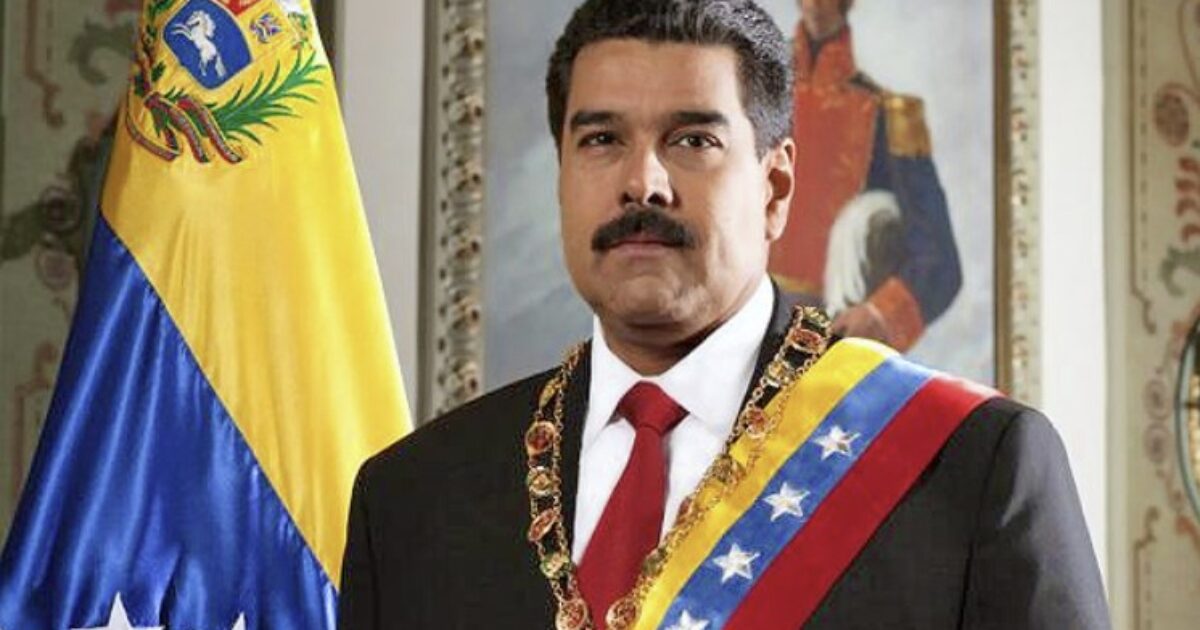
President of the Bolivarian Republic of Venezuela, Nicolás Maduro Moros. Photo courtesy of the Jamaican Information Service.
President Trump has ordered a total blockade of oil tankers entering or leaving Venezuela and formally designated the Nicolás Maduro regime as a Foreign Terrorist Organization, accusing it of using oil revenues and seized U.S. assets to finance terrorism, drug trafficking, human trafficking, and other criminal activity.
Trump warned that pressure will continue until oil, land, and other assets allegedly taken from the United States are returned.
The administration’s justification rests heavily on the claim that Venezuela stole U.S. oil assets, framing the blockade and tanker seizures as asset recovery rather than coercion.
That claim traces back to Venezuela’s nationalization of foreign oil holdings, which occurred in two distinct phases.
In 1976, under President Carlos Andrés Pérez, Venezuela nationalized its entire oil industry and created PDVSA.
Foreign firms such as Standard Oil, Shell, and Mobil were replaced by state entities, a move broadly accepted under international law’s principle of permanent sovereignty over natural resources.
The second and more controversial wave occurred in 2007 under Hugo Chávez.
This effort targeted foreign participation in heavy oil projects in the Orinoco Belt. Chávez demanded that companies convert their holdings into joint ventures with PDVSA holding at least 60 percent control. Firms that refused were expropriated.
ConocoPhillips lost stakes in the Petrozuata and Hamaca heavy crude upgrading projects and the Corocoro offshore project, part of roughly $30 billion in foreign investment in the Orinoco Belt. ExxonMobil lost similar holdings.
Both companies rejected the new terms and pursued international arbitration. Other firms, including Chevron, Total, Statoil, and BP, accepted minority positions and continued operating.
International arbitration rulings overwhelmingly favored the expropriated companies.
In 2019, an ICSID tribunal awarded ConocoPhillips $8.7 billion. With accumulated interest, the award now exceeds $11 billion.
A separate ICC ruling in 2018 added another $2 billion. In January 2025, Venezuela attempted to annul the ICSID ruling, but the tribunal rejected the appeal and ordered additional legal fees and court costs. Total liability to ConocoPhillips now exceeds $13 billion.
ExxonMobil received a $1.6 billion ICSID award in 2014. PDVSA paid only $255 million in 2012, roughly 16 percent of the total, and enforcement efforts continue.
Other companies, including Total and Statoil, negotiated settlements of roughly $1 billion combined, while mining and energy firms such as Crystallex, Gold Reserve, and Williams Companies still hold unpaid awards.
Conservatively, Venezuela owes more than $20 billion in outstanding arbitration judgments, with ConocoPhillips representing more than half.
These cases were adjudicated under the International Centre for Settlement of Investment Disputes, part of the World Bank, and based on bilateral investment treaties requiring prompt, adequate, and effective compensation for expropriation.
Although Venezuela withdrew from ICSID in 2012, it remains liable for cases filed before withdrawal.
Tribunals ruled that the 2007 expropriations violated international law because compensation was far below market value, negotiations were coerced, and takings were discriminatory against firms that refused new terms.
Enforcement efforts have intensified. ConocoPhillips is pursuing global asset seizures, including Delaware court proceedings targeting Citgo shares, Venezuela’s most valuable U.S. asset, estimated to be worth between $8 and $13 billion.
Citgo is slated for auction to satisfy creditor claims totaling $21.3 billion.
Internationally, ConocoPhillips has secured favorable rulings in Caribbean jurisdictions, including a May 2024 decision in Trinidad and Tobago allowing potential seizure of proceeds from Venezuelan gas projects.
PDVSA assets, oil tankers, and offshore platforms are being targeted worldwide.
OFAC has authorized ConocoPhillips to pursue enforcement globally, including freezing Venezuelan government accounts, seizing Venezuelan-flagged vessels, and blocking oil shipment revenues. These actions align with standard civil enforcement mechanisms, though their scale is unprecedented.
The Trump administration’s legal position blends several distinct issues. The arbitration awards against Venezuela are legitimate, binding, and enforceable under international law. At the same time, administration rhetoric has expanded beyond compensation for expropriation.
Stephen Miller’s claim that American “sweat, ingenuity, and toil” created Venezuela’s oil industry implies U.S. ownership of the oil itself, a position not supported by international law.
Venezuela owes compensation for lost investment value, not ownership of its oil reserves. Sovereignty over natural resources remains legally Venezuelan.
What is unprecedented is the use of unpaid civil arbitration awards to justify measures resembling economic warfare, including blockades and tanker seizures backed by military force.
Venezuela argues that nationalization is a sovereign right, that compensation was offered, and that ICSID tribunals are biased toward Western corporations.
While international law recognizes the right to nationalize, it also requires prompt, adequate, and effective compensation, a standard tribunals found Venezuela failed to meet.
Apart from the partial ExxonMobil payment, Venezuela remains in default on ICSID awards. Civil asset seizures through courts are standard enforcement tools. A naval blockade as an enforcement mechanism, however, is legally novel and highly questionable.
The administration’s framing collapses three separate issues into one narrative: real unpaid debts exceeding $13 billion to U.S. companies, Venezuela’s legitimate sovereignty over its oil resources, and a historical grievance suggesting U.S. ownership based on past development.
The result is a significant expansion of how arbitration awards are enforced, shifting from civil remedies to military-economic coercion against a sovereign state.
The endgame remains unclear. “Return of assets” is an imprecise standard. It is not clear whether this means payment of arbitration awards, broader compensation, regime change, or something else entirely. It is also unclear how the administration intends to account for assets already sold or consumed.
The post President Trump’s Venezuela Asset Claims Explained: $20 Billion in Unpaid Arbitration Awards appeared first on The Gateway Pundit.