
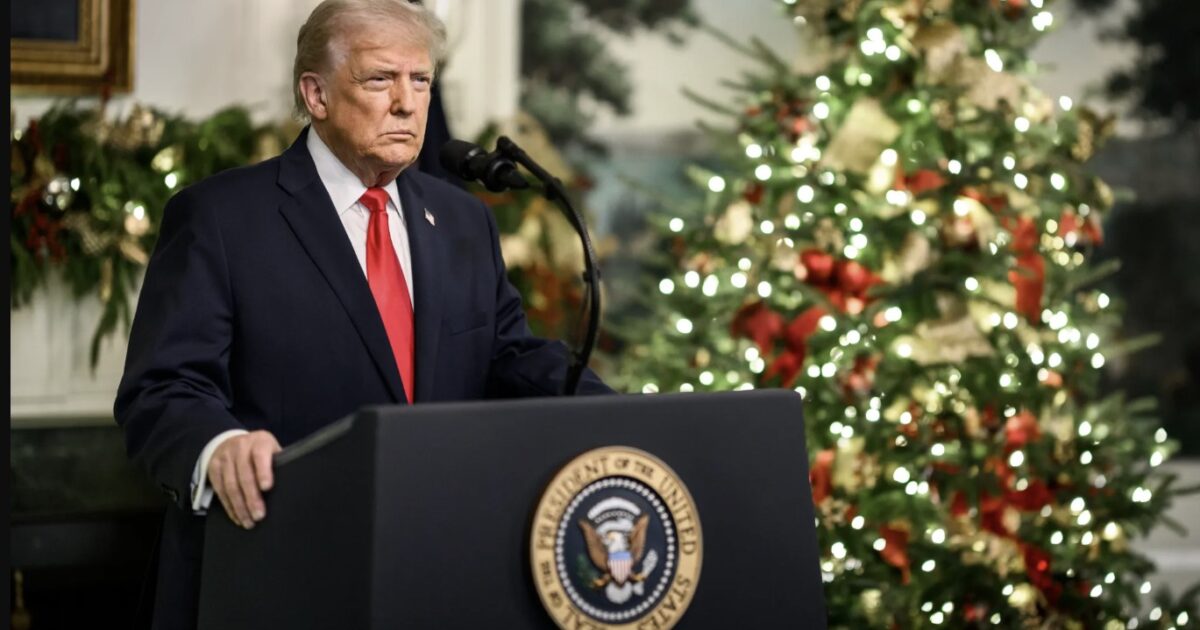
President Trump addresses the nation on December 17. Photo courtesy of the White House.
On December 17, 2025, from the White House’s Diplomatic Reception Room, President Trump delivered what was widely reported as a year-end address to the nation, highlighting his first year’s record and outlining priorities moving into 2026. Foreign policy and other achievements will be covered in separate articles. However, what most Americans care about is the economy. Overall, conditions are much better than they were a year ago, and there is hope that this improvement will continue.
President Trump began by pointing out that he had inherited a seriously mismanaged economy from President Biden, but he said he is fixing it. Among his most irrefutable successes is border security, with illegal immigration down to the lowest numbers in history. For the past seven months, U.S. Border Patrol has released zero illegal aliens into the United States, with more than two million illegal aliens either self-deporting or being deported by ICE.
Immigration enforcement ties into the economy in several ways. First, the estimated 20 million illegal aliens increased demand for housing, which drove up prices for both rentals and home purchases. Liberals argue that most Americans are unaffected because they do not want to live in the same apartments illegal aliens choose, but this logic is flawed. Increased demand at the bottom of the market pushes prices upward throughout the entire housing market.
Illegal immigration is also suppressing wages. When illegal aliens are removed from the labor pool, employers are forced to offer higher wages to attract legal workers. In addition, employers and legal employees must pay payroll taxes, including Social Security, which reduces the burden on everyone else. Illegal aliens were also receiving hundreds of billions of dollars in state and federal benefits, which will now stop. Taken together, these changes benefit working people over the medium and long term.
Inflation is lower now than at its Biden-era peak of 9 percent, with a cumulative increase of more than 21 percent during his administration. The latest reports show the Consumer Price Index down to 2.7 percent. The Federal Reserve typically targets an inflation rate of 2 percent and currently expects inflation to decline to 2.4 percent next year. By these measures, the economy is moving in the right direction. Food prices are already lower than they were during the Biden years, with Thanksgiving dinner this year estimated to have cost about 5 percent less than last year.
Gasoline reached $5 a gallon during the Biden administration. It is now under $3 nationally and as low as $2.49 in some areas. Real wages are up slightly and are growing faster than inflation.
President Trump claimed that the United States is the hottest economy in the world, and from a macroeconomic standpoint, the data supports that assertion. The stock market was up 16.45 percent year-to-date through November, reaching a record high. U.S. GDP growth is typically targeted at around 2 percent, but estimates for this year place growth at approximately 2.7 percent, a strong result for a large, mature economy. By comparison, many G7 nations reported little or no growth, or growth rates closer to 1 percent.
Manufacturing investment has also increased sharply. Annual construction spending reached $237 billion in October 2024, roughly triple January 2020 levels, marking a 30-year high for manufacturing’s share of total construction. Spending reached an annualized rate of $190 billion in April 2025, up from $90 billion in June 2022. Job creation tied to reshoring and foreign direct investment totaled 287,000 positions in 2023, an 11 percent increase over 2022, followed by 244,000 additional jobs in 2024.
Nearly two million manufacturing jobs have been brought back to the United States since 2010, with projections estimating 3.8 million new manufacturing job openings by 2033.
According to U.S. Customs and Border Protection, tariff collections reached record levels in 2025, totaling more than $200 billion between January 20 and December 15, a roughly 150 percent increase over fiscal year 2024’s $77 billion. During the same period, foreign direct investment into the United States reached record levels, with capital inflows from the Middle East, Europe, and East Asia.
From the Middle East, announced commitments exceeded $2.2 trillion over multiple years. The United Arab Emirates pledged approximately $1.4 trillion through 2035 for investments in artificial intelligence, semiconductors, manufacturing, energy, and aluminum, including a $100 billion MGX fund for AI data centers. Saudi Arabia announced $600 billion over four years, including a $142 billion defense deal, $80 billion in technology-sector investments from U.S. companies, and $20 billion for AI data centers. Qatar announced a $1.2 trillion economic framework that includes trade and investment components, a $96 billion Boeing aircraft deal, and $10 billion for upgrades to the Al Udeid Air Base.
East Asian commitments included a $550 billion package from Japan, consisting largely of loans and guarantees, with officials stating that 1 to 2 percent would be direct equity investment. Targeted sectors include semiconductors, shipbuilding, small modular reactors, AI infrastructure, and energy. South Korea announced $350 billion in commitments, including $150 billion for U.S. shipbuilding and $200 billion across energy, manufacturing, and technology. India announced a bilateral trade target of $500 billion by 2030 under its “Mission 500” initiative, reflecting total trade volume rather than direct investment.
The European Union projected approximately $600 billion in private investment through 2028, described as an aspirational estimate, as the European Commission does not have authority to compel private-sector investment.
The “One Big Beautiful Bill,” signed into law on July 4, 2025, included multiple tax provisions affecting working families. The Child Tax Credit increased to $2,200 per child for 2025 and was temporarily raised to $2,500 from 2025 through 2028, with inflation indexing thereafter. Eligibility requires a Social Security number. The bill also permanently increased the standard deduction to $31,500 for married couples, $16,000 for single filers, and $24,000 for heads of household.
The legislation eliminated federal income taxes on tip income and overtime pay, created a deduction for interest on auto loans for American-made vehicles, and provided seniors with an additional $6,000 tax break. Parents may open tax-advantaged savings accounts for children under age eight, with a $1,000 federal contribution for children born between 2025 and 2028. The state and local tax deduction cap was also increased above the prior $10,000 limit.
Congressional estimates show an average tax reduction of $1,300 for working families, with a typical family of four earning about $80,000 receiving roughly $1,700 in relief. Workers earning $30,000 to $80,000 saw an estimated 15 percent tax reduction, while households under $100,000 saw an average reduction of about 12 percent. For the 2026 filing season, total individual income tax reductions are estimated at $144 billion, with refunds expected to increase due to lower withholding.
The bill also made permanent several provisions of the 2017 Tax Cuts and Jobs Act, preventing scheduled reductions in the standard deduction and Child Tax Credit and higher estate taxes on family farms and small businesses. Additional permanent provisions included expanded child care credits, paid leave tax credits, health savings accounts, education savings accounts, and a refundable adoption tax credit.
The post President Trump’s Address on the Economy After 11 Months: Dramatic Improvement, Moving in the Right Direction appeared first on The Gateway Pundit.