
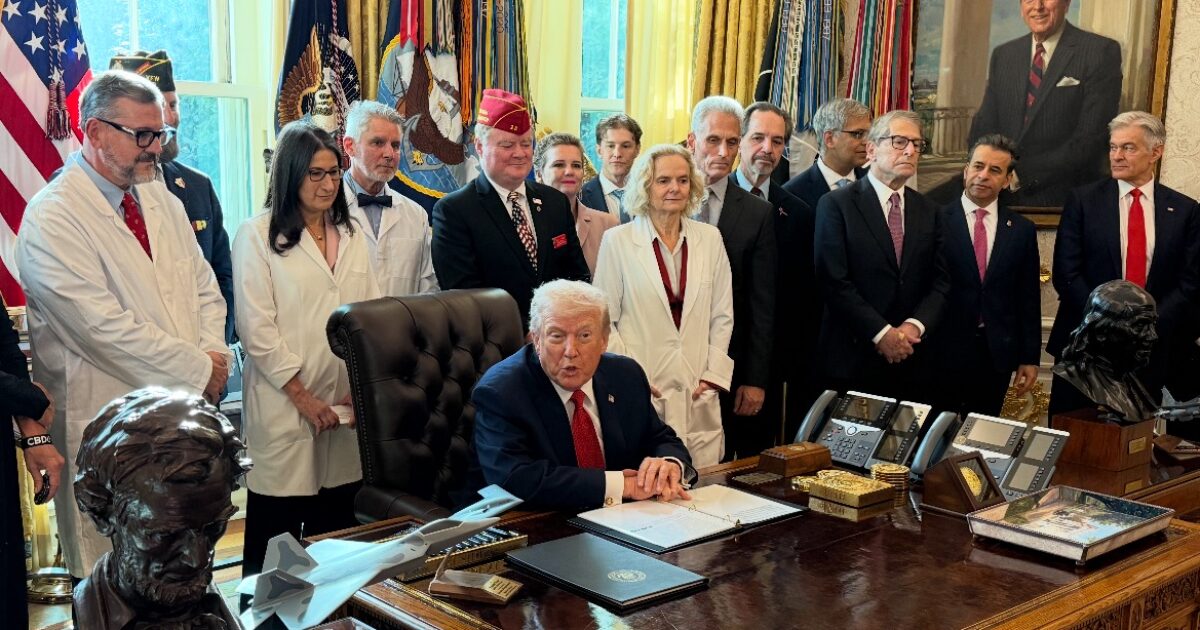
Trump signs executive order reclassifying marijuana / TGP Photo / Jordan Conradson
President Trump on Thursday signed an executive order reclassifying marijuana from a Schedule I to a Schedule III drug.
“Marijuana can be legitimate in terms of medical applications when carefully administered,” President Trump said in the Oval Office.
“Prescription pain killers have legitimate uses, but also can do damage,” Trump said. “I promised to be the president of common sense. That’s exactly what I am doing.”
President Trump emphasized that he is not legalizing marijuana for recreational use.
“I want to emphasize that the order I am about to sign is not the legalization or does it legalize marijuana in any way, shape, or form — and in no way sanctions its use as a recreational drug – it has nothing to do with that,” Trump said.
WATCH:
Full statement from the White House:
Section 1. Purpose and Policy. Americans deserve access to the best medical treatments and research infrastructure in the world. In 2023, the Food and Drug Administration (FDA) completed a review of the landscape of medical use of marijuana and found scientific support for its use to treat anorexia related to a medical condition, nausea and vomiting, and pain. Chronic pain affects nearly 1 in 4 United States adults and more than 1 in 3 United States seniors, and 6 in 10 people who use medical marijuana report doing so to manage pain. Forty States plus the District of Columbia have State- or locally-sanctioned, regulated medical marijuana programs. Yet decades of Federal drug control policy have neglected marijuana’s medical uses. That oversight has limited the ability of scientists and manufacturers to complete the necessary research on safety and efficacy to inform doctors and patients.
Marijuana is currently controlled under Schedule I of the Controlled Substances Act (CSA). In 2023, the Department of Health and Human Services (HHS) recommended to the Drug Enforcement Agency that marijuana be controlled under Schedule III of the CSA. Schedule I drugs are defined as drugs with no currently accepted medical use, a high potential for abuse, and a lack of accepted safety for use of the drug under medical supervision. Schedule III drugs are classified as having a potential for abuse less than the drugs or other substances in Schedules I and II, a currently accepted medical use in treatment in the United States, and a potential for moderate or low physical dependence or high psychological dependence in the event of drug abuse.
The recommendation from HHS included a determination that medical marijuana has a currently accepted medical use. That determination was based in part on a finding by the HHS Office of the Assistant Secretary of Health that more than 30,000 licensed healthcare practitioners across 43 United States jurisdictions are authorized to recommend the medical use of marijuana for more than 6 million registered patients to treat at least 15 medical conditions. It was also based on a finding by the FDA of credible scientific support to substantiate the use of marijuana in the treatment of pain, anorexia related to certain medical conditions, and nausea and vomiting induced by chemotherapy. The National Institute on Drug Abuse concurred with the FDA’s recommendation that marijuana be rescheduled from Schedule I to Schedule III of the CSA. In May 2024, the Department of Justice issued a proposed rule to reschedule marijuana to Schedule III. The proposed rule received nearly 43,000 public comments and is currently awaiting an administrative law hearing.
The Federal Government’s long delay in recognizing the medical use of marijuana does not serve the Americans who report health benefits from the medical use of marijuana to ease chronic pain and other various medically recognized ailments. Americans who often seek alternative relief from chronic pain symptoms are particularly impacted. For example, in one research survey, 20 percent of participating United States veterans reported using fewer opioids as a result of their medical marijuana use. One in 10 seniors used marijuana in the last year and some evidence shows improvements in seniors’ health-related quality of life and pain with medical marijuana use. However, the current Schedule I position of marijuana has impeded research. The lack of appropriate research on medical marijuana and consequent lack of FDA approval leaves American patients and doctors without adequate guidance on appropriate prescribing and utilization. One patient survey showed that just 56 percent of older Americans using marijuana have discussed the usage with their healthcare provider. This places patients, especially seniors who may be on multiple medications, at increased risk of drug interactions or other adverse events. The Federal Government must improve the research infrastructure for medical marijuana to better serve Americans.
In addition to medical marijuana, which is primarily made up of two cannabinoids — cannabidiol (CBD) and tetrahydracannabinol (THC) — hemp-derived cannabinoid products, defined by section 297A of the Agricultural Marketing Act of 1946 (7 U.S.C. 1639o), have shown potential to improve patient symptoms for common ailments and are frequently used by Americans. One in 5 United States adults and nearly 15 percent of seniors reported using CBD in the past year, and chronic pain patients have reported improvements with CBD use in clinical studies. Furthermore, evidence suggests that the amount of THC in hemp-derived cannabinoid products can affect both pain treatment efficacy and adverse events. Hemp-derived cannabinoids, as defined in 7 U.S.C. 1639o, are not controlled substances under the CSA but are subject to the same authorities and requirements as FDA-regulated products containing any other substance. Adding complexity is the fact that some full-spectrum CBD products will once again be controlled as marijuana under the CSA when section 781 of Public Law 119-37 goes into effect because they contain THC levels above the per-container threshold set by that law. Further, a recent study found that some commercially available CBD products evaluated were inaccurately labeled regarding CBD isolate, broad-spectrum, or full-spectrum composition, posing safety risks for consumers. In short, the current legal landscape leaves American patients and doctors without adequate guidance or product safeguards for CBD.
It is the policy of my Administration to increase medical marijuana and CBD research to better inform patients and doctors. It is critical to close the gap between current medical marijuana and CBD use and medical knowledge of risks and benefits, including for specific populations and conditions. Research methods and models should include real-world evidence and should facilitate affordable access in order to rapidly assess the health outcomes of medical marijuana and legal CBD products while focusing on long-term health effects in vulnerable populations like adolescents and young adults.
Sec. 2. Rescheduling Medical Marijuana and Improving Access to Cannabidiol Products. (a) The Attorney General shall take all necessary steps to complete the rulemaking process related to rescheduling marijuana to Schedule III of the CSA in the most expeditious manner in accordance with Federal law, including 21 U.S.C. 811.
(b) The Assistant to the President and Deputy Chief of Staff for Legislative, Political, and Public Affairs shall work with the Congress to update the statutory definition of final hemp-derived cannabinoid products to allow Americans to benefit from access to appropriate full-spectrum CBD products while preserving the Congress’s intent to restrict the sale of products that pose serious health risks. This will include consultation with appropriate executive departments and agencies and authorities to develop a regulatory framework for hemp-derived cannabinoid products, including development of guidance on an upper limit on milligrams of THC per serving with considerations on per container limits and CBD to THC ratio requirements. The Secretary of Health and Human Services, the Commissioner of Food and Drugs, the Administrator of the Centers for Medicare and Medicaid Services, and the Director of the National Institutes of Health shall develop research methods and models utilizing real-world evidence to improve access to hemp-derived cannabinoid products in accordance with Federal law and to inform standards of care.
Sec. 3. General Provisions. (a) Nothing in this order shall be construed to impair or otherwise affect:
(i) the authority granted by law to an executive department or agency, or the head thereof; or
(ii) the functions of the Director of the Office of Management and Budget relating to budgetary, administrative, or legislative proposals.
(b) This order shall be implemented consistent with applicable law and subject to the availability of appropriations.
(c) This order is not intended to, and does not, create any right or benefit, substantive or procedural, enforceable at law or in equity by any party against the United States, its departments, agencies, or entities, its officers, employees, or agents, or any other person.
(d) The costs for publication of this order shall be borne by the Department of Health and Human Services.
The post WATCH: President Trump Signs Executive Order Reclassifying Marijuana appeared first on The Gateway Pundit.