
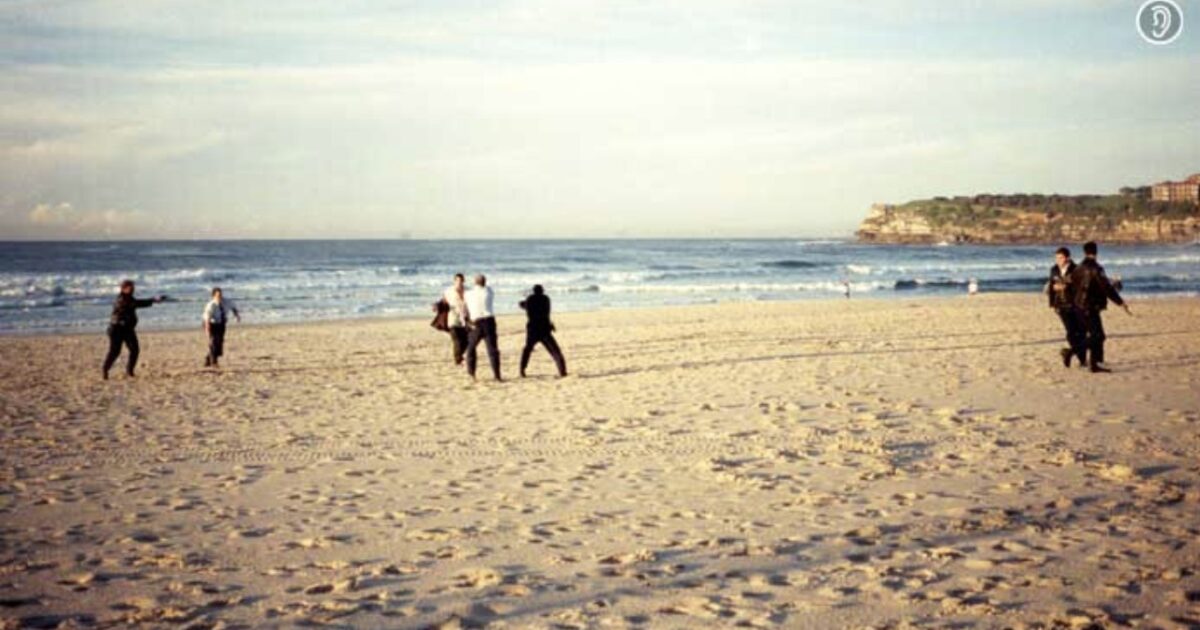
Islamist attack on Jews at Bondi Beach, inspired by ISIS. Photo courtesy of the New South Wales Government.
Islamic extremists, one of whom had previously been tracked by intelligence services for ties to ISIS, were able to legally obtain firearms in Australia despite strict gun laws and kill innocent people. The Australian government’s response has been to further tighten gun laws rather than address immigration policies that allowed Islamic extremists to enter and remain in the country.
On Sunday, December 14, 2025, a mass shooting occurred at Bondi Beach during a Hanukkah celebration, killing at least 15 people and injuring approximately 40 others. The attack was the deadliest mass shooting in Australia since the 1996 Port Arthur massacre and the deadliest terrorist incident in the country’s history. The shooting took place during a Hanukkah event hosted by Chabad of Bondi, attended by roughly 1,000 people.
The attackers were identified as Sajid Akram, a 50-year-old Pakistani national who arrived in Australia in 1998 on a student visa and became a permanent resident in 2001, and his 24-year-old son, Naveed Akram, an Australian-born citizen. Sajid Akram was killed in a shootout with police at the scene. Naveed Akram was critically injured and taken to hospital, where he remained under police guard in stable condition.
Australian authorities stated that the attack was motivated by Islamic State ideology and that the gunmen deliberately targeted the Jewish community on the first day of Hanukkah. Investigators reported that the attackers fired a total of 103 rounds. Homemade explosive devices were discovered inside a vehicle parked on Campbell Parade and were later removed by the New South Wales bomb squad.
Naveed Akram had previously come to the attention of Australian intelligence services. In 2019, he was investigated by the Australian Security Intelligence Organisation after being linked to individuals associated with an Islamic State cell in Sydney. Prime Minister Anthony Albanese said Akram was assessed at the time and cleared after six months, with authorities concluding there was no indication of an imminent threat.
According to officials from the Joint Counter Terrorism Team, Naveed Akram maintained close ties to members of the ISIS-linked cell, including Isaac El Matari, who was arrested in July 2019 and identified himself as the group’s leader in Australia. El Matari was later convicted of terrorism offenses, including discussing the establishment of a local insurgency and potential attacks on Australian landmarks such as St Mary’s Cathedral in Sydney and the U.S. Embassy. He is currently serving a seven-year prison sentence.
Investigators reported that the vehicle registered to the younger suspect contained improvised explosive devices and two homemade Islamic State flags. Authorities also believe the attackers pledged allegiance to the Islamic State prior to carrying out the attack.
New South Wales Police Commissioner Mal Lanyon confirmed that both Sajid and Naveed Akram were licensed to possess firearms under Australian law. Sajid Akram had been a licensed firearms holder for approximately 10 years and held licenses for six firearms, all of which police believe were used in the attack.
The case has raised serious questions about intelligence and security oversight. Despite Naveed Akram’s documented associations with a convicted ISIS terrorist, neither he nor his father were on active watch lists at the time of the attack.
The Australian government is responding by strengthening gun laws, implying that firearms are the primary cause of the attack rather than the ideological motivation behind it. However, global terrorism data shows that Islamist extremists are responsible for the majority of terrorist attacks worldwide and that the deadliest terrorist organizations are Islamist.
Authoritative data from the Institute for Economics and Peace’s Global Terrorism Index 2025 and the Fondation pour l’innovation politique show that Islamist terrorist groups account for the overwhelming share of global terrorism fatalities. Fondapol’s study covering the period from 1979 to April 2024 identifies the Taliban, Islamic State and its affiliates, Boko Haram, al-Shabaab, and al-Qaeda as the five deadliest terrorist organizations, responsible for 81.8 percent of all victims of Islamist terrorist attacks during that period.
According to Fondapol, the Taliban was responsible for 71,965 deaths, followed by Islamic State and its affiliates with 69,641 deaths. Boko Haram accounted for 26,081 deaths, al-Shabaab for 21,784, and al-Qaeda for 14,856. These figures represent cumulative global death tolls from sustained terrorist campaigns.
Additional major organizations identified by the Global Terrorism Index include Tehrik-e-Taliban Pakistan, Jamaat Nusrat al-Islam wal Muslimeen, Hezbollah, Islamic State West Africa Province, Islamic State Khorasan Province, Hamas, and Lashkar-e-Taiba. Fondapol data shows that Islamist terrorist attacks caused approximately 218,734 deaths worldwide between 1979 and April 2024, representing 87.5 percent of all terrorism-related deaths during that period.
The Global Terrorism Index 2025 further reports that in 2024, Islamic State was responsible for 1,805 deaths across 22 countries, followed by Jamaat Nusrat al-Islam wal Muslimeen with 1,454 deaths, Tehrik-e-Taliban Pakistan with 558 deaths, and al-Shabaab with 387 deaths. Together, these four groups accounted for more than 75 percent of terrorism deaths attributed to specific organizations that year.
These findings are drawn from multiple independent sources, including the Global Terrorism Index, Fondapol’s global terrorism database, the University of Maryland’s Global Terrorism Database, and the CIA World Factbook. Across these datasets, the pattern remains consistent: Islamist extremist organizations dominate global terrorism by both frequency and lethality.
And yet, liberals claim that Christians or right-wing extremists pose the greatest threat, despite the absence of supporting evidence. There is no ideological equivalent to jihad among Christians or nationalists, no transnational Christian or nationalist terrorist organizations, and no comparable record of mass killings.
The post Bondi Beach Mass Shooting: The Guns Aren’t the Problem, Jihad Is appeared first on The Gateway Pundit.