
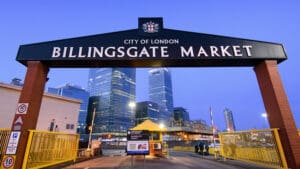
Two of London’s oldest and most storied food markets, Smithfield and Billingsgate, are set to begin a new chapter in the Docklands after the City of London Corporation confirmed Albert Island as their future home.
The decision marks a dramatic turnaround after both markets appeared destined for closure last year when rising costs forced the Corporation to abandon a £740 million relocation plan to Dagenham. At the time, traders feared the historic meat and fish hubs, which have supplied London for more than eight centuries, would be lost entirely.
Instead, the Corporation has now earmarked a 10-hectare brownfield site at Royal Docks, next to London City Airport, offering a lifeline to traders and preserving a piece of the capital’s commercial heritage. The move is subject to planning approval from Newham Council and the passage of a private bill through Parliament to repeal the Acts that legally tie both markets to their current sites.
The Corporation estimates the project will generate £750 million in local economic activity and support around 2,200 jobs in one of London’s most deprived boroughs. Plans for Albert Island also include a new shipyard for Thames vessels, a marina and further regeneration initiatives.
Greg Lawrence, chair of Smithfield Market Traders’ Association, welcomed the news, calling it a “significant step forward” for the industry.
“This location offers traders the space and opportunity to grow our businesses while continuing to serve customers across London and the south-east.”
For traders who have worked the markets for generations, the announcement ends months of anxiety and uncertainty. Many had feared that permanent closure would wipe out long-standing supply chains and devastate independent fishmongers and butchers across the capital.
The Corporation faced fierce criticism earlier this year from traders and hospitality businesses who warned that closing the markets without a replacement would cause irreversible damage. Fishmongers from Hackney’s Ridley Road Market, many of whom shop daily at Billingsgate, publicly warned that losing the wholesale site would put them out of business.
Alicia Weston, founder of food poverty charity Bags of Taste and spokesperson for the fishmongers, said the new location was “the best we could have hoped for”.
“What was absolutely key for the fishmongers was that there should be a replacement market. Albert Island isn’t too far from the current site and gives traders a fighting chance.”
Smithfield has operated near Farringdon for over 800 years, becoming one of the world’s oldest continuously functioning markets. Two of its buildings are being transformed into the new London Museum, set to open in 2026.
Billingsgate moved to its current site beside Canary Wharf in 1982 and has long been slated for redevelopment into housing as part of wider regeneration.
Despite diminished volumes compared with their pre-supermarket heyday, an independent report found the two markets still supply roughly 10% of all meat and fish consumed in London and the south-east, underlining their continued importance to the region’s food economy.
The Corporation said traders can remain in their current locations until at least 2028, giving time for construction at Albert Island and for agreements with developers to be finalised. The new “New Smithfield” and “New Billingsgate” complexes will also include a food school and continue apprenticeship programmes to support future generations of traders.
Chris Hayward, policy chair at the City of London Corporation, called the move “undeniable progress”, although he acknowledged the project remains at an early stage.
Read more:
Centuries-old Smithfield and Billingsgate markets secure new Docklands home on Albert Island