
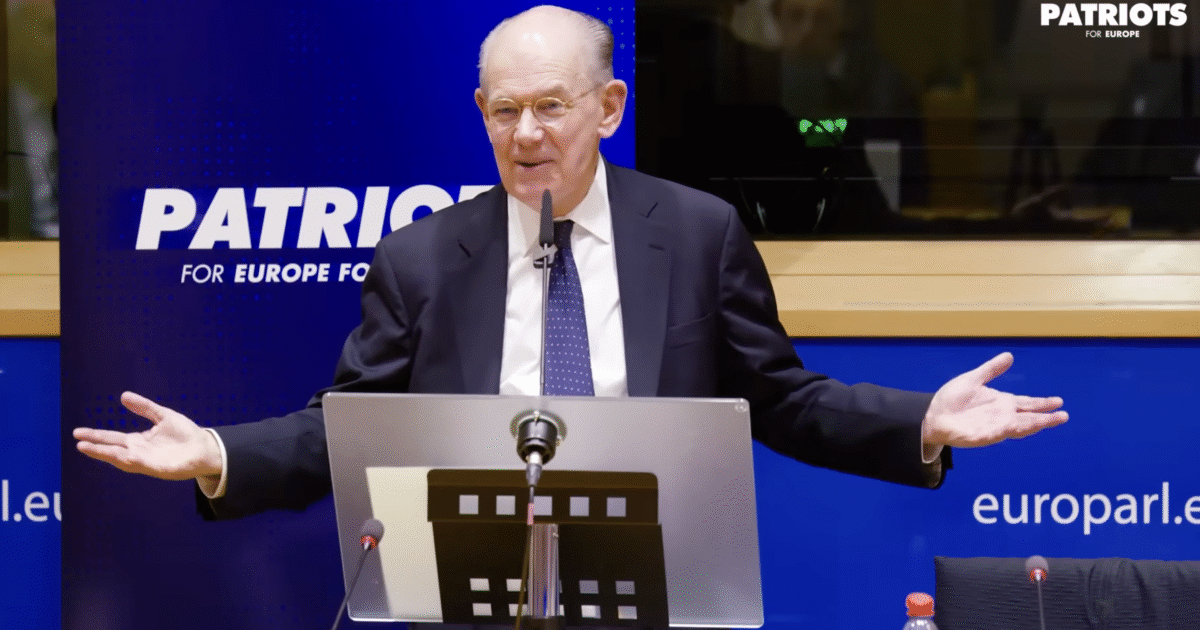
Renowned Political Science and International Relations Scholar John Mearsheimer speaks at Patriots for Europe event at the European Parliament in Brussels via Patriots for Europe parliamentary grouping
Europe’s ruling class received a brutal wake-up call last month when renowned American scholar John Mearsheimer addressed the European Parliament at the invitation of the Flemish nationalists of Vlaams Belang.
Speaking bluntly, he argued that the war in Ukraine has not just devastated Ukraine—it has accelerated the collapse of Europe’s geopolitical relevance.
For Mearsheimer, the continent is “in serious danger,” and the decline is overwhelmingly the result of political delusions held by Europe’s entrenched, globalist establishment.
He reminded the audience that Europe’s post-WWII stability didn’t come from Brussels slogans or EU treaties, but from American military power and the security umbrella of NATO.
That era, he said, is over. With the rise of China and the reassertion of Russia, the global order is now multipolar, and Washington will no longer subsidize Europe’s security while European elites moralize about “rules-based order.”
In his view, the U.S. must concentrate on competing with China, managing Middle East instability—leaving Europe a far lower priority than at any point since the Cold War.
Meanwhile, Mearsheimer dismissed the cartoonish propaganda portraying Russia as an unstoppable juggernaut preparing to conquer Europe. Moscow, he argued, has neither the population nor the industrial base to dominate the continent.
The U.S. justification for permanently garrisoning Europe—“keeping Russia out”—is therefore collapsing on its own terms.
At the heart of his lecture was a position he has held for years: the Ukraine war was ignited by the West’s reckless push to drag Ukraine into NATO, despite countless warnings from diplomats, scholars, and even past U.S. ambassadors.
He reminded listeners that both Russia and Western observers repeatedly described NATO expansion into Ukraine as an existential threat to Moscow, a reality ignored by EU and NATO elites drunk on their own ideological crusade.
According to Mearsheimer, there is no evidence Putin planned to swallow all of Ukraine. Instead, Russia moved militarily because NATO crossed every red line Russia had ever stated.
Describing the war today, he said Ukraine is locked in a slow, grinding conflict in which manpower, artillery, and industrial capacity decide the winner—and Russia holds every meaningful advantage.
He believes no negotiated peace is remotely plausible because Russia’s demands—Ukrainian neutrality, demilitarization, and permanent territorial concessions—are incompatible with the fantasies promoted in Kyiv and Brussels.
His prediction was stark. Ukraine will lose more territory, end up dependent on European aid indefinitely, and exist as a fractured state unable to defend itself.
Europe will pay a heavy price as well. By severing itself from Russian energy and doubling down on sanctions, Europe has kneecapped its own industry and given the U.S. and China an enormous competitive edge.
He warned that NATO’s credibility will suffer a historic blow once Ukraine’s defeat becomes undeniable—triggering bitter internal disputes and weakening the EU, which has always relied on NATO for its security backbone.
Finally, Mearsheimer said the transatlantic divide will only grow, especially if Donald Trump returns to office and demands that Europe defend itself rather than hide behind American power.
To the question of what Ukraine should do, he gave an answer that Europe’s political class refuses to consider: sue for peace now, accept neutrality, and surrender the lost territories—or risk losing far more.
The alternative, he said, is simple and devastating: the war will grind on until Ukraine collapses militarily, and Europe will continue its downward spiral—politically, militarily, and economically.
The post Renowned International Relations Scholar John Mearsheimer Warns Brussels That Europe’s Geopolitical Relevance Is Collapsing appeared first on The Gateway Pundit.